ALIGN
AI Creates the Greatest Business Value When It
Aligns with Strategic Workflows
ALIGN: Align AI with Strategic Objectives and Big Bets
AI creates the greatest business value when it is aligned to the strategic workflows that matter most.
Many professional service firms are already using AI. Consultants are accelerating research. Marketing teams are producing more content. Advisors are drafting reports faster. Recruiters are screening information more quickly. Partners are preparing proposals in less time.
Some of these efforts are useful and increase productivity.
But productivity alone does not create strategic impact.
A firm can save hundreds or even thousands of hours with AI and still fail to improve profitability, delivery quality, client retention, strategic differentiation, or long-term competitive advantage. In many organizations, disconnected experiments create scattered productivity gains without meaningful business impact.
That is the problem the ALIGN stage in the AXIS AI implementation framework is designed to solve.
The purpose of ALIGN is not to redesign an entire firm overnight. It is to help leadership identify the strategic workflows, operational priorities, and carefully selected long-term Big Bets where AI can improve measurable business performance.
For professional service firms, this distinction matters enormously.
The organizations creating the greatest AI impact are not necessarily using the most tools or the most expensive tools. They are aligning AI to the workflows that most affect strategic objectives: revenue growth, profitability, client value, delivery quality, strategic insight, proposal velocity, and operational leverage.
McKinsey describes leading AI organizations as firms that apply AI to solving real business problems rather than treating AI as disconnected experimentation (McKinsey & Company, 2026).
Quick Answer
What is AI Strategic Alignment?
AI strategic alignment is the process of ensuring that AI initiatives are aligned with the workflows, business objectives, and operational priorities that most affect strategic performance.
The ALIGN stage helps leadership determine where AI should create measurable business impact, which workflows deserve being prioritized, which initiatives support long-term competitive advantage, and which AI ideas should be delayed or rejected.
Without strategic alignment, organizations often create fragmented experimentation without meaningful operational or financial impact. The result is often referred to as Pilot Purgatory.
TL;DR
AI strategy should begin with strategic objectives and workflows, not with AI tools.
Professional service firms create the greatest value when AI implementation aligns with high-value workflows that impact strategic objectives. And when that impact is measurable.
The ALIGN stage helps firms prioritize strategic initiatives and carefully selected Big Bets. It also prevents random productivity experiments from becoming disconnected “islands of productivity.”
Most firms do not need to redesign their entire firm’s operating model to get big paybacks from implementing AI. But they may need to redesign critical strategic workflows that objectives such as revenue, margin, delivery quality, proposal delivery, client value, and leveraging internal knowledge.
…I don't ever recommend training, but this is a rare exception.
Of the dozens of trainings I have been involved with over the last twenty years, this is hands down the best business training I have attended at any price point, highly recommended.

Steve Birks, BizDash Systems Ltd.
Providing managers with custom-made business dashboards,
and Visual Management Operating Systems
Why This Matters
Why Aligning AI with Strategic Objectives Matters
AI adoption is accelerating faster than most professional service firms expected.
Clients increasingly expect faster insight, more personalized recommendations, shorter proposal cycles, quicker response times, and more strategic analysis. This is changing buying behavior across consulting, marketing, advisory, recruiting, accounting, and professional services industries.
The competitive risk is no longer simply “not using AI.”
The larger risk is competitors aligning AI to strategic workflows faster than your firm does.
A consulting firm that accelerates proposal workflows, research synthesis, and client intelligence may improve responsiveness and close opportunities faster.
A marketing agency that aligns AI to strategic content and campaign workflows may increase a campaign’s breadth without increasing headcount.
An advisory firm that improves the quality and depth of recurring analysis and knowledge retrieval may strengthen client retention and scalability.
These are not random productivity gains.
These are strategically aligned workflow advantages.
That distinction matters because AI should not become an uncontrolled collection of disconnected experiments. AI should support the workflows that most impact critical strategic business objectives.
Most firms do not need to redesign their entire operating model immediately. But they may need to redesign selected strategic workflows where operational leverage matters most.
Operational leverage is the purpose of the ALIGN stage.
Where the Align Stage Fits for Professional Services
The CTS AXIS Framework™ organizes AI implementation into four connected stages.
ALIGN identifies where AI should create strategic business impact.
eXAMINE evaluates workflows, metrics, pilots, feasibility, and proof-of-value.
IMPLEMENT embeds AI into operational workflows and delivery systems.
SCALE expands governance, optimization, operational consistency, and firm-wide adoption.
ALIGN is the strategic foundation that sets the direction for all later stages.
Before organizations launch pilots, deploy agents, train teams, or scale AI systems, leadership must determine which workflows matter most, where measurable value exists, which initiatives deserve investment, and which AI efforts are distractions.
Without the ALIGN stage, firms often move directly into experimentation without strategic prioritization. That is the beginning of AI Pilot Purgatory.
How Professional Firms Fail with AI
Most firms do not fail because AI lacks capability.
They fail because the alignment between AI and major business objectives is weak or non-existent.
Common failure patterns include purchasing tools before defining strategic priorities, launching disconnected pilots without workflow ownership, allowing isolated productivity islands to grow uncontrolled, treating AI as an IT initiative instead of a business initiative, and focusing on low-value automation while ignoring strategic leverage points.
Another common problem is AI sprawl. Departments begin creating disconnected prompts, workflows, systems, and governance approaches without coordination. Over time this reduces operational consistency and makes scaling more difficult.
Weak knowledge foundations create additional problems. AI systems depend heavily on accessible and organized information. Box COO Olivia Nottebohm noted that
“AI agents need curated content to work on” (Nottebohm, 2026).
What Successful Firms Do Differently
Successful firms approach AI with significantly more strategic discipline than struggling firms.
They begin with strategic objectives rather than software tools. They prioritize workflows that affect measurable business outcomes. They identify operational leverage points before launching pilots. They focus on workflow integration rather than isolated experimentation.
These firms also recognize that not every workflow deserves transformation at the same level. Instead, they identify a limited number of strategic priorities where AI can create meaningful operational advantage.
That disciplined focus is one of the clearest differences between organizations generating measurable AI impact and organizations trapped in continuous experimentation.
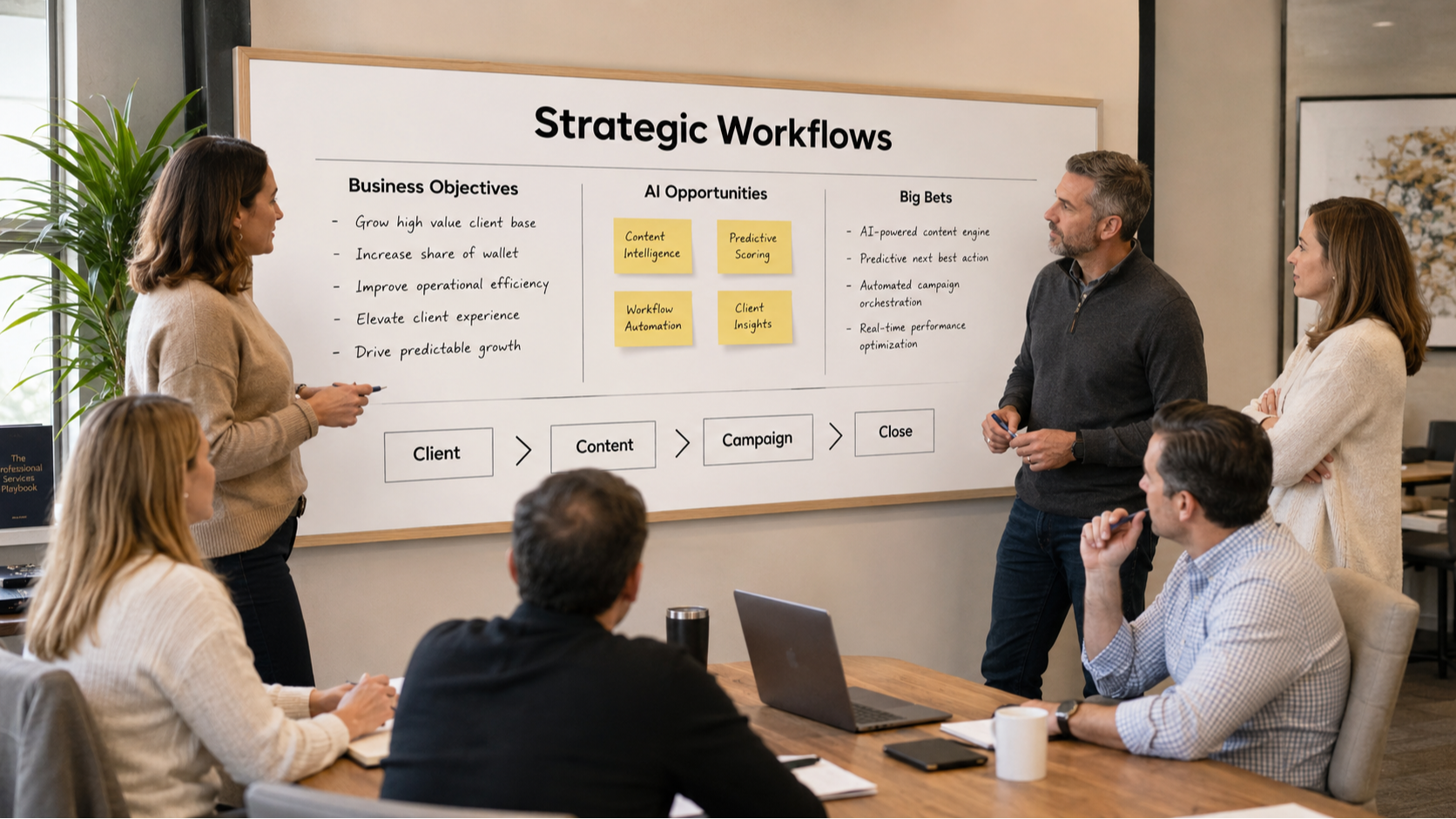
Balancing AI Strategic Priorities
Professional service firms should not approach AI as a single large initiative. AI creates the greatest business value when organizations balance three different types of AI initiatives: Strategic Alignment, Big Bets, and Productivity Initiatives.
These three categories serve different purposes, produce different outcomes, and require different levels of executive involvement.
The majority of AI efforts should usually focus on Strategic Alignment because this is where competitive advantage, sustainable strategic impact and measurable business impact is most likely to occur.
1. Strategic Alignment
Failure to focus on strategic alignment is the primary reason the majority of AI efforts fail to create measurable impact.
Strategic Alignment focuses AI efforts on the workflows, business objectives, and operational priorities that drive strategic objectives. These are usually the 3 to 5 key metrics that measure the firm’s strategic performance.
Some of the most common Strategic Objectives for professional service firms are,
- Revenue growth
- Profitability
- Client retention
- Proposal velocity
- Competitive differentiation
- Delivery quality
- Operational leverage
Strategic Alignment usually concentrates on,
- Highest-value workflows
- Cross-functional workflows
- Client-facing workflows
- Operational bottlenecks affecting key outcomes
For most firms, Strategic Alignment should be the focus of 3 to 5 AI initiatives and involve approximately 60–70% of AI effort.
This is where AI is most likely to produce measurable operational and financial impact.
The purpose is not random experimentation. The purpose is measurable strategic leverage.
2. Big Bets
Big Bets are carefully selected strategic initiatives designed to strengthen future business such as competitive position, operational capability, or long-term differentiation.
These initiatives may not always produce immediate ROI, but they support future strategic direction and long-term organizational advantage.
Big Bets are typically,
- Longer term
- Important but not a current strategic objective
- Closely aligned to leadership priorities
Examples may include,
- Developing AI-enabled client intelligence systems
- Creating AI-enhanced knowledge platforms
- Expanding into a new strategic niche supported by AI
- Creating proprietary research platforms
- Building AI-supported advisory systems
Most firms should pursue only a small number of Big Bets at one time, no more than 3, and that should be after strategic alignment opportunities.
Attempting too many AI initiatives creates fragmentation, operational overload, and weak execution.
For many professional service firms, Big Bets may represent approximately 15–25% of AI effort.
The goal for Big Bets is not speculative AI futurism. The goal is to carefully select projects that build future strategic capability.
3. Productivity Initiatives
Productivity initiatives operate primarily at the individual, team, or functional level.
While productivity initiatives rarely contribute to the firm’s strategic objectives, they help build a culture of AI adoption and innovation.
Individuals who see productivity increases from their own AI creations are much more willing to use AI and develop their own skills. That can help the firm.
Productivity initiatives improve,
- Personal productivity
- Task execution
- Team efficiency
- Day-to-day workflow speed
Examples may include,
- Drafting email responses
- Meeting summaries
- Research acceleration
- Content creation
- Administrative automation
- Internal workflow assistance
Productivity projects are useful because they,
- Increase adoption
- Develop AI familiarity
- Create internal AI Champions and AI Heroes
- Help teams become more comfortable with AI-assisted work
However, productivity initiatives alone rarely create measurable firm-wide strategic impact.
When organizations overemphasize isolated productivity experimentation, they often create,
- Disconnected workflows
- Inconsistent outputs
- Duplicated prompts
- Fragmented systems
Fragmented and unaligned AI experimentation often results in what is commonly referred to as AI Pilot Purgatory
That is why productivity efforts should remain aligned to broader strategic priorities whenever possible.
For many firms, productivity initiatives may be approximately 5–15% of total AI effort and may include,
- Personal productivity projects
- Departmental AI projects outside a strategic workflow
- Experimentation
These initiatives support adoption and capability development, but they should not replace strategic alignment or Big Bets.
What are Big Bets? A Few Carefully Selected Strategic Priorities
Big Bets are not the same as strategic objectives, and they should not be confused with speculative AI futurism.
At CTS, Big Bets refer to a small number of AI-enabled opportunities that may create substantial future advantages but that do not immediately impact measurable strategic objectives.
They may be designed to expand into a new niche, strengthen internal knowledge, or develop additional channels. Other examples may include,
- Strategic knowledge platforms
- Executive/Professional decision support systems
- AI-supported research systems
- AI-enhanced client insight systems
- Client support systems
When Box.com implemented AI, it described its process as shifting from broad experimentation to a smaller number of strategically prioritized initiatives (Box, 2026).
Targeting a small number of Big Bets, 3 to 5 and no more, after completing strategic alignment is particularly important for professional service firms because resources are limited and workflows are often interconnected.
Big Bets should remain,
- Subordinate to strategically aligned projects
- Carefully prioritized
- Operationally grounded
- Measurable where possible
The objective is not to reinvent the entire firm. The objective is to strengthen operational objectives and build long-term capacity and capabilities.
Professional Services Demand Human & AI Orchestration
AI does not change the fact that professional services are fundamentally a human-dependent business.
Clients still expect judgment, accountability, interpretation, strategic thinking, and trust. AI should strengthen these capabilities rather than casually replace them.
Human & AI orchestration means determining where AI accelerates, assists, analyzes, drafts, or coordinates. Meanwhile, professionals continue to interpret implications, validate conclusions, exercise judgment, manage client relationships, and remain accountable for strategic recommendations.
Human & AI orchestration is discussed in greater detail in the IMPLEMENT and SCALE stages. Research has shown that the greatest increases in productivity and the creation of client value occur when humans and AI collaborate.
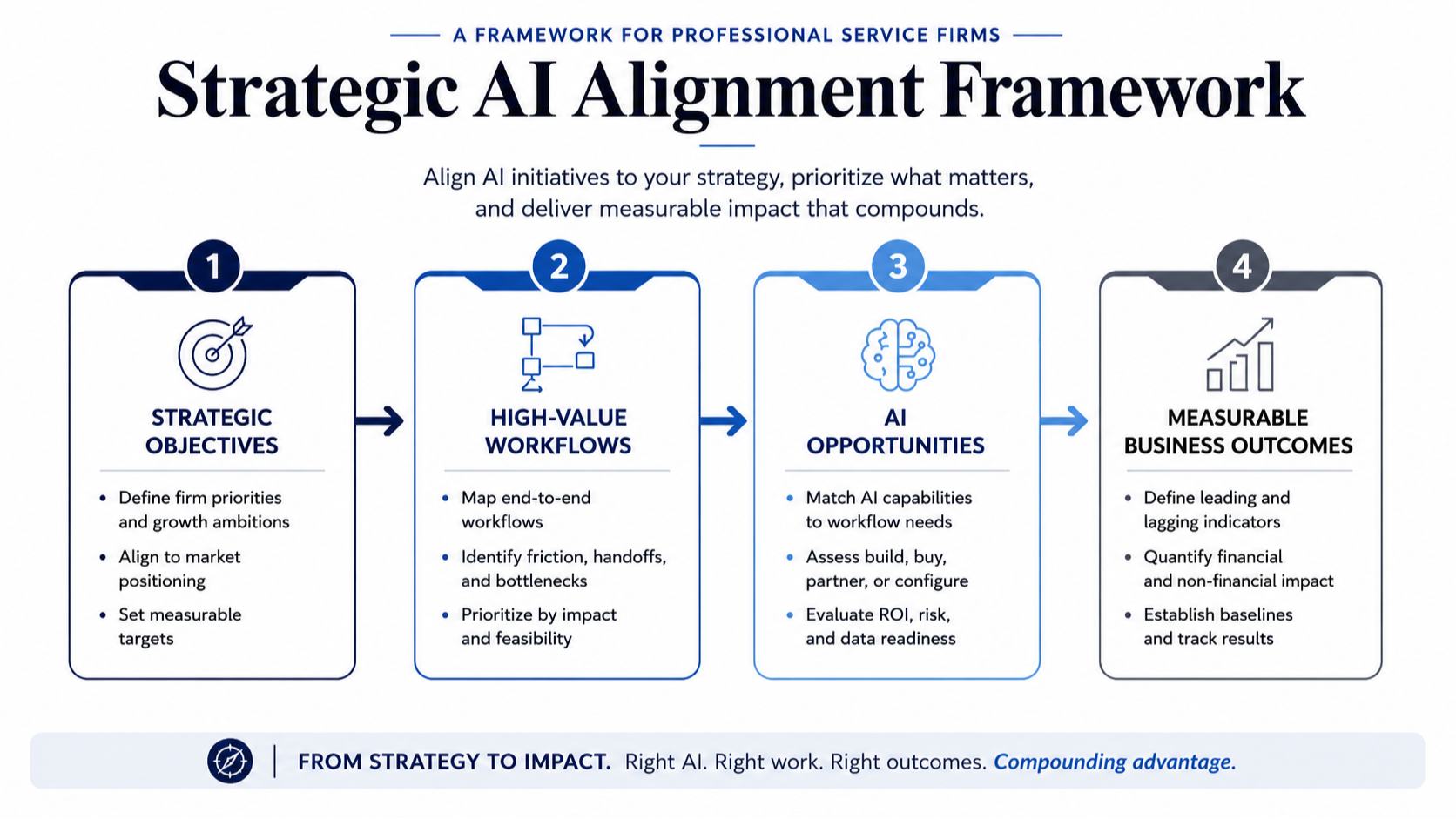
How The ALIGN Stage Prepares the Firm for the XAMINE Stage
The ALIGN stage establishes the most valuable strategic direction for AI initiatives. Without it AI initiatives can devolve into random efforts.
At the end of the ALIGN stage, organizations should have prioritized workflows, candidate AI initiatives, initial ROI hypotheses, strategic metrics, operational priorities, Big Bet candidates, and executive ownership.
These outputs become the inputs for the XAMINE (eXamine) stage, the following stage that validates feasibility and operational value.
XAMINE evaluates workflow feasibility, proof-of-value opportunities, pilot readiness, KPI definitions, workflow scoring, operational risks, and measurable business impact.
Governance, risk, and data preparedness are also parts of the XAMINE stage that ensure AI optimization for a workflow will succeed.
Without the ALIGN stage, firms often launch pilots without strategic clarity.
Without the XAMINE stage, firms may pursue strategically interesting ideas that cannot realistically create operational value.
Together, these two stages move organizations from experimentation toward measurable strategic execution.
FAQ
Frequently Asked Questions
What is AI strategic alignment?
Why does strategic alignment matter in AI implementation?
What are strategic workflows?
What are AI Big Bets?
Does AI require redesigning the entire operating model?
What is Pilot Purgatory?
Editorial Note
This article is part of the Critical to Success AI implementation library. It is written for professional service firm leaders who need practical guidance on AI strategy, workflow improvement, governance, adoption, and measurable business value. Content is periodically reviewed and updated to reflect changes in AI tools, implementation practices, and the needs of professional service firms.
About the Author
Ron Person is the founder of Critical to Success (CTS) and the creator of the AXIS AI Implementation Framework™. He brings more than 30 years of consulting experience with Fortune 1000 and Global 1000 firms. His experience includes business strategy, digital marketing, data analytics, process improvement, and technology implementation.
Ron has authored 27 books with almost 3 million copies in print and has served as an adjunct professor at University California, Executive Extension teaching strategy and technology for executives. His work helps professional service firms align AI with strategic objectives, develop and implement AI in departments and functional teams, and apply the AXIS AI Implementation Frameworktm.


About Critical to Success
Critical to Success helps professional service firms implement AI to impact strategic objectives, Big Bets for the future, and workflow performance. The firm works with consultants, marketers, accountants, financial service firms, architecture firms, engineering firms, and other knowledge-based businesses that want to measurably improve strategic objectives, workflow performance, productivity, and client value.
Critical to Success developed the CTS AXIS AI Implementation Frameworktm to help firms move from random AI experimentation to structure implementation. The framework guides firms through four stages of adopting AI: Align, eXamine, Implement, and Scale.
Critical to Success provides AI advisory services, AI implementation workshops tailored to departments and functional teams, executive education, AI implementation playbooks, and development of AI solutions.
This article is part of the Critical to Success AI implementation library and is designed to help leaders move from AI experimentation to structured, measurable, and scalable AI adoption.
SOURCES
Box. (2026). AI-first transformation: Box’s principles, strategy, and execution framework (Box Blog).
https://blog.box.com/ai-first-part-1
Nottebohm, O. (2026). How AI transformation really happens (Box Blog).
https://blog.box.com/coo-ai-transformation-lessons
McKinsey & Company. (2026). The AI transformation manifesto: 12 themes driving growth (McKinsey & Company).
https://www.mckinsey.com/capabilities/tech-and-ai/our-insights/the-ai-transformation-manifesto