AI Implementation Framework
CTS AXIS AI Implementation Framework™
CTS AXIS AI Implementation Framework™:
ALIGN, eXAMINE, IMPLEMENT, and SCALE AI
Most professional service firms are already using AI.
Consultants are using AI to speed up research. Marketing teams are using AI to create content. Advisors are using AI to draft reports. Executives are using AI to prepare for meetings. Operations teams are testing copilots, assistants, automations, and agents.
This activity is useful. But activity is not the same as implementation.
A firm can have many AI tools, many prompts, and many pilots and still fail to improve revenue, margin, quality, client value, delivery speed, or competitive advantage.
In fact, MIT research has found that 95% of AI initiatives fail to impact measurable strategic metrics.
That is why Critical to Success created the CTS AXIS Framework™.
The AXIS Framework helps professional service firms move from scattered AI experiments to measurable AI implementation. It gives leaders a practical way to align AI with strategy, examine workflows and data, implement AI into real work, and scale what works across the firm.
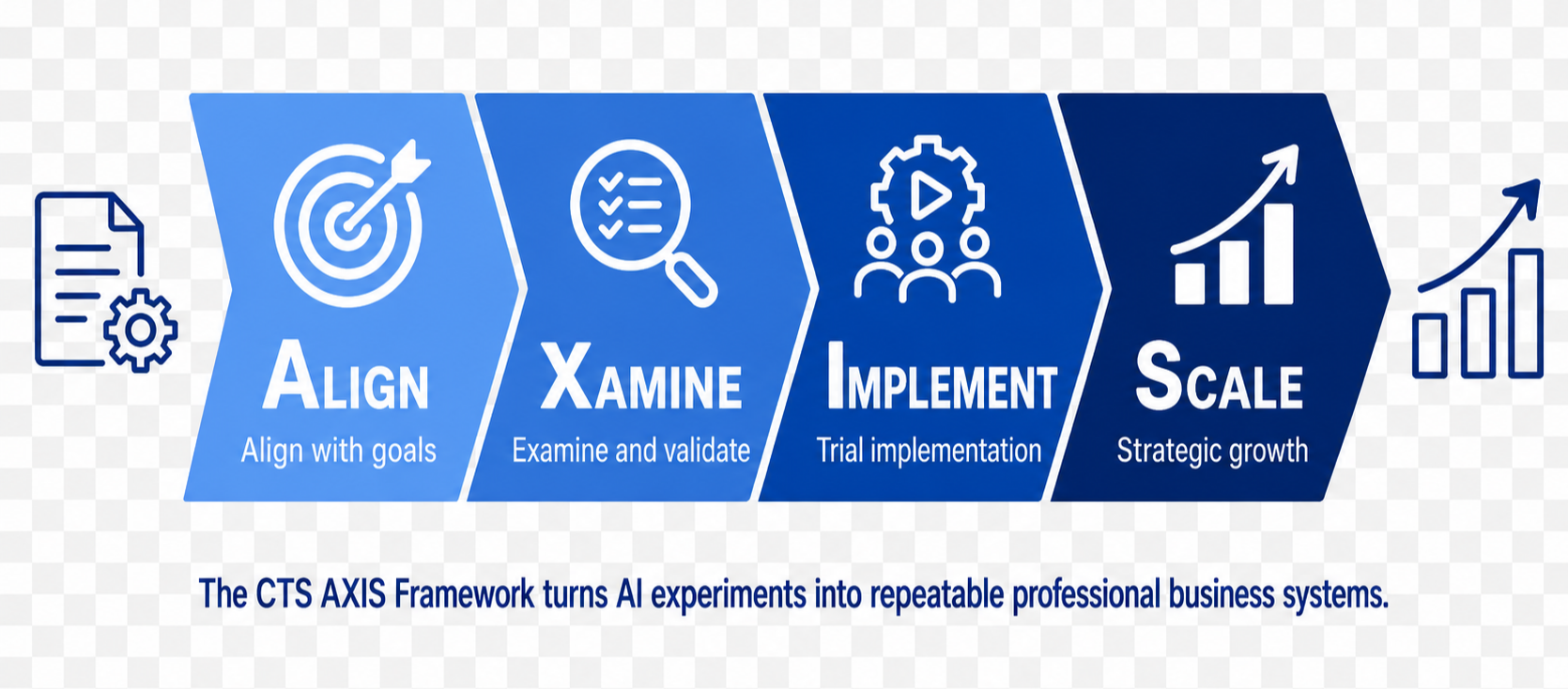
AXIS stands for four connected stages:
ALIGN: Align AI with strategic objectives and Big Bets.
eXAMINE: Examine workflows, data quality, use cases, pilots, and proof-of-value.
IMPLEMENT: Embed AI into real workflows, SOPs, human review, governance, and KPIs.
SCALE: Expand proven AI workflows into repeatable, governed, measurable operating capability.
The goal is not to “use more AI.”
The goal is to build a better operating model where people and AI work together to improve the way the firm serves clients, creates value, and grows.
Quick Answer
What is the CTS AXIS AI Implementation Framework?
The CTS AXIS AI Implementation Framework is a four-stage framework that helps professional service firms align, validate, implement, and scale AI in real business workflows.
The four stages are ALIGN, XAMINE, IMPLEMENT, and SCALE.
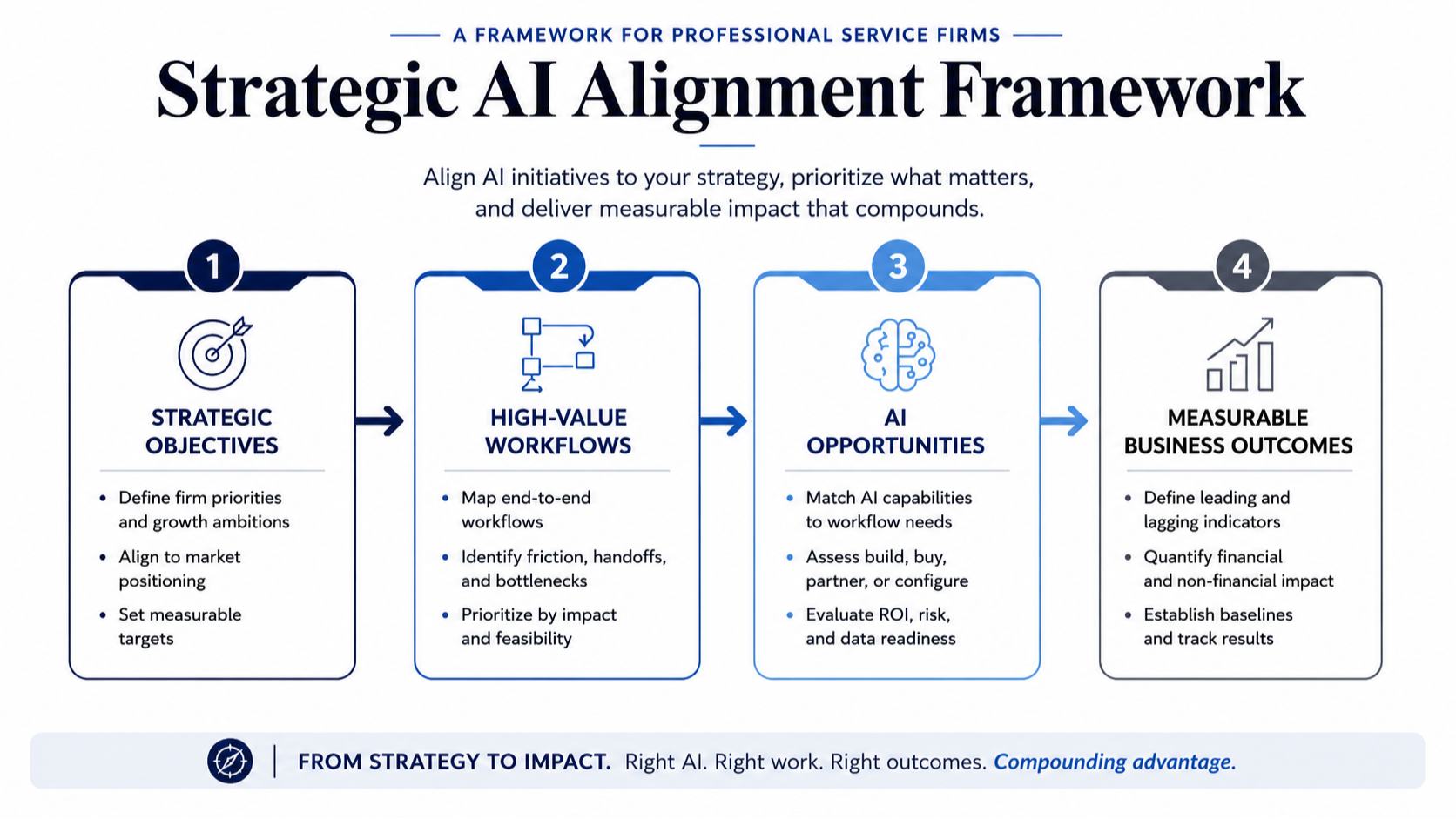
ALIGN helps leaders connect AI to strategic objectives, high-value workflows, measurable outcomes, and long-term Big Bets.
eXAMINE tests whether selected AI opportunities are feasible, data-ready, measurable, safe, and valuable enough to implement.
IMPLEMENT turns validated AI opportunities into working operational systems by embedding AI into workflows, SOPs, prompt systems, agents, human review checkpoints, governance rules, and performance metrics.
SCALE expands proven AI workflows across teams, departments, and the firm with standards, dashboards, governance, adoption systems, and continuous improvement.
The AXIS Implementation Framework helps firms avoid Pilot Purgatory, where AI pilots create local productivity but fail to become measurable business capability.
TL;DR
Take Aways
The CTS AXIS Framework™ helps professional service firms turn AI from scattered experimentation into measurable business improvement.
- ALIGN connects AI to strategy, workflows, and business goals.
- XAMINE validates workflows, data, use cases, and pilot value.
- IMPLEMENT embeds AI into real work, SOPs, and team routines.
- SCALE expands proven AI workflows with governance and measurement.
- The goal is business impact, not just more AI activity.
Why This Matters
Why Professional Service Firms Need an AI Implementation Framework
Many firms begin AI adoption in the same way.
A few people experiment. Some create useful prompts. A department tests a tool. A team runs a pilot. Early adopters become more productive. Executives see demos and become excited.
At first, this looks like progress.
But over time, problems appear.
The firm has too many tools. Prompts are duplicated. Teams use different standards. Data is scattered. No one owns the workflow. Human review is unclear. Outputs vary in quality. Risk increases. Leaders cannot prove ROI.
This is how firms get stuck in Pilot Purgatory.
Pilot Purgatory happens when AI activity increases but the firm’s operating performance does not change enough to matter.
Professional service firms need a better path because their work depends on trust, judgment, quality, speed, and client results. AI must support those things, not create confusion around them.
The AXIS Framework gives leaders a practical sequence.
First, decide where AI should matter.
Second, test whether the opportunity is real.
Third, make AI part of the way work actually gets done.
Fourth, scale only what has proven value.
Stage 1: ALIGN AI with Strategy and Big Bets
ALIGN is the strategic foundation of the AXIS Framework.
The purpose of ALIGN is to decide where AI should create measurable business impact.
This stage helps leaders avoid the common mistake of starting with tools before deciding what business problem they are solving.
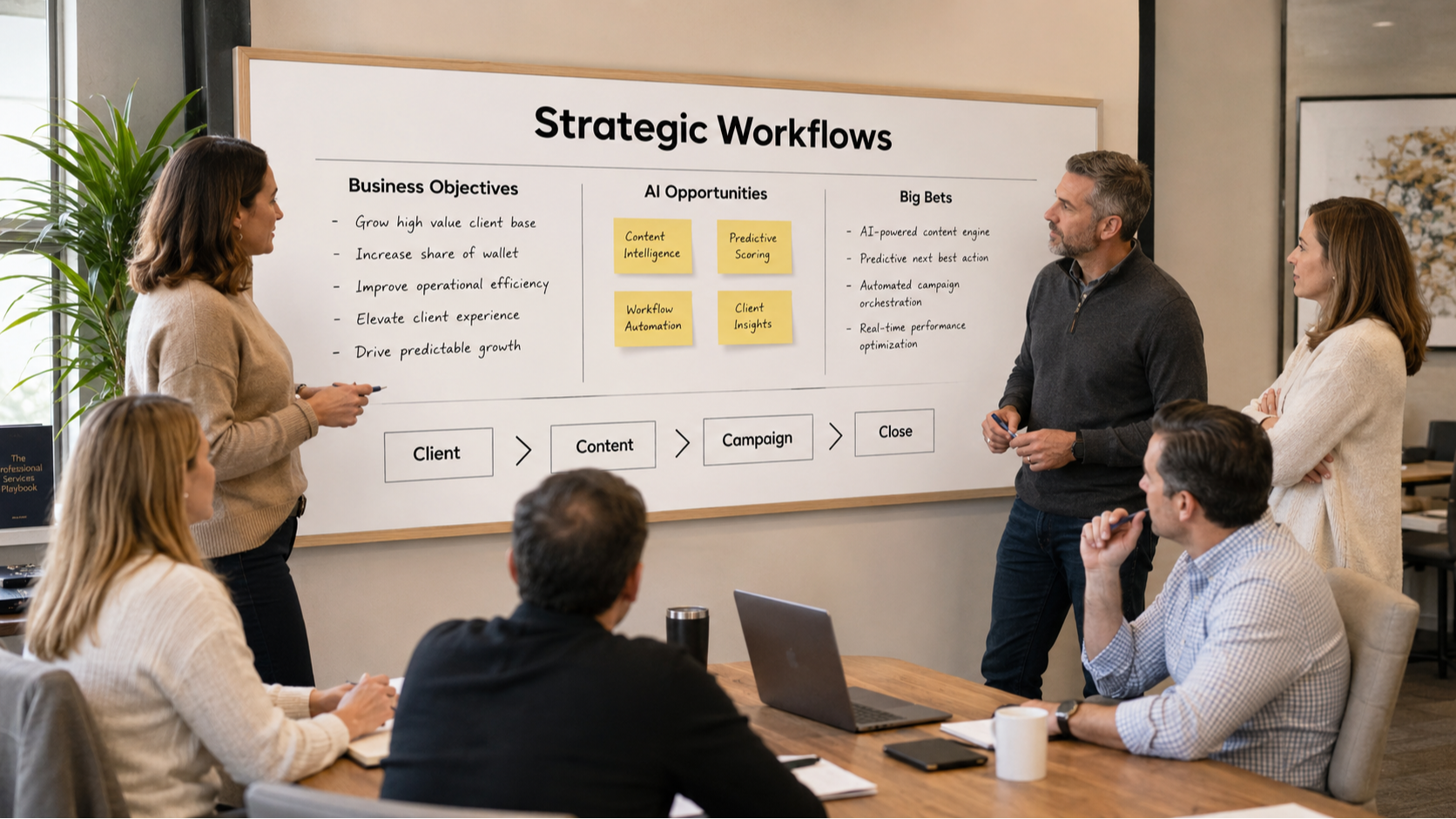
In ALIGN, the firm identifies the strategic workflows that matter most. These may include proposal development, client discovery, research synthesis, marketing campaigns, client onboarding, advisory analysis, knowledge reuse, financial reporting, or recruiting.
The firm also identifies the business objectives these workflows support. Common objectives include revenue growth, profitability, client retention, proposal velocity, delivery quality, utilization, strategic differentiation, and operational leverage.
ALIGN also includes Big Bets.
Big Bets are longer-term AI initiatives that may create future competitive advantage. Examples include AI-enabled client intelligence, proprietary knowledge platforms, AI-supported advisory systems, or new AI-enhanced service lines.
Not every AI idea deserves investment.
ALIGN helps leadership focus on the the few workflows and opportunities where AI can create the greatest business value.
Stage 2: eXAMINE Workflows, Data, Use Cases, Pilots, and Proof-of-Value
XAMINE is the validation stage.
After the firm selects strategic AI opportunities in ALIGN, it must test whether those opportunities are ready for implementation.
XAMINE asks practical questions:
Is the workflow important enough to improve?
Is the data usable, current, accurate, and safe?
Is the use case valuable enough to justify the effort?
Can the prompt, assistant, agent, or automation perform reliably?
Can the firm measure improvement?
What human review is required?
What risks must be controlled?
What proof-of-value must be shown before implementation?
This stage protects the firm from implementing AI ideas that look impressive in a demo but fail in real work.
A good XAMINE process creates a ranked list of validated AI opportunities. It also identifies which ideas should move forward, which need more testing, which should be delayed, and which should be stopped.
The outcome of XAMINE is not a random list of pilots. It is a validated AI pilot portfolio ready for disciplined implementation.
Stage 3: IMPLEMENT AI into Real Workflows
IMPLEMENT is where AI becomes part of the operating model.
This stage takes validated workflows from XAMINE and turns them into practical systems that teams can use in real work.
Implementation is more than giving people AI tools. It includes workflow redesign, SOP updates, prompt systems, assistants, agents, human review checkpoints, governance rules, adoption support, and KPIs.
A strong AI-enabled workflow defines the business purpose, trigger, inputs, AI-supported steps, human responsibilities, review standards, approval rules, output format, storage location, and performance metrics.
For example, in a proposal workflow, AI may help synthesize discovery notes, draft proposal sections, identify differentiators, and create a first-pass project approach. But senior professionals still review strategy, risk, pricing, quality, and client fit.
That is Human + AI workflow orchestration.
AI supports the work. People own the judgment.
IMPLEMENT also requires ownership. Someone must be accountable for adoption, quality, performance, governance, and improvement.
The goal is not local productivity. The goal is improved workflow performance.
Stage 4: SCALE AI Across the Firm
SCALE turns proven AI workflows into repeatable operating capability.
Many firms fail at this stage because they try to roll out AI broadly before they have standards, owners, dashboards, training, governance, or proof.
SCALE is not the same as “buy more AI licenses.”
Scaling means the firm standardizes the workflows that have proven value. It creates reusable prompts, agents, playbooks, templates, SOPs, review rules, and knowledge assets. It embeds AI into dashboards, management routines, onboarding, governance, and continuous improvement.
At scale, AI must be measured like any other operating capability.
Leaders should track adoption, cycle time, quality, rework, cost, risk, client value, revenue impact, margin impact, and ROI.
SCALE also requires data and knowledge discipline. Professional service firms have valuable knowledge stored in proposals, reports, call notes, research, templates, project files, case studies, and expert experience. If that knowledge is scattered, outdated, or poorly governed, AI cannot scale reliably.
The purpose of SCALE is to make AI repeatable, measurable, safe, and continuously improving.
Why AXIS Works
AXIS works because it follows the natural order of successful AI implementation.
Strategy comes before tools.
Validation comes before deployment.
Implementation comes before scaling.
Governance and measurement run through the entire process.
This sequence matters because each stage reduces a different type of failure.
ALIGN reduces strategic failure.
XAMINE reduces data and governance failure.
IMPLEMENT reduces adoption and operating-model failure.
SCALE reduces integrated systems, governance, and measurement failure.
Together, the four stages help professional service firms impact strategic objectives and create reproducible systems without creating AI chaos.
FAQ
Frequently Asked Questions
What does AXIS stand for?
What is the first step in using the AXIS Framework?
Who is the AXIS Framework for?
Why should firms not start with AI tools?
What is the difference between AI adoption and AI implementation?
What is Pilot Purgatory?
How does AXIS help professional firms scale AI?
About the Author
Ron Person is the founder of Critical to Success (CTS) and the creator of the AXIS AI Implementation Framework™. He brings more than 30 years of consulting experience with Fortune 1000 and Global 1000 firms. His experience includes business strategy, digital marketing, data analytics, process improvement, and technology implementation.
Ron has authored 27 books with almost 3 million copies in print and has served as an adjunct professor at University California, Executive Extension teaching strategy and technology for executives. His work helps professional service firms align AI with strategic objectives, develop and implement AI in departments and functional teams, and apply the AXIS AI Implementation Frameworktm.


About Critical to Success
Critical to Success helps professional service firms implement AI to impact strategic objectives, Big Bets for the future, and workflow performance. The firm works with consultants, marketers, accountants, financial service firms, architecture firms, engineering firms, and other knowledge-based businesses that want to measurably improve strategic objectives, workflow performance, productivity, and client value.
Critical to Success developed the CTS AXIS AI Implementation Frameworktm to help firms move from random AI experimentation to structure implementation. The framework guides firms through four stages of adopting AI: Align, eXamine, Implement, and Scale.
Critical to Success provides AI advisory services, AI implementation workshops tailored to departments and functional teams, executive education, AI implementation playbooks, and development of AI solutions.
This article is part of the Critical to Success AI implementation library and is designed to help leaders move from AI experimentation to structured, measurable, and scalable AI adoption.