CTS ADVIS AI Implementation Framework™
AI Implementation Framework
TL;DR
Take Aways
The CTS ADVIS AI Implementation Framework™ is a structured framework that guides professional services firms in improving strategic performance through AI systems and optimized workflows.
- ALIGN AI with an important strategic objective, business drivers, ownership, and targets.
- DIAGNOSE the impact of AI systems, workflows, bottlenecks, root causes, data, governance, human-in-the-loop, and AI opportunities.
- VALIDATE the proposed AI-enabled system under controlled conditions with skilled operators and valid data.
- IMPLEMENT validated systems with real users, real work, operational data, SOPs, ownership, and measurement.
- SCALE proven systems into multiple operational domains.
Quick Answer
What is the
CTS ADVIS AI Implementation Frameworktm?
The CTS ADVIS AI Implementation Framework™ is a five-stage framework for turning AI opportunities into measurable improvements in business performance.
The five stages are:
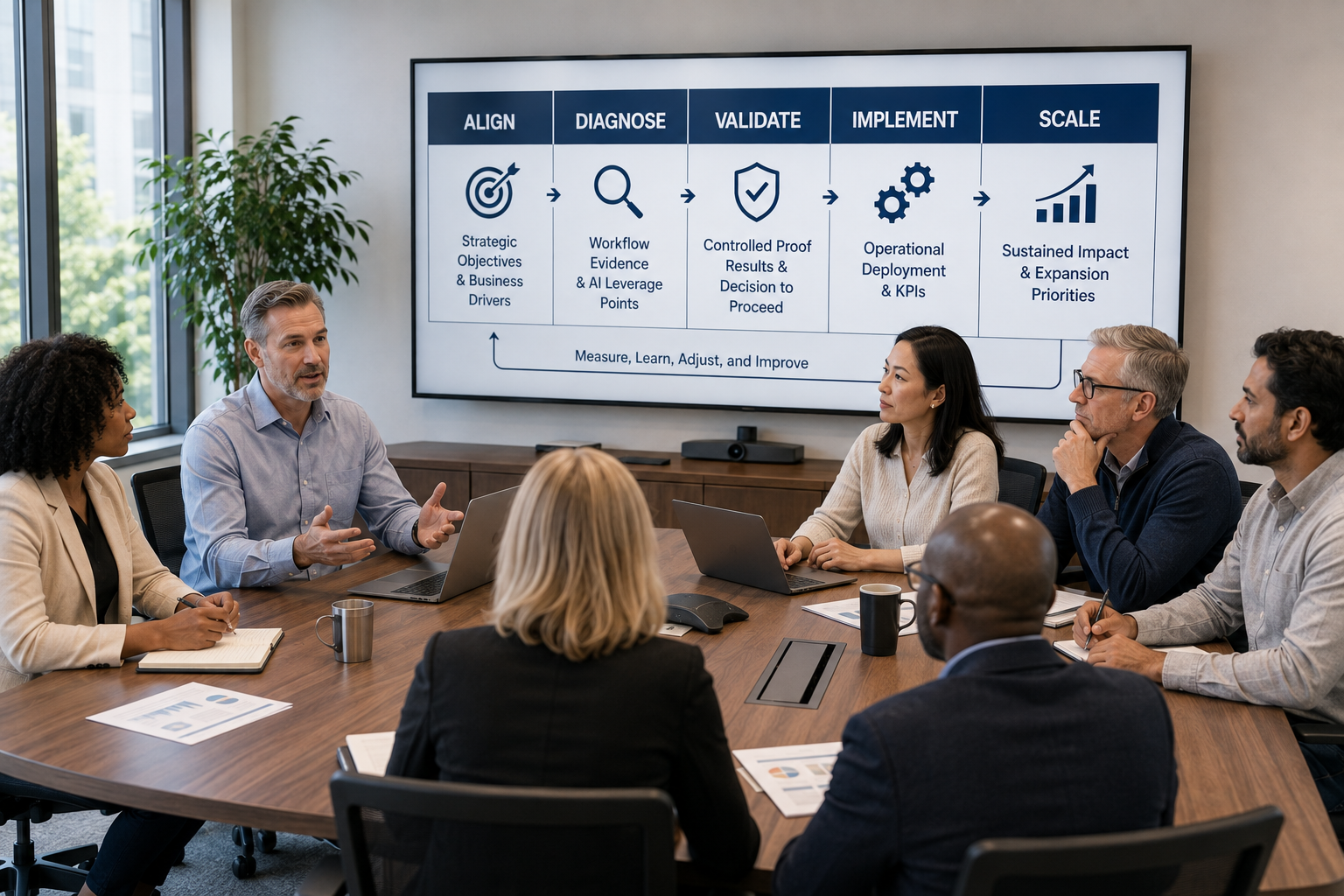
ALIGN → DIAGNOSE → VALIDATE → IMPLEMENT → SCALE
The ADVIS implementation framework identifies where AI can create strategic value, diagnoses the work that drives performance, proves what works in a controlled environment, implements AI in real operations, and then scales successful systems into multiple operational domains.
Why It Matters
Why an AI Implementation Framework Matters
Most organizations are already using AI.
Professionals use it for research, analysis, writing, marketing, sales preparation, client service, decision support, content development, and administrative work.
Teams experiment with copilots, prompts, agents, automations, and AI-enabled workflows.
The challenge is no longer getting people to try AI.
The challenge is converting AI activity into measurable business performance.
McKinsey's 2025 global AI research found that 88% of respondents said their organizations used AI in at least one business function. Yet most organizations remained early in enterprise scaling, and only 39% reported enterprise-level EBIT impact from AI (McKinsey & Company, 2025).
This gap between widespread AI use and measurable organizational impact is one reason firms need a structured AI implementation process.
Individual AI productivity can be valuable.
But local productivity does not automatically improve revenue, margin, capacity, quality, client retention, cycle time, competitive differentiation, or another strategic objective.
Without structure, organizations can develop what CTS describes as AI Pilot Purgatory. The organization develops disconnected islands of AI productivity rather than integrated business capability.
The result is sometimes close to chaos with the results:
- Knowledge is not shared.
- Governance is inconsistent.
- Metrics focus on usage rather than results.
- Ownership is unclear.
- Human review may consume much of the productivity gain.
- And leadership cannot show that AI is materially improving strategic performance.
ADVIS is designed to prevent that progression.
It creates a sequence of checks:
Align AI systems and workflows with strategic priorities.
Diagnose AI and workflow elements before optimizing.
Validate operations and create hypotheses in a controlled environment.
Implement AI systems and workflows in one or two domains.
Scale solutions into related domains in the firm.
Each stage reduces uncertainty as proof increases and the firm and people become more committed.
How the ADVIS Framework Works
ADVIS begins with a business question, not an AI tool:
What important strategic result does the organization need to improve?
Leadership then develops an initial hypothesis about how AI could contribute.
That hypothesis becomes progressively more specific as evidence increases.
The core progression is:
Strategic AI Hypothesis →
AI Implementation Hypothesis →
Controlled Proof →
Operational Proof →
Sustained & Expanded Proof
A strategic idea becomes a workflow opportunity.
The workflow opportunity becomes a testable AI-enabled system.
The controlled test becomes an operating system.
The successful operating system becomes an organizational capability.
This progressive proof model is one of the most important differences between structured AI implementation and scattered AI experimentation.
ALIGN - Start With the Strategic Objective
Make sure AI implementation begins with a business result worth improving.
ALIGN asks:
What important business result should AI help improve?
Leadership begins with a strategic objective such as:
- Revenue Growth
- Client Retention
- Operating Margin
- Professional Capacity
- Service Quality
- Cycle Time
- Competitive Differentiation
- Innovation
- Risk Reduction
It then identifies Business Drivers believed to influence that objective.
From this relationship, leadership develops a Strategic AI Hypothesis.
For example:
Strategic Objective: Improve client retention.
Business Driver: Improve client responsiveness.
Strategic AI Hypothesis: AI may reduce response delays while preserving service quality.
Ownership: Client Services Director.
Metric + Target: Reduce average response time from 18 hours to four hours.
ALIGN does not prove that AI is the answer.
It creates enough strategic justification to determine whether deeper investigation is worthwhile.
The sequence is:
Objective → Driver → AI Hypothesis → Ownership → Metric + Baseline/Target
DIAGNOSE - Find Where AI Should Actually Be Applied
Understand the work before designing the AI solution.
A business problem is not automatically an AI use case.
DIAGNOSE examines what actually happens inside the workflow that influences the strategic objective.
The team maps how work moves from trigger to final output and examines:
- Bottlenecks
- Delays
- Rework
- Root Causes
- Data
- Organizational Knowledge
- Systems
- Human Judgment
- Handoffs
- Measurement
- Readiness
- Potential AI Leverage Points
DIAGNOSE can produce three legitimate outcomes.
Improve Without AI
Fix the workflow, policy, roles, information management, existing automation, or other underlying problem without adding unnecessary AI.
Improve Before AI
The AI opportunity may be worthwhile, but data, knowledge, workflow design, controls, or another foundation needs improvement first.
Develop an AI-Enabled Improvement
Evidence supports a specific AI Implementation Hypothesis that is strong enough to test.
The purpose of DIAGNOSE is not to find somewhere to use AI.
It is to determine where AI should actually be applied to create measurable strategic value.
VALIDATE - Create Controlled Proof
Test the proposed AI system before the business depends on it.
VALIDATE asks:
Does the proposed AI-enabled system work well enough under controlled conditions to justify implementation?
The organization confirms its KPIs and baseline, defines acceptance criteria before results are known, and builds the smallest useful pilot capable of testing the important assumptions.
The pilot should include realistic work.
That means testing routine cases as well as:
- Difficult Cases
- Incomplete Inputs
- Ambiguous Requests
- Exceptions
- Edge Cases
- Higher-Risk Conditions Where Appropriate
The team measures quality, reliability, errors, failure conditions, human-review burden, risk, time, cost, and expected business value.
One distinction is critical:
VALIDATE creates controlled proof. It does not create operational proof.
A successful pilot can justify taking the next step.
It cannot prove that the same system will perform successfully with ordinary employees, real workloads, real clients, actual systems, organizational resistance, competing priorities, and normal operating pressures.
That evidence comes in the IMPLEMENT stage.
IMPLEMENT - Turn AI Into an Operating Business System
Put validated AI into real work and prove that it performs.
IMPLEMENT asks:
Does the AI-enabled system work when real people use it to perform real business work?
The organization converts the validated system into a complete future-state workflow.
It defines:
- AI Responsibilities
- Human Responsibilities
- Human-in-the-Loop Review
- SOPs
- Governance Controls
- Data and Knowledge Requirements
- Ownership
- Operational KPIs
- Exception Handling
- Escalation
- Integration Requirements
IMPLEMENT has two internal phases:
Phase 1 — Operational Deployment
The system is used by real employees performing real work.
The organization measures performance, adoption, quality, exceptions, review burden, cost, and contribution to the strategic objective.
Phase 2 — Operational Integration
The organization determines whether the new system works with surrounding workflows, applications, data flows, handoffs, governance, and other operating requirements.
Only after both forms of evidence are sufficient should the organization consider broader scale.
Learn AI While Implementing AI
AI training is part of implementation, but training alone is not implementation.
CTS uses AI Implementation Workshops so teams develop their AI skills while working with the implementation framework they use to maintain performance: workflows, AI systems, SOPs, human-review methods, data standards, measurements, and governance.
The objective is:
Learn AI + Implement AI + Build Organizational Capability
SCALE - Expand, Manage, and Evolve
Turn proven AI systems into a broader organizational capability.
SCALE begins after IMPLEMENT has demonstrated dependable operational performance.
Its operating model is:
EXPAND → MANAGE → EVOLVE
EXPAND
Extend proven systems into additional users, teams, workflows, departments, locations, or business units where they can create additional measurable value.
MANAGE
Manage performance, ownership, governance, adoption, costs, risks, vendors, data, and the wider AI portfolio.
EVOLVE
Improve systems as strategy, workflows, data, models, regulations, client requirements, costs, and technology change.
An important principle is:
Scaling is not copying.
An AI system proven in one environment may encounter different data, users, workflow requirements, quality standards, clients, regulations, or risks in a different environment.
In some cases, the system may need to return to DIAGNOSE, VALIDATE, or IMPLEMENT before expansion continues.
SCALE does more than distribute AI. It creates the management systems needed to keep AI valuable after implementation.
ADVIS Is a Controlled Feedback Loop
Business environments rarely stay the same. Conditions are always changing:
- Business conditions change
- Workflows evolve
- Data changes
- Employees develop new ways of working
- Regulations change
- Strategic priorities move
- Professional services are constantly changing
ADVIS therefore does not force an initiative forward just because resources have been invested.
At every stage, evidence can lead to a decision to:
- Proceed
- Revise
- Retest
- Return
- Defer
- Stop
A system in SCALE may return to VALIDATE when a new model or major technology change needs controlled testing.
IMPLEMENT may return to DIAGNOSE when real operations reveal a previously hidden workflow problem.
DIAGNOSE may return to ALIGN when evidence shows that the original business driver or strategic assumption was wrong.
VALIDATE may stop an initiative when controlled evidence shows that the expected value does not justify implementation.
A Stop decision is not necessarily an ADVIS failure.
Stopping a weak AI initiative before committing more resources, exposing the organization to operational risk, or scaling a poor system can be a successful management decision.
What Successful AI Implementation Builds
The final product of ADVIS is not a collection of AI tools.
It is an organizational capability for identifying, implementing, managing, and continuously improving AI-supported work.
Over time, that capability can include:
- Strategically Aligned AI Investments
- Optimized AI-Enabled Workflows
- Validated AI Systems
- Human + AI Operating Methods
- Reusable Prompts and Agents
- Approved Data and Knowledge Sources
- SOPs
- Governance Controls
- Trained Work Teams
- Performance Dashboards
- Exception and Improvement Systems
- Reusable Implementation Assets
- AI Portfolio Management
- Continuous Improvement
- AI Innovation
For professional services firms, these capabilities can improve productivity, professional capacity, knowledge reuse, service quality, client responsiveness, revenue, margin, and competitive advantage.
Most importantly, the organization develops a repeatable method for answering a continuing business question:
Where can AI create measurable strategic value, and what evidence do we need before making the next investment?
How Critical to Success Can Help
Move From Scattered AI Activity to Structured AI Implementation
Organizations do not always need help with every ADVIS stage.
Some need to determine where AI should support strategy.
Others have dozens of potential use cases and need to determine which workflows deserve investment.
Some have promising pilots that have never reached normal operations.
Others already have successful AI systems and now need to expand them without creating fragmented technology, governance, and operating standards.
Critical to Success supports organizations through several approaches.
AI Strategy Advisory Consulting
For executives who need strategic alignment, AI portfolio priorities, governance, measurement, implementation planning, or scaling guidance.
AI Workflow Opportunity and Readiness Assessments
For organizations that need to identify high-value workflows, diagnose root causes, examine readiness, and determine where AI can create measurable performance improvement.
AI Implementation Workshops
For professional teams and departments that need to learn AI while implementing AI.
CTS workshops place AI learning inside realistic workflows so participants develop practical skills while building, validating, documenting, implementing, measuring, and learning to manage AI-enabled systems.
The CTS approach is particularly suited to AI for professional services, where successful AI implementation must combine technology with expert judgment, organizational knowledge, client context, quality standards, human accountability, and measurable business results.

Want to create
measurable business value?
CTS can help your team at every stage of ADVIS: ALIGN, DIAGNOSE, VALIDATE, IMPLEMENT, and SCALE - so you can measure success.
SCHEDULE AN AI STRATEGY DISCUSSIONPeak Professional Performance
The Critical to Success newsletter keeps you up to date on AI for professional services.
Unsubscribe anytime.
FAQ
Frequently Asked Questions
Why should AI implementation start with strategy instead of technology?
What is the difference between DIAGNOSE and VALIDATE?
What is the difference between AI validation and AI implementation?
Does every AI initiative complete all five ADVIS stages?
What is the difference between AI adoption and AI implementation?
Why is ADVIS a feedback loop?
Is ADVIS only for large enterprises?
References
Boston Consulting Group. (2025). AI at Work 2025: Momentum builds, but gaps remain. Boston Consulting Group.
https://www.bcg.com/publications/2025/ai-at-work-momentum-builds-but-gaps-remain
McKinsey & Company. (2025). The state of AI in 2025: Agents, innovation, and transformation. McKinsey & Company.
https://www.mckinsey.com/capabilities/quantumblack/our-insights/the-state-of-ai/
About Ron Person
Ron Person is an AI strategic advisor, consultant, author, and educator with more than 30 years of experience in technology, strategy, performance improvement, and digital marketing. He consulted for 17 years as one of Microsoft’s first independent consultants and later for 14+ years advising Fortune 1000 and Global 1000 organizations on strategic performance improvement and digital marketing. Ron has written 27 business and technology books, taught at the University of California, Berkeley Executive Extension, and has worked extensively with Generative AI since its public release.
About Critical to Success
Critical to Success helps professional service firms turn AI experimentation into measurable performance improvement. CTS provides AI Strategic Advisory, AI Implementation Consulting, and AI Implementation Workshops for professional teams and departments. CTS applies its proprietary CTA ADVIS Implementation Frameworktm to align AI systems and optimize workflows that drive strategic objectives. It then diagnoses and validates workflows, metrics, governance, and risk before implementing in a controlled environment and later scaling to additional professional domains.
Editorial Note
This article is part of the Critical to Success AI implementation library. It is written for professional service firm leaders who need practical guidance on AI strategy, workflow improvement, governance, adoption, and measurable performance improvement. Content is periodically reviewed and updated to reflect changes in AI tools, implementation practices, and the needs of professional service firms.
Declaration of AI Assistance
Disclaimer: This article was researched and drafted with the assistance of AI tools. You can read our full human-oversight process in our AI Transparency Policy.