DIAGNOSE
Identify where AI can improve
performance in a controlled environment
TL;DR
Take Aways
DIAGNOSE provides the workflow evidence needed to decide what should change before a firm begins testing an AI solution.
- DIAGNOSE is the second stage in the ADVIS Implementation Framework.
- Find workflow bottlenecks and root causes instead of reacting to visible symptoms
- Examine data, knowledge, systems, human judgment, and measurement
- Decide whether improvement should occur without AI, before AI, or with AI
- Prioritize the AI opportunity most likely to create measurable strategic value
Answer
Quick Answer
DIAGNOSE examines the current workflow before an organization commits to an AI solution.
In the DIAGNOSE stage the team maps how work moves from the start to final output, measuring current performance, identifying delays and rework, finding bottlenecks and root causes, and checking data quality and requirements.
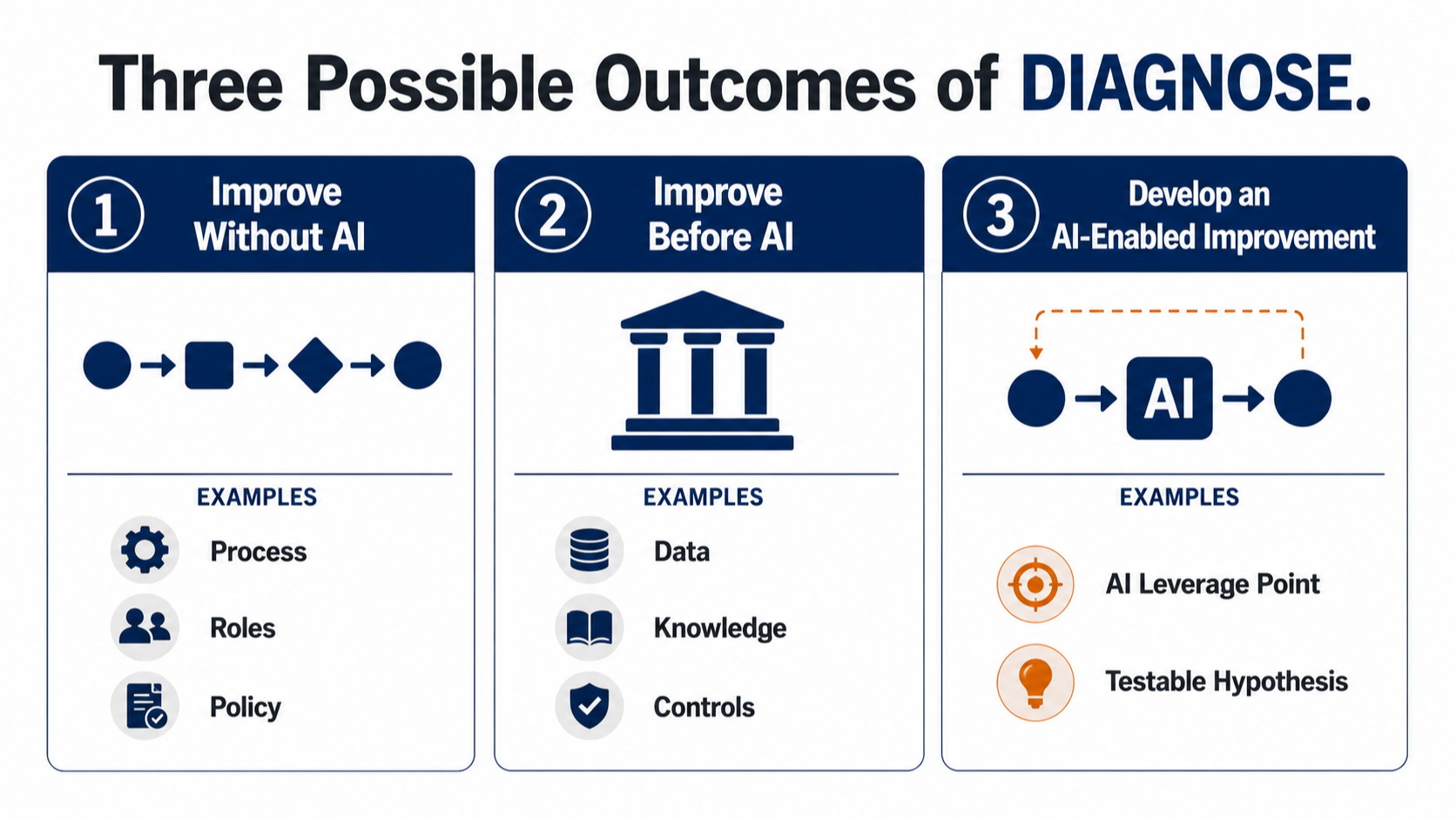
DIAGNOSE produces three possible outcomes:
Improve Without AI. Improve Before AI. Improve with AI augmentation.
Where is the DIAGNOSE Stage in ADVIS?
ALIGN → DIAGNOSE → VALIDATE → IMPLEMENT → SCALE
ALIGN = Strategic Justification →
DIAGNOSE = Diagnostic Evidence →
VALIDATE = Controlled Proof →
IMPLEMENT = Operational Proof →
SCALE = Sustained & Expanded Proof
Why This Matters
Why the DIAGNOSE Stage Matters
Much of the value from AI comes from changing how work gets done.
That makes understanding workflows central to successful AI implementation.
McKinsey's 2025 global research found that redesigning workflows had the largest effect among 25 organizational practices tested on respondents' ability to report EBIT impact from generative AI. Yet only 21% of respondents using generative AI said their organizations had fundamentally redesigned at least some workflows (McKinsey & Company, 2025a). (McKinsey & Company)
More recent McKinsey research found the same pattern. Leaders were 5.3 times more likely to report enterprise value from AI when workflows were redesigned rather than left unchanged (McKinsey & Company, 2026). (McKinsey & Company)
BCG similarly reports that organizations capturing greater AI value are moving beyond tool deployment and redesigning workflows end-to-end (Boston Consulting Group, 2025a). (BCG Global)
The lesson for executives is important:
AI value depends on understanding the workflow before redesigning the work.
DIAGNOSE prevents firms from automating the wrong problem
Consider a professional services firm where producing a major client proposal takes five days.
Management may initially conclude that proposal writing is too slow.
That observation describes the symptom. The actual causes might include:
- Information scattered across multiple systems
- Slow expert approvals
- Poor reuse of previous work
- Inconsistent templates
- Unclear responsibilities
- Repetitive drafting
- Missing client information
- Too many handoffs
AI could help with some of these causes.
Others may require a process change, clearer ownership, better information management, or conventional automation.
An AI workflow assessment separates the visible problem from the conditions creating it.
DIAGNOSE improves investment decisions by separating AI from the problems
Knowing that AI is a potential solution is dangerous.
Experimenting and demoing potential AI solutions is fun, exciting, and potentially wrong.
The ease of creating an AI demonstration can make weak opportunities look attractive.
DIAGNOSE identifies problems that should be fixed first
Some workflows are not ready for AI.
The underlying process may be inconsistent.
Data may be unreliable.
Knowledge may exist only in the heads of a few experts.
Roles may be unclear.
A workflow may contain unnecessary approvals or duplicate work.
Faster may not be better
Adding AI under those conditions can make a poor process faster without making it better.
A diagnosis identifies those weaknesses before they become AI implementation problems.
This is especially important when applying AI to professional services.
Consulting, accounting, marketing, legal, financial, advisory, and other professional work often combines repeatable tasks with expert judgment.
A workflow analysis should identify:
- Where professional evaluation is required
- Where approval is necessary
- Which exceptions need escalation
- Where client context changes the answer
- Who remains accountable for the result
- Where unnecessary work is performed
- Where communications slow the process and more
The goal is not to remove people wherever possible.
The goal is to design a better system that combines AI efficiency with human expertise, creativity, ethics, and values.
Want to create
measurable business value?
CTS can help your team at every stage of ADVIS: ALIGN, DIAGNOSE, VALIDATE, IMPLEMENT, and SCALE - so you can measure success.
SCHEDULE AN AI STRATEGY DISCUSSION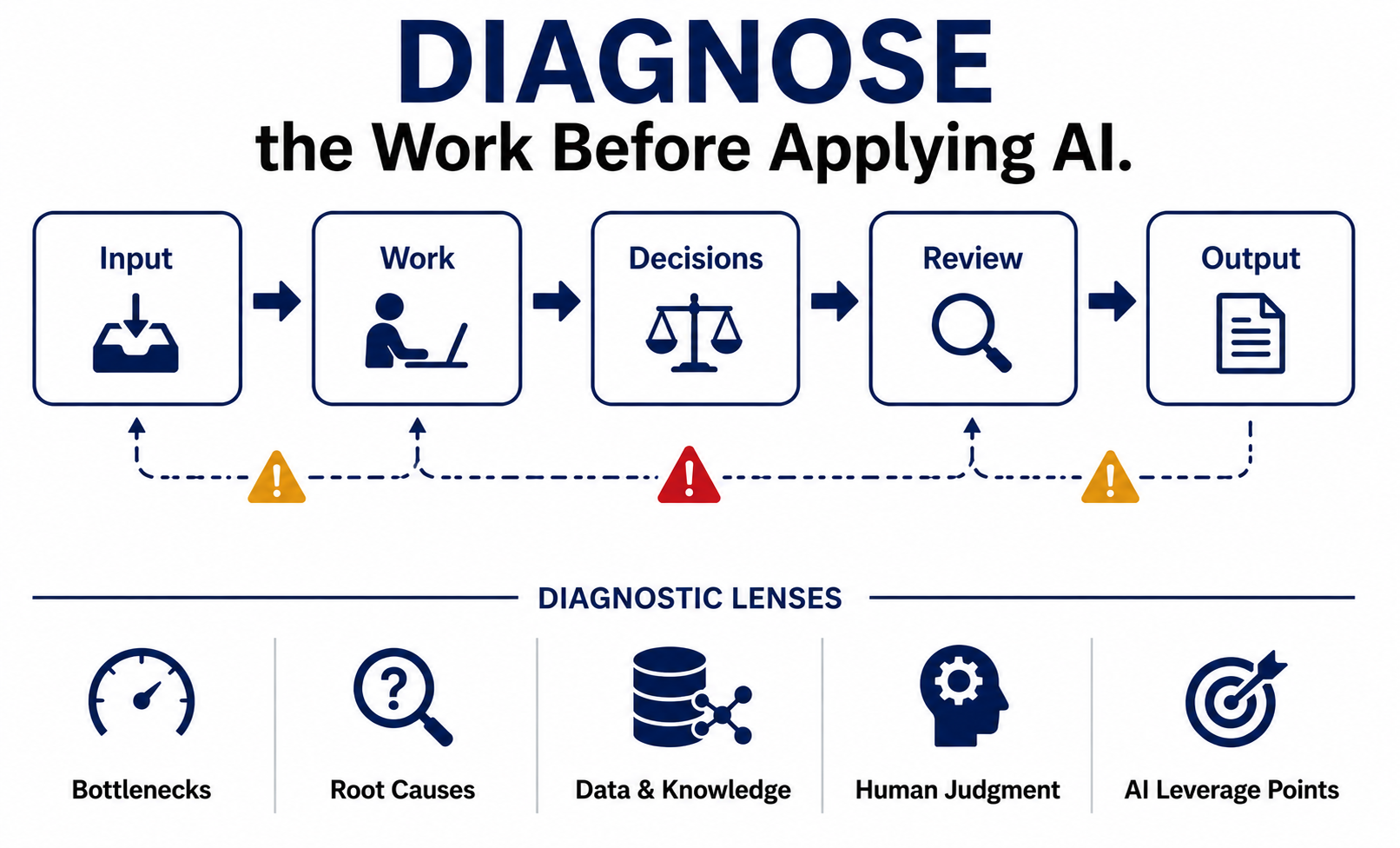
What Successful Firms Do
A successful DIAGNOSE stage gives leadership a credible picture of how the work performs today and what should be changed.
The work team doing the DIAGNOSE stage should understand the workflow well enough to explain where value is being lost, where bottlenecks are, and why there are slow downs.
The team working on this workflow should know:
- What triggers the work
- What information enters the process
- Which tasks are performed
- Where decisions are made
- Which systems are used
- Who performs the work
- Where handoffs occur
- What outputs are produced
- What requirements are unnecessary
- Where workflow chokepoints are and their severity
The team should be able to identify where performance is gained or lost.
Current performance is measurable
The team has usable evidence about current performance.
Depending on the workflow, their evidence might include:
- Cycle time
- Costs
- Error rates
- Rework
- Quality
- Professional hours
- Throughput
- Client response time
- Conversion
- Capacity
Metrics established in ALIGN should be cross-checked in the DIAGNOSE stage.
The original assumptions may prove incomplete once the workflow is examined.
Bottlenecks and root causes and their severity are identified
The team diagnosing the workflow should be able to identify the problem and its causes. For example, if proposal turnaround is slow, the diagnosis should identify why. If client response time is poor, the team should know where the delay occurs.
This is one of DIAGNOSE's most important outputs. At this stage, the team must understand where bottlenecks slow the work and identify the impact level of each bottleneck.
In any workflow, only one bottleneck throttles work through the entire workflow at a time. You must find each bottleneck in turn, from most critical to least critical, and use process improvement or AI systems to open each one.
Data and knowledge requirements are understood
The organization knows what data and information the workflow requires and whether it is:
- Accurate
- Available
- Accessible
- Reliable
- Current
- Relevant
- Appropriately secured
For knowledge-intensive professional work, DIAGNOSE also examines where expertise resides and how consistently it can be accessed.
Human judgment is visible
The future AI-enabled workflow should not be designed until the organization understands where human judgment, approval, discretion, client interaction, and accountability are required.
Those points later become part of the human-in-the-loop design.
DIAGNOSE should focus the scope of AI
The DIAGNOSE team has moved beyond a general idea such as:
“AI could improve proposal development.”
It now has a more specific implementation such as:
“AI may reduce proposal cycle time by retrieving approved prior work, creating a first draft from defined sources, and routing exceptions to the appropriate subject-matter expert.”
That is specific enough to move toward VALIDATE.
What Causes Failure
Automating waste
A poor workflow doesn't become a good workflow just because AI does part of it faster.
Unnecessary steps, duplicate reviews, confusing responsibilities, and poor information flows should be addressed before they are automated.
BCG makes the same point in its work on AI agents: process redesign must address the logic of the process itself, including unnecessary steps, roles, knowledge, systems, and data quality (Boston Consulting Group, 2025b). (BCG Global)
Confusing symptoms with root causes
“Proposal development is slow” is a problem statement, not a root cause.
The underlying cause could be writing time, research, approvals, information retrieval, data quality, expert capacity, or workflow design.
Different causes require different solutions.
Selecting easy AI use cases instead of valuable ones
Some AI applications are easy to demonstrate.
That does not make them the best place to invest.
A useful opportunity should combine strategic impact with realistic feasibility, manageable risk, and sufficient capability.
Ignoring data and knowledge readiness
AI results depend heavily on the information available to the system.
If critical knowledge is inaccessible, inconsistent, outdated, or poorly structured, the AI solution may never perform acceptably.
Ignoring human judgment
A workflow can appear highly repetitive when processes are normal, but exceptions and outliers cause slowdowns and bottlenecks.
Professional judgment may be required for unusual clients, incomplete information, regulatory issues, quality control, or decisions carrying business consequences.
Teams must identify where these outliers and exceptions are most likely to occur and then use human-in-the-loop interventions and judgment.
In some cases, especially with newly implemented AI systems, the human-in-the-loop review can take up the time saved by the AI automation. In these cases, the human managers of the system must include an improvement loop to examine delays and modify the AI system to handle those delays as well as the original system.
Designing around one AI tool
AI platforms, models, agents, and capabilities are changing rapidly. They are all approaching an asymptote of the same power, performance, and capabilities.
A diagnosis should define what the workflow needs before the organization locks itself into a particular product.
Keeping AI platform decisions open preserves more options during VALIDATE and IMPLEMENT.
How to Do the Diagnose Stage
DIAGNOSE begins with the workflow(s) selected through ALIGN.
The work should then be examined from several perspectives.
1. Map the current workflow
Start where the work actually begins.
Document:
Trigger — What causes the workflow to start?
Inputs — What information is required?
Tasks — What work is performed?
Decisions — Where are choices or approvals required?
People — Which roles participate?
Systems — What applications or tools are involved?
Handoffs — Where does work move between people or systems?
Outputs — What must the workflow produce?
For many professional workflows, a simple current-state map provides enough visibility to start.
2. Measure current performance
Determine how the workflow performs today.
Use existing data when it is reliable.
If measurement is weak, collect enough information to understand the current state before assuming potential improvements.
This may also reveal that the metric or baseline established during ALIGN needs adjustment.
3. Find friction
Look for places where value is lost.
Common examples include:
- Waiting
- Unnecessary reviews
- Rework
- Errors
- Repetitive research
- Duplicate data entry
- Searching for information
- Inconsistent outputs
- Expert bottlenecks
- Manual transfer between systems
These become candidates for deeper root-cause analysis.
4. Determine root causes
Ask why the bottleneck or friction occurs.
Useful categories to examine include:
Process — Is the workflow poorly designed?
Policy — Do rules or approvals create unnecessary work?
Data — Is required information missing or unreliable?
Knowledge — Is expertise difficult to access or reuse?
Capability — Do people lack required skills?
Capacity — Are scarce experts or resources overloaded?
System — Do applications fail to support the workflow?
Technology — Is an important capability unavailable?
Do not assume the answer to these causes will be AI.

5. Examine data and knowledge
Determine what information each important task requires.
Ask:
- Where does the information come from?
- Can the right people or systems access it?
- How reliable is it?
- Is it current?
- Is it structured or unstructured?
- Is confidential information involved?
- Are there regulatory or client restrictions?
- Does critical knowledge exist only with individual experts?
This step is particularly important for AI systems that retrieve, summarize, analyze, recommend, or generate work from organizational knowledge.
6. Identify where human judgment and accountability are needed
Map where professional judgment matters.
Examples include:
- Approval
- Interpretation
- Client advice
- Unusual cases
- Risk decisions
- Quality review
- Exceptions
- Escalation
Also determine who remains accountable when AI participates in the work.
Your redesign must make it clear where responsibility lies for a good AI workflow – people, technology, or AI system.
7. Review measurement assumptions
Return to the metric, baseline, and target created during ALIGN.
Examine whether the workflow diagnosis supports those measurement assumptions.
Often DIAGNOSE reveals that in addition to a primary (results) metric, one or more operational metrics are needed.
For example, the strategic target may be improved client retention, while the workflow requires measurement of response time, resolution quality, and professional review effort.
VALIDATE will later determine formal acceptance criteria.
8. Identify AI leverage points
Now examine where AI could make a meaningful difference.
Useful categories include:
Automate
Perform repeatable tasks with limited human involvement where risk is acceptable.
Augment
Help a professional complete work faster or with better information.
Analyze
Examine documents, data, patterns, or large volumes of information.
Recommend
Provide possible actions or decisions for human review.
Generate
Create drafts, summaries, analyses, plans, or other work products.
Accelerate
Reduce waiting, retrieval, research, coordination, or cycle time.
Not every leverage point should become an AI use case.
The purpose is to create options.
9. Consider future capabilities and innovations
Do not design your improvements only around today's capabilities.
Consider future potential and opportunities:
- Model portability
- Platform changes
- Integration requirements
- APIs
- Reusable prompts
- Agents
- Data portability
- Growth in transaction volume
- Reuse across teams
- Potential cross-department application
10. Prioritize opportunities
Rank opportunities using criteria such as:
- Strategic impact
- Economic value
- Feasibility
- Workflow readiness
- Data readiness
- Risk
- Complexity
- Implementation effort
- Scalability
- Future value
It is easy to be overwhelmed by the number of potential projects. But it is critical to choose the few that will go on to the VALIDATE stage. Forwarding too many potential projects to the next stage can overwhelm your team.
Several methods can identify projects with the best potential. One of the easiest and fastest to use is the Impact – Effort Matrix. This simple matrix ranks improvement projects by how difficult they are to fix and the impact they have on the business objective.
If more than two criteria are important for selecting improvement projects, then use a Weighted Project Prioritization Matrix and enter a ranking for different criteria in a spreadsheet to produce a final weighted sort.
Want to create
measurable business value?
CTS can help your team at every stage of ADVIS: ALIGN, DIAGNOSE, VALIDATE, IMPLEMENT, and SCALE - so you can measure success.
SCHEDULE AN AI STRATEGY DISCUSSIONHow to DIAGNOSE an AI Workflow
For executives and teams that want a concise AI workflow analysis process:
- Select the strategically important workflow that drives aligned objectives.
- Map the current state.
- Measure current performance.
- Identify bottlenecks, human-in-the-loops, delays, errors, and rework.
- Determine the root causes of friction.
- Examine data, knowledge, systems, and human judgment.
- Review KPI and baseline assumptions from ALIGN.
- Identify potential AI leverage points.
- Assess feasibility, risk, complexity, and future flexibility.
- Rank the improvement opportunities by impact and effort (or multi-criteria selection).
- Select 5 to 10 of the strongest hypothesis to go to the VALIDATE stage.
Your selections of five to ten workflows from the DIAGNOSE stage will go on to the VALIDATE stage. In the VALIDATE sta e they will be refined to the two or three workflows that are the best AI systems candidates.
How Diagnose Works: A Professional Services Example
The most important principle in this stage is simple:
A business problem is not automatically an AI use case.
For example, suppose proposal development takes five days.
A team might immediately propose an AI proposal-writing assistant.
DIAGNOSE first examines the workflow.
The team discovers:
- Approved case studies are stored in several locations
- Subject-matter experts spend significant time locating previous examples
- Pricing approval adds a full day
- Proposal writers repeatedly re-create similar company descriptions
- Senior partners review every proposal regardless of complexity
- Some proposals arrive with incomplete client information
The diagnosis has changed the problem.
The organization is no longer trying to “use AI to write proposals.”
It is trying to improve an end-to-end workflow containing several different problems.
Some could benefit from AI.
Others should be fixed another way.
This produces three possible outcomes.
OUTCOME 1 — IMPROVE WITHOUT AI
The diagnosis may show that AI is unnecessary.
A workflow may improve through:
- Removing an approval
- Clarifying responsibilities
- Standardizing a template
- Consolidating information
- Changing a policy
- Using existing automation
- Improving management
This is a successful ADVIS result.
The organization has improved the business without taking on unnecessary AI complexity.
OUTCOME 2 — IMPROVE BEFORE AI
The AI opportunity may be attractive, but the foundation is not ready.
For example:
- Source documents may be unreliable
- Client information may not be consistently captured
- Access rules may be unclear
- Workflow steps may vary too widely
- Quality standards may not exist
- Organizational knowledge may need to be organized
The organization should fix these conditions first.
AI remains an option after readiness improves.
OUTCOME 3 — DEVELOP AN AI-ENABLED IMPROVEMENT
The diagnosis may show that AI can address a meaningful root cause.
In the proposal example, the implementation hypothesis might become:
AI could retrieve approved prior work, assemble relevant client and service information, create a structured first draft, and route defined exceptions to human experts.
That is much stronger than:
“Let's use AI to write proposals.”
It defines a workflow opportunity that can be tested.
DIAGNOSE has now converted the original Strategic AI Hypothesis from ALIGN into a more specific AI Implementation Hypothesis.
VALIDATE will determine whether it actually works.
RECOMMENDED RESOURCES
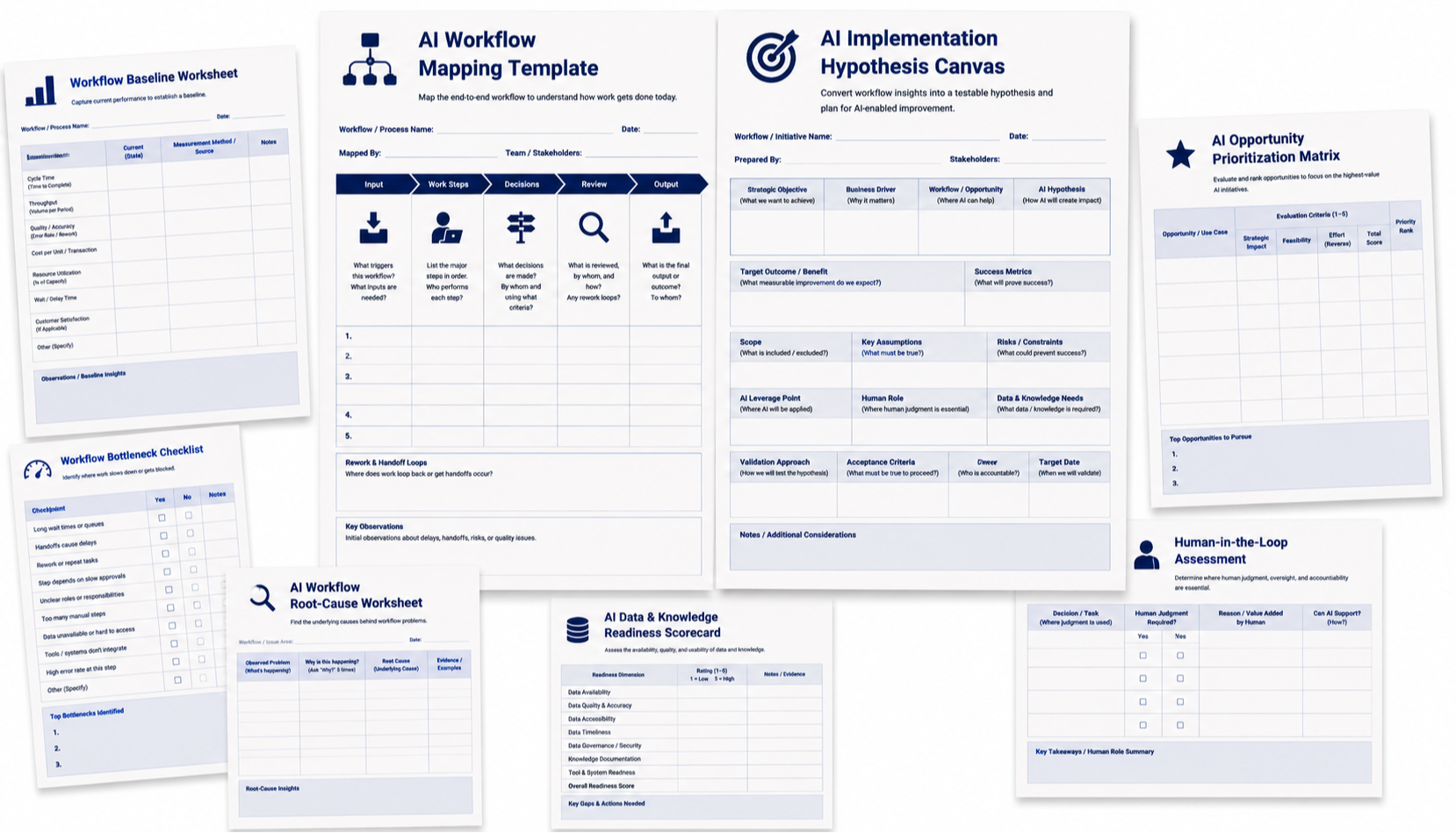
CTS has developed assessments, templates, worksheets, and canvases that make it easier and more straightforward to complete each ADVIS stage. In this stage, clients use:
- AI Workflow Mapping Template
- Workflow Baseline Worksheet
- Workflow Bottleneck Checklist
- AI Workflow Root-Cause Worksheet
- AI Data & Knowledge Readiness Scorecard
- Human-in-the-Loop Assessment
- AI Opportunity Prioritization Matrix
- AI Implementation Hypothesis Canvas
These assets are used by CTS to support consulting engagements, AI Implementation Workshops, executive assessments, and future lead-generation resources.
Results and Deliverables
A completed DIAGNOSE stage should produce evidence that can guide the validation decision.
Current-State Workflow Map
A clear representation of how the work currently moves from trigger to output.
Reusable asset opportunity
AI Workflow Mapping Template.
Workflow Baseline
Current measures for cycle time, cost, quality, effort, throughput, or other relevant operating performance.
Reusable asset opportunity
Workflow Baseline Worksheet
Bottleneck Analysis
The major points where time, effort, quality, capacity, or value are being lost.
Reusable asset opportunity
Workflow Bottleneck Checklist.
Root-Cause Findings
Evidence showing why important workflow problems occur.
Reusable asset opportunity
AI Workflow Root-Cause Worksheet.
Data and Knowledge Readiness Findings
Assessment of the information required to support the proposed workflow.
Reusable asset opportunity
AI Data & Knowledge Readiness Scorecard.
Human-Judgment Requirements
A map of decisions, approvals, reviews, exceptions, and accountability requiring human involvement.
Reusable asset opportunity
Human-in-the-Loop Assessment.
Measurement Review
Confirmation or revision of the KPI, baseline, and target assumptions established during ALIGN.
AI Opportunity List
Potential leverage points identified through the diagnosis.
Prioritization Score
A structured ranking using impact, feasibility, readiness, risk, complexity, and scalability.
Reusable asset opportunity
AI Opportunity Prioritization Matrix.
AI Implementation Hypothesis
A specific explanation of how a redesigned AI-enabled workflow might produce measurable improvement.
DECISION Gate
At the DIAGNOSE decision gate, the question is, “Do we understand the workflow, root causes, measures, constraints, and proposed improvement well enough to design a meaningful validation test?”
Possible decisions here include:
Proceed to VALIDATE
The workflow is understood, readiness is sufficient, and the AI Implementation Hypothesis deserves controlled testing.
Optimize the workflow first
The diagnosis identified process problems that should be corrected before introducing AI.
Improve data or knowledge readiness
The opportunity remains promising, but the required information foundation is not ready.
Correct the measurement model
The KPI, baseline, target, or operating measures are not sufficiently reliable.
Change the AI Implementation Hypothesis
The original approach does not address the most important root cause.
Select another workflow
Another opportunity offers greater strategic impact or feasibility.
Return to ALIGN
The diagnosis raises questions about the original strategic objective, driver, metric, or assumptions.
Defer or Stop
The expected value does not justify further AI implementation effort right now.
What Comes Next: VALIDATE
DIAGNOSE determines what deserves testing.
VALIDATE determines whether the proposed AI-enabled system performs well enough under controlled conditions to justify operational implementation.
The next stage will test:
- The business hypothesis
- The workflow hypothesis
- The technology hypothesis
- The measurement hypothesis
It will establish acceptance criteria before testing and compare the proposed system with current performance.
Most important:
VALIDATE produces proof in a controlled environment, not operational proof.
That distinction prevents an impressive demonstration from being mistaken for a production-ready AI system.

How Critical To Success Can Help
Find where AI should actually be applied before committing to implementation
Many organizations already have lists of AI use cases.
The more difficult problem is determining which workflows offer enough strategic value, readiness, and measurable opportunity to justify serious investment.
Critical to Success helps professional services firms and business departments move from scattered AI ideas to prioritized implementation opportunities.
An AI Workflow Opportunity and Readiness Assessment can identify high-value workflows, diagnose root causes, evaluate readiness, and determine where AI could make a meaningful difference.
CTS AI Implementation Workshops take the process further.
Teams learn practical AI skills while diagnosing, developing, validating, and implementing AI-enabled workflows tied to their actual work.
For organizations pursuing AI for professional services, this workflow-centered approach helps preserve the expert judgment, knowledge, client context, and accountability that make professional work valuable.
Want to create
measurable business value?
CTS can help your team at every stage of ADVIS: ALIGN, DIAGNOSE, VALIDATE, IMPLEMENT, and SCALE - so you can measure success.
SCHEDULE AN AI STRATEGY DISCUSSIONPeak Professional Performance
The Critical to Success newsletter keeps you up to date on AI for professional services.
Unsubscribe anytime.
FAQ
Frequently Asked Questions
What is an AI workflow assessment?
Should a workflow be optimized before AI is added?
How do you know whether a business problem actually needs AI?
What makes a workflow ready for AI?
How important is human judgment in AI workflow design?
How can companies avoid AI platform lock-in?
References
Boston Consulting Group. (2025a). AI at Work 2025: Momentum builds, but gaps remain. Boston Consulting Group.
https://www.bcg.com/publications/2025/ai-at-work-momentum-builds-but-gaps-remain
Boston Consulting Group. (2025b). How AI can be the new all-star on your team. Boston Consulting Group.
https://www.bcg.com/publications/2025/how-ai-can-be-the-new-all-star-on-your-team
McKinsey & Company. (2025a). The state of AI: How organizations are rewiring to capture value. McKinsey & Company.
https://www.mckinsey.com/capabilities/quantumblack/our-insights/the-state-of-ai-how-organizations-are-rewiring-to-capture-value
McKinsey & Company. (2026). From adoption to impact: Three horizons of AI transformation. McKinsey & Company.
https://www.mckinsey.com/capabilities/people-and-organizational-performance/our-insights/from-adoption-to-impact-three-horizons-of-ai-transformation
About Ron Person
Ron Person is an AI strategic advisor, consultant, author, and educator with more than 30 years of experience in technology, strategy, performance improvement, and digital marketing. He consulted for 17 years as one of Microsoft’s first independent consultants and later for 14+ years advising Fortune 1000 and Global 1000 organizations on strategic performance improvement and digital marketing. Ron has written 27 business and technology books, taught at the University of California, Berkeley Executive Extension, and has worked extensively with Generative AI since its public release.
About Critical to Success
Critical to Success helps professional service firms turn AI experimentation into measurable performance improvement. CTS provides AI Strategic Advisory, AI Implementation Consulting, and AI Implementation Workshops for professional teams and departments. CTS applies its proprietary CTA ADVIS Implementation Frameworktm to align AI systems and optimize workflows that drive strategic objectives. It then diagnoses and validates workflows, metrics, governance, and risk before implementing in a controlled environment and later scaling to additional professional domains.
Editorial Note
This article is part of the Critical to Success AI implementation library. It is written for professional service firm leaders who need practical guidance on AI strategy, workflow improvement, governance, adoption, and measurable performance improvement. Content is periodically reviewed and updated to reflect changes in AI tools, implementation practices, and the needs of professional service firms.
Declaration of AI Assistance
Disclaimer: This article was researched and drafted with the assistance of AI tools. You can read our full human-oversight process in our AI Transparency Policy.