VALIDATE
VALIDATE the Proposed AI System Works
in a Controlled Environment
TL;DR
Take Aways
VALIDATE replaces AI enthusiasm and promising demonstrations with controlled evidence that leadership can use to make implementation decisions.
- VALIDATE is the third stage in the ADVIS Implementation Framework.
- Confirm the KPIs, baseline, and business assumptions established earlier in ADVIS.
- Define acceptance criteria before results are known.
- Measure quality, reliability, failures, human review, risk, and expected value.
- Test realistic cases, including difficult and exception conditions and proceed when the evidence justifies operational implementation.
Answer
Quick Answer
AI validation tests whether a proposed AI-enabled workflow can meet requirements before operational deployment.
The implementation team confirms the AI system meets defined acceptance criteria in a controlled work environment.
The final question is straightforward:
Is there enough controlled evidence to justify moving this AI system into IMPLEMENT?
Where is the ALIGN Stage in ADVIS?
ALIGN → DIAGNOSE → VALIDATE → IMPLEMENT → SCALE
ALIGN = Strategic Justification →
DIAGNOSE = Diagnostic Evidence →
VALIDATE = Controlled Proof →
IMPLEMENT = Operational Proof →
SCALE = Sustained & Expanded Proof
Why This Matters
Why Validation Matters
AI experimentation is widespread, yet many organizations still struggle to move from pilots into production.
McKinsey's 2025 global AI survey found that nearly two-thirds of respondents said their organizations had not yet begun scaling AI across the enterprise. Only 39% reported enterprise-level EBIT impact from AI (McKinsey & Company, 2025a).
Deloitte's 2026 State of AI research found a similar pilot-to-production problem. Only 25% of respondents said their organizations had moved 40% or more of their AI pilots into production (Deloitte, 2026).
The answer is not to randomly eliminate pilots. Firms need to select pilots that pass selection matrices and that can produce decision-quality evidence.
BCG recommends proving value during the pilot phase before scaled implementation and testing early prototypes with users while rigorously evaluating error and bias (Boston Consulting Group, 2025a).
For executives, VALIDATE provides a disciplined point between “this looks promising” and “we are ready to put this into the business.”
VALIDATE lowers implementation risk.
Problems discovered during controlled testing are usually easier to correct than problems discovered after employees, clients, data systems, and operating processes depend on the new AI system.
VALIDATE improves investment decisions.
Executives gain evidence about whether the proposed system can create enough value to justify implementation expense, integration, training, governance, and management attention.
VALIDATE reveals the real cost of human oversight.
An AI system may produce results faster, but if the system results aren’t trustworthy enough the human-in-the-loop review process could absorb all the time savings.
If professionals must spend 30 minutes checking an AI output that previously took 40 minutes to create, the improvement may be much smaller than the demonstration suggests.
That matters especially when applying AI for professional services, where accuracy, expert judgment, client context, and professional accountability can be as important as speed.
VALIDATE improves confidence in the business case.
McKinsey's 2026 AI measurement research recommends defining value and relevant metrics up front, connecting technical performance to operational and financial outcomes, and using clear stage gates so only use cases that demonstrate defensible impact move forward (McKinsey & Company, 2026).
VALIDATE creates that evidence before the system reaches normal operations.
Want to identify AI opportunities most likely to create measurable business value?
CTS can help your team at every stage of ADVIS: ALIGN, DIAGNOSE, VALIDATE, IMPLEMENT, and SCALE - so you can measure success.
SCHEDULE AN AI STRATEGY DISCUSSION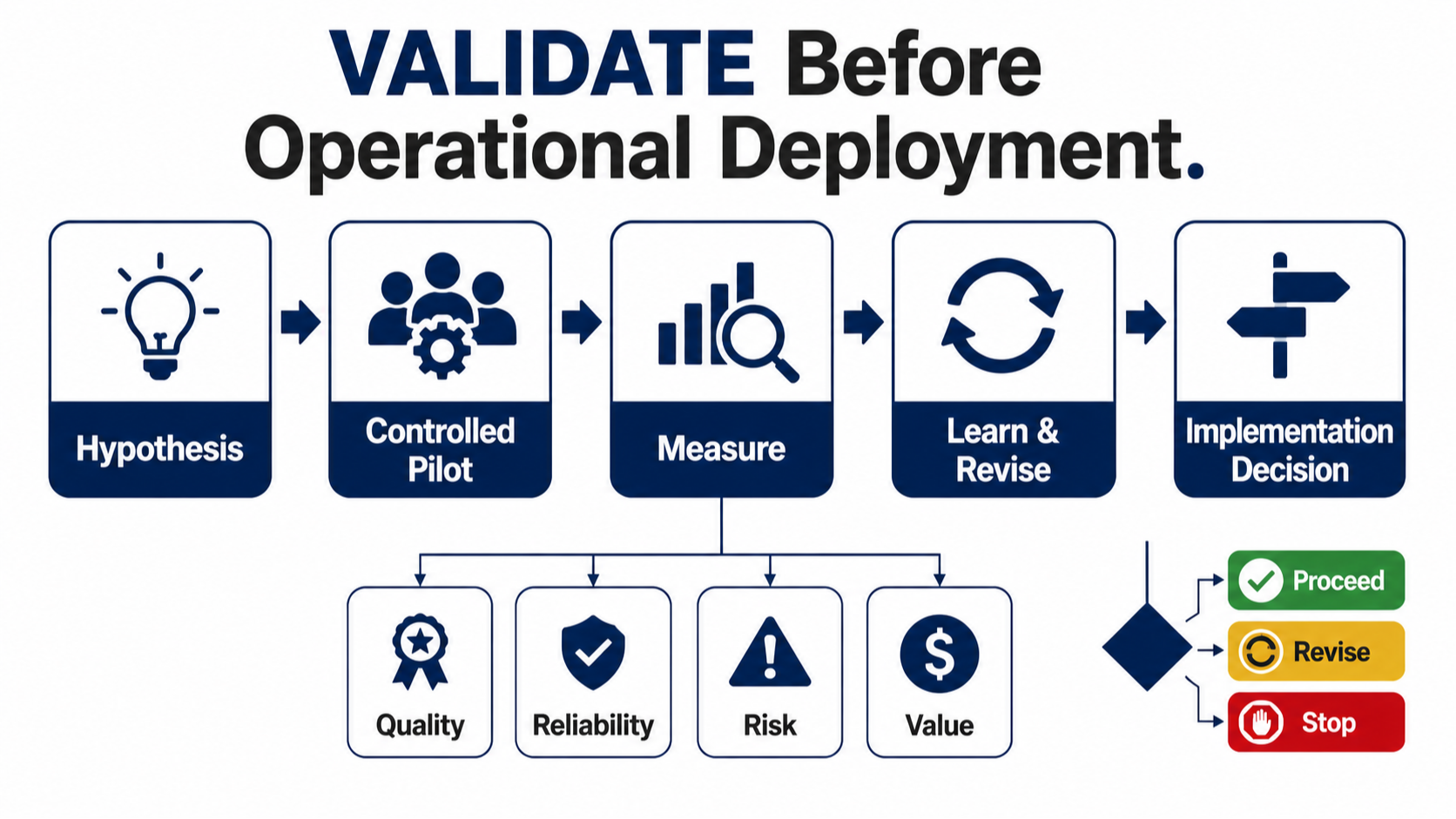
What Successful Firms Do
VALIDATE succeeds when the organization has enough credible evidence to decide whether the proposed AI-enabled workflow deserves to be implemented in an operational environment.
Remember, success does not require perfection. It requires performance that meets predetermined standards and a clear understanding of what still needs to change.
Validation success is when the implementation hypothesis is supported by evidence.
The proposed workflow performs well enough that leadership can justify taking the next step.
Results should indicate that the solution can improve the business driver identified earlier.
The measurement model is credible.
The team has confirmed that the KPIs, baseline, targets, and supporting measures are appropriate.
If DIAGNOSE exposed weaknesses in earlier measurement assumptions, they have been corrected.
Acceptance criteria were established before testing.
Success was defined before the team knew the result.
Beware of the temptation to redefine success after seeing what the pilot can achieve.
Quality is acceptable.
The outputs meet the professional or operational standards required for the work.
For a research system, that could include source accuracy, completeness, and reasoning quality.
For proposal development, it could include factual accuracy, relevance, tone, and compliance with approved content.
Performance is repeatable.
One excellent result is not enough.
The system performs consistently across a representative set of cases.
Failure patterns are understood.
The team knows where the system performs poorly and what conditions increase the chance of an error.
This allows operations to understand risks and watch to repair them rather than discovered accidentally during implementation.
Human oversight is defined.
The team understands where people must review, approve, correct, interpret, or escalate AI-supported work.
The cost and time of that review are included in the value assessment.
Expected business value is credible.
The team can estimate the likely impact on time, capacity, quality, cost, revenue, client experience, or another relevant measure.
The estimate is still not operational proof.
It is strong enough to support the decision to move into real operations.
What Causes Failure
Treating a demonstration as validation
A demonstration shows what an AI system can do.
Validation asks whether it can do the required work reliably enough across realistic conditions.
A polished example selected by the project team provides very little information about failure rates, repeatability, or edge cases.
Testing only easy cases
AI systems often perform best on clean, complete, predictable inputs.
Real work includes ambiguity, missing information, unusual requests, conflicting sources, exceptions, and poor-quality inputs.
A useful validation set must reflect that reality.
Setting success criteria after testing
Teams naturally want a project they have worked on to succeed.
That creates a risk of adjusting standards after results appear.
Acceptance criteria should be documented in advance.
Measuring speed while ignoring quality
A faster system that produces more errors may create no business value.
Evaluate time savings alongside output quality, correction effort, review burden, and downstream consequences.
Ignoring human-review cost
Critical points in workflows often require human-in-the-loop review.
That consumes professional time and can offset the productivity gains from an AI system.
Many AI systems targeting productivity improvement have failed because human review consumes all the time savings from AI’s increased productivity.
VALIDATE should measure that burden rather than treat human review as free.
Testing technology without testing the workflow
An AI model may perform a task well while the overall workflow remains inefficient.
The pilot should test the proposed AI-enabled way of working, not simply a model or prompt in isolation.
Treating pilot results as production proof
This is one of the most important boundaries in ADVIS.
Controlled validation cannot fully reproduce normal workload pressure, employee skill differences, organizational resistance, cross-system integration, long-term governance, or operating variation.
Those test elements belong in IMPLEMENT.
HOW TO DO THE VALIDATE STAGE
VALIDATE should answer four related questions.
- Does the Business Hypothesis still make sense?
Will improvement in this workflow materially influence the strategic objective established during ALIGN?
Evidence from DIAGNOSE may have strengthened or changed that assumption.
VALIDATE should keep the connection visible.
- Does the Workflow Hypothesis work?
Is the proposed AI-enabled workflow materially better than the current way of working?
This includes the complete sequence of AI activity, human review, approvals, exception handling, and output.
- Does the Technology Hypothesis work?
Can the selected AI capability perform its assigned tasks with acceptable quality, consistency, safety, and reliability?
This may involve:
- Models Used for generation, analysis, classification, or reasoning.
- Retrieval Used to access approved organizational knowledge.
- Prompts Used to structure outputs and guide behavior.
- Agents Used to complete multi-step activities.
- Automation Used to move work between tasks or systems.
- Integrations Needed for a meaningful pilot.
- Does the Measurement Hypothesis work?
Can the organization actually determine whether the proposed system creates value?
The team should be confident that its metrics, baseline, targets, and testing methods support a credible decision.

HOW TO VALIDATE THE AI IMPLEMENTATION HYPOTHESIS
Use the following process to move from an AI Implementation Hypothesis to a defensible implementation decision.
- State the hypothesis.
Describe what the proposed AI-enabled workflow is expected to improve.
For example:
AI-assisted proposal development may reduce proposal cycle time while maintaining approved quality and limiting senior-partner review.
The hypothesis should connect back to the strategic objective and workflow findings from ALIGN and DIAGNOSE.
- Identify what must be proven.
List the questions the pilot needs to answer.
Examples might include:
- Can the AI retrieve the correct approved data and materials?
- Can it produce a usable first draft?
- Can professionals review the work efficiently?
- Can the system recognizes cases that require escalation?
- Can it improve cycle time enough to make a difference?
- Confirm the KPI.
Return to the primary measures established earlier in ADVIS.
Confirm that they still represent the intended improvement.
Add a small number of secondary or operating measures where necessary.
- Confirm the baseline.
Make sure current performance is credible enough to support comparison.
If the baseline was estimated earlier, gather additional observations before relying on it.
- IMPORTANT: Define validation acceptance criteria.
This is one of the most important steps.
Acceptance criteria define what the pilot must demonstrate before the firm moves into IMPLEMENT.
They should be specific enough that leadership can make a decision without debating afterward what counts as success.
- Build the smallest useful pilot.
Do not build the full production system.
Build enough of the proposed workflow to test its critical assumptions.
The pilot should include the elements necessary to evaluate the business question without adding unnecessary complexity.
- Build a representative test set.
Include more than routine cases.
A strong test set may contain:
- Routine cases
- Difficult cases
- Incomplete inputs
- Ambiguous requests
- Exceptions requiring judgment
- Edge Cases Likely to expose weaknesses
- High-Risk Cases where appropriate
- Compare AI-assisted and current performance
Use the current workflow as the reference point.
A useful comparison might examine:
- Cycle time
- Professional effort
- Quality
- Error rate
- Review time
- Throughput
- Cost
- Client or user experience
- Test repeatability
Run enough cases to determine whether results are consistent.
The exact sample size depends on the workflow, risk, volume, and type of AI system.
The important point is to avoid basing a decision on a small number of hand-picked successes.
- Test failures and exceptions.
Identify what happens when the AI system produces wrong results.
Ask whether the system:
- Detects Uncertainty
- Requests Missing information
- Escalates Appropriate cases
- Avoids Unsupported claims
- Preserves Required source information
- Routes Work to a qualified human when needed
- Measure human-review burden.
Record how much time people spend checking and correcting AI-supported work.
Review effort should be included in productivity and economic calculations.
- Evaluate risk and controls
Consider privacy, security, bias, intellectual property, client confidentiality, compliance, professional standards, and other workflow-related risks.
Determine whether controls can reduce those risks to an acceptable level.
- Estimate business and economic value.
Combine expected benefits with realistic costs.
Include:
- Technology cost
- Implementation cost
- Human review cost
- Training requirements
- Integration effort
- Governance requirements
- Expected productivity or revenue impact
- Document required changes.
Validation rarely produces a perfect system. But it does identify where the system needs change or improvement.
Document changes needed to prompts, workflow design, models, data, knowledge sources, human-review points, controls, or measurement.
- Make the decision.
Want to identify AI opportunities most likely to create measurable business value?
CTS can help your team at every stage of ADVIS: ALIGN, DIAGNOSE, VALIDATE, IMPLEMENT, and SCALE - so you can measure success.
SCHEDULE AN AI STRATEGY DISCUSSIONKeep a Clear Distinction Between the Validation Criteria and Strategic Impact
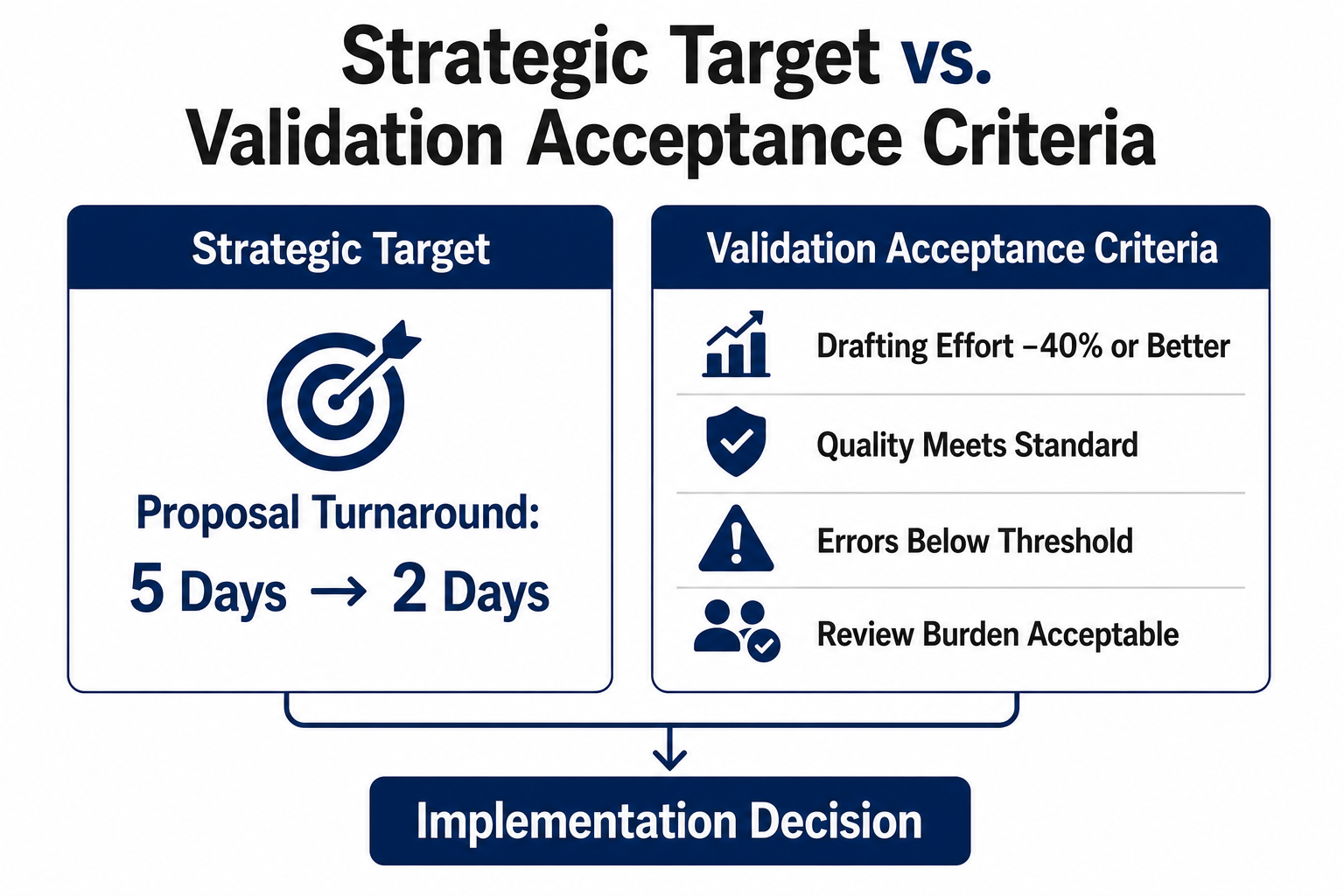
The distinction between impact on the strategic objective and the validation acceptance criteria must remain clear throughout AI implementation.
A strategic performance impact describes the business improvement the organization wants to achieve.
A validation acceptance criterion defines what the proposed AI system must demonstrate before entering real operations.
Consider a consulting firm trying to improve proposal development.
The strategic target might be:
Reduce average proposal turnaround from five days to two days.
That target expresses the desired business result.
The validation acceptance criteria could include:
- Reduce drafting effort by at least 40%
- Maintain defined proposal quality standards
- Keep factual errors below an established threshold
- Limit senior-expert review to an acceptable amount
- Correctly escalate defined exception cases
- Use only approved company and client information sources
The pilot does not need to prove that the organization will achieve the full strategic target under normal operating conditions.
It just needs to show that the proposed system performs well enough to justify operational deployment.
Remember, the VALIDATE stage measures performance in a controlled test environment. It is the IMPLEMENT stage of ADVIS that will determine what happens in a real work environment with real employees, normal workloads, operating pressure, integrations, and work variations.
How VALIDATE Works: A Professional Services Example
Let’s return to the proposal-development example from DIAGNOSE.
The firm found that proposal delays were caused by scattered prior work, repeated drafting, expert bottlenecks, inconsistent reuse, and slow exception handling.
Its AI Implementation Hypothesis is:
AI can retrieve approved prior work, assemble relevant client and service information, create a structured first draft, and route exceptions to human experts.
The firm now builds a limited pilot.
It does not connect multiple systems.
It does not train the entire business-development team.
It does not automate final proposal approval.
The pilot contains enough functionality to test the critical assumptions within a controlled environment.
The test set
The team selects completed proposals representing:
- Standard opportunities
- Complex opportunities
- Incomplete client information
- Multiple-service proposals
- Cases requiring senior-expert judgment
- Cases containing information the ai should not reuse
The historical outcomes allow the team to compare AI-supported work against known examples.
The measures
The team measures:
- Time to retrieve source material
- Time to create a usable draft
- Factual accuracy
- Use of approved sources
- Quality of the draft
- Amount and time of expert correction
- Failure and exception rates
The findings
Suppose drafting effort falls 55%.
Quality meets the required standard in routine and moderately complex proposals.
The AI struggles when client information is incomplete and occasionally selects an outdated case study.
Senior review falls, although not as much as expected.
Those results are useful.
They show where the system creates value and where it needs revision.
The AI pilot and workflow can now be improved and retested before leadership makes the operational implementation decision.
WHAT VALIDATE PROVES
Controlled testing can provide evidence about several important questions.
VALIDATE can show:
- Feasibility Whether the proposed AI-enabled workflow can perform the required work.
- Quality Whether outputs meet defined standards
- Reliability Whether performance is reasonably consistent
- Failure Conditions Where the system breaks down
- Human Oversight What review and escalation appear necessary
- Risk Which controls will be needed
- Expected Value Whether the system has a credible path to meaningful business improvement
- Required Revisions What must change before implementation
This is enough evidence to support a decision.
It is not enough to claim production success.
What Validate Cannot Fully Prove
A controlled environment cannot recreate everything that occurs in normal business operations.
VALIDATE cannot fully prove:
- Employee Adoption Across the normal workforce
- Performance Under real workload pressure
- Behavior Across different employee skill levels
- Cross-System Effects In the complete operating environment
- Long-Term Governance Burden
- Organizational Change Requirements
Results and Deliverables
A completed VALIDATE stage should produce a concise evidence package to support the implementation decision. That package might contain elements like these:
Validation Hypothesis
The specific proposition being tested.
Validation Plan
The scope, method, responsibilities, measures, and testing approach.
Confirmed KPI Set
The business and operating measures needed to judge performance.
Confirmed Baseline
The current-state performance used for comparison.
Validation Acceptance Criteria
Predetermined requirements that define an acceptable pilot result.
Pilot or Prototype
The smallest useful AI-enabled system capable of testing the critical assumptions.
Representative Test Set
Routine, difficult, incomplete, exception, and edge cases.
Validation Results
Documented performance against the defined measures.
Quality and Reliability Findings
Evidence about output performance and consistency.
Failure Analysis
Known failure conditions, frequency, and consequences.
Human-Review Requirements
The review, approval, escalation, and accountability needed for implementation.
Risk Findings
Risks discovered and controls required.
Value Estimate
Expected operational and financial benefit based on controlled evidence.
Required Revisions
Changes necessary before or during operational implementation.
Implementation Recommendation
Proceed, revise and retest, return to DIAGNOSE, change technology, defer, or stop.
RECOMMENDED RESOURCES
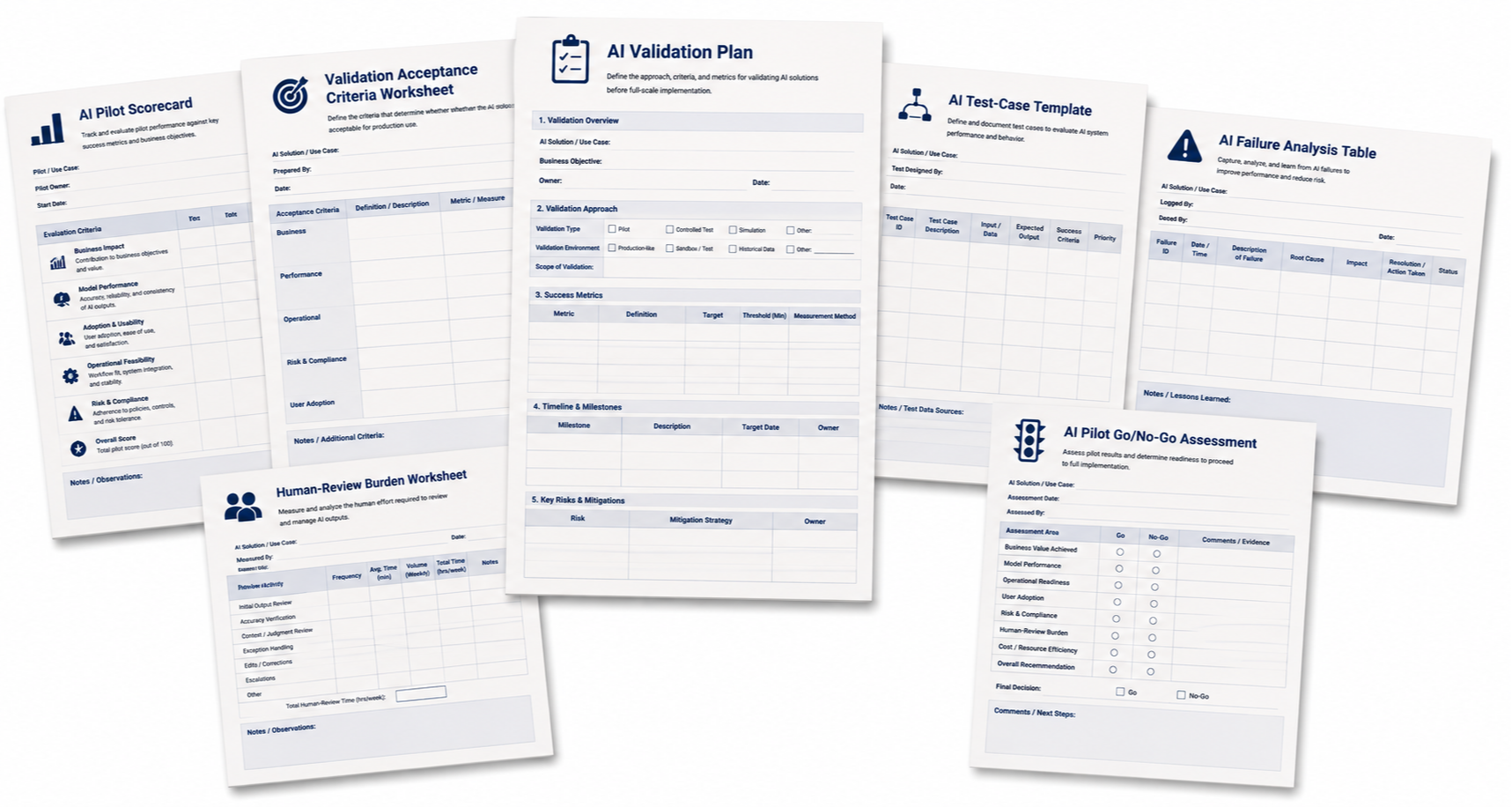
CTS has developed assessments, templates, worksheets, and canvases that make it easier and more straightforward to complete each ADVIS stage. In this stage, clients use:
- AI Validation Plan
- AI Pilot Scorecard
- Validation Acceptance Criteria Worksheet
- AI Test-Case Template
- AI Failure Analysis Table
- Human-Review Burden Worksheet
- AI Pilot Go/No-Go Assessment
These assets are used by CTS to support consulting engagements, AI Implementation Workshops, executive assessments, and future lead-generation resources.
DECISION GATE
You need a decision before moving to the IMPLEMENT stage. Possible decisions include:
Does the controlled evidence justify putting the AI system into a real operational environment?
The decision should be based on the evidence package rather than enthusiasm for the technology.
Proceed to IMPLEMENT
The system meets the required criteria and remaining issues can reasonably be managed during controlled operational deployment.
Revise and Retest
The concept remains sound, although important improvements are needed before implementation.
Return to DIAGNOSE
Testing exposed a deeper workflow, data, knowledge, or root-cause issue.
Change the Measurement Model
The organization cannot yet judge value reliably.
Change the Technology
The workflow opportunity is valid, but the selected model, platform, agent, retrieval approach, or other technology does not perform well enough.
Defer
The opportunity remains attractive, but current cost, technology, resources, or timing do not justify implementation.
Stop
Controlled evidence does not support further investment.
A Stop decision can save the organization substantial cost and operational disruption.
That is a successful validation outcome.
What Comes Next: IMPLEMENT
VALIDATE asks the question:
Will the proposed AI-enabled system work under controlled conditions?
IMPLEMENT asks a harder and more important question:
Will the proposed AI-enabled system work when real people use it to perform real work?
The Implement stage introduces:
- Real users
- Real workloads
- Normal time pressure
- Incomplete and unexpected inputs
- Actual systems
- Operational governance
- Team training
- Cross-functional handoffs
- Real adoption
- Operating economics
IMPLEMENT has two internal phases.
Operational Deployment proves that the AI-enabled workflow can function with real users and real work.
Operational Integration determines whether it works as part of the larger business system.
That is why controlled validation should never be described as production proof.
How Critical to Success Can Help
Test the AI system before your organization depends on it.
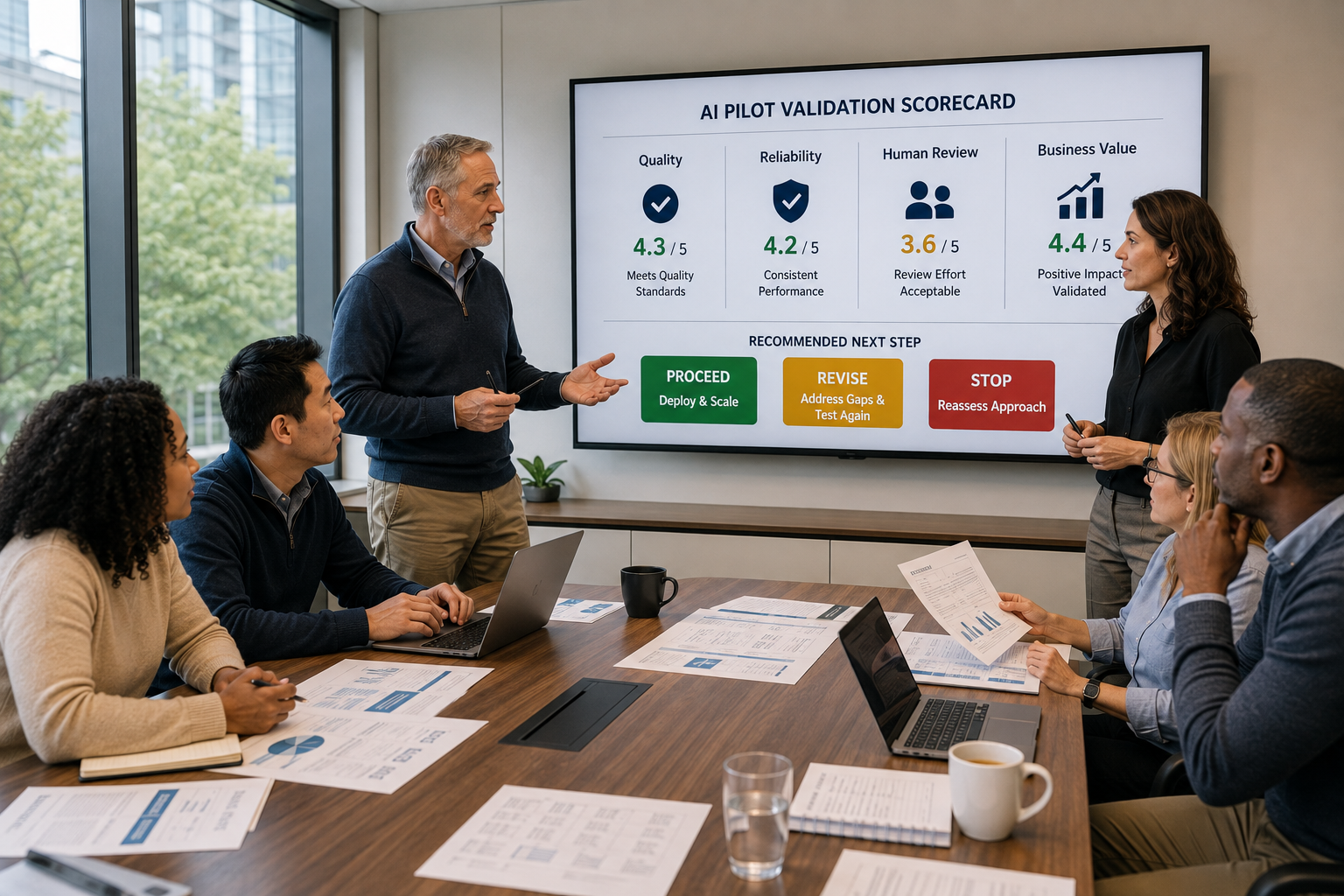
AI pilots are most valuable when they provide evidence to support a business decision.
Critical to Success can help your firm turn promising AI ideas into structured validation tests tied to real workflows, measurable outcomes, realistic cases, human review, risk, and business value.
CTS AI Implementation Workshops help teams move from DIAGNOSE through VALIDATE while developing the skills needed to operate the systems they are testing.
The implementation workshop centers around the team's actual work or a work simulation.
Workshop participants do much more than receive general AI training. They develop prompts, workflows, human-review methods, measurement approaches, controls, and AI-enabled systems they can later implement.
For organizations applying AI in professional services, that approach is particularly valuable because validation must account for expert judgment, client requirements, quality standards, knowledge sources, and professional accountability.
Want to identify AI opportunities most likely to create measurable business value?
CTS can help your team at every stage of ADVIS: ALIGN, DIAGNOSE, VALIDATE, IMPLEMENT, and SCALE - so you can measure success.
SCHEDULE AN AI STRATEGY DISCUSSIONPeak Professional Performance
The Critical to Success newsletter keeps you up to date on AI for professional services.
Unsubscribe anytime.
FAQ
Frequently Asked Questions
What is AI validation?
What is the difference between an AI pilot and AI validation?
How is AI validation different from AI implementation?
How long should an AI pilot run?
What metrics should an AI pilot measure?
Should AI pilots include difficult and edge cases?
When should an AI pilot be stopped?
References
Boston Consulting Group. (2025a). Benefits of AI in government. Boston Consulting Group.
https://www.bcg.com/publications/2025/benefits-of-ai-in-government
Boston Consulting Group. (2025b). GenAI is a game-changer in health care operations. Boston Consulting Group.
https://www.bcg.com/publications/2025/gen-ai-is-game-changer-in-health-care-operations
Deloitte. (2026). From ambition to activation: Organizations stand at the untapped edge of AI's potential. Deloitte.
https://www.deloitte.com/us/en/about/press-room/state-of-ai-report-2026.html
McKinsey & Company. (2025a). The state of AI in 2025: Agents, innovation, and transformation. McKinsey & Company.
https://www.mckinsey.com/capabilities/quantumblack/our-insights/the-state-of-ai/
McKinsey & Company. (2026). From promise to impact: How companies can measure and realize the full value of AI. McKinsey & Company.
https://www.mckinsey.com/capabilities/quantumblack/our-insights/from-promise-to-impact-how-companies-can-measure-and-realize-the-full-value-of-ai
About Ron Person
Ron Person is an AI strategic advisor, consultant, author, and educator with more than 30 years of experience in technology, strategy, performance improvement, and digital marketing. He consulted for 17 years as one of Microsoft’s first independent consultants and later for 14+ years advising Fortune 1000 and Global 1000 organizations on strategic performance improvement and digital marketing. Ron has written 27 business and technology books, taught at the University of California, Berkeley Executive Extension, and has worked extensively with Generative AI since its public release.
About Critical to Success
Critical to Success helps professional service firms turn AI experimentation into measurable performance improvement. CTS provides AI Strategic Advisory, AI Implementation Consulting, and AI Implementation Workshops for professional teams and departments. CTS applies its proprietary CTA ADVIS Implementation Frameworktm to align AI systems and optimize workflows that drive strategic objectives. It then diagnoses and validates workflows, metrics, governance, and risk before implementing in a controlled environment and later scaling to additional professional domains.
Editorial Note
This article is part of the Critical to Success AI implementation library. It is written for professional service firm leaders who need practical guidance on AI strategy, workflow improvement, governance, adoption, and measurable performance improvement. Content is periodically reviewed and updated to reflect changes in AI tools, implementation practices, and the needs of professional service firms.
Declaration of AI Assistance
Disclaimer: This article was researched and drafted with the assistance of AI tools. You can read our full human-oversight process in our AI Transparency Policy.