AI for Peak Professional Performance: What It Takes to Get There
Oct 22, 2026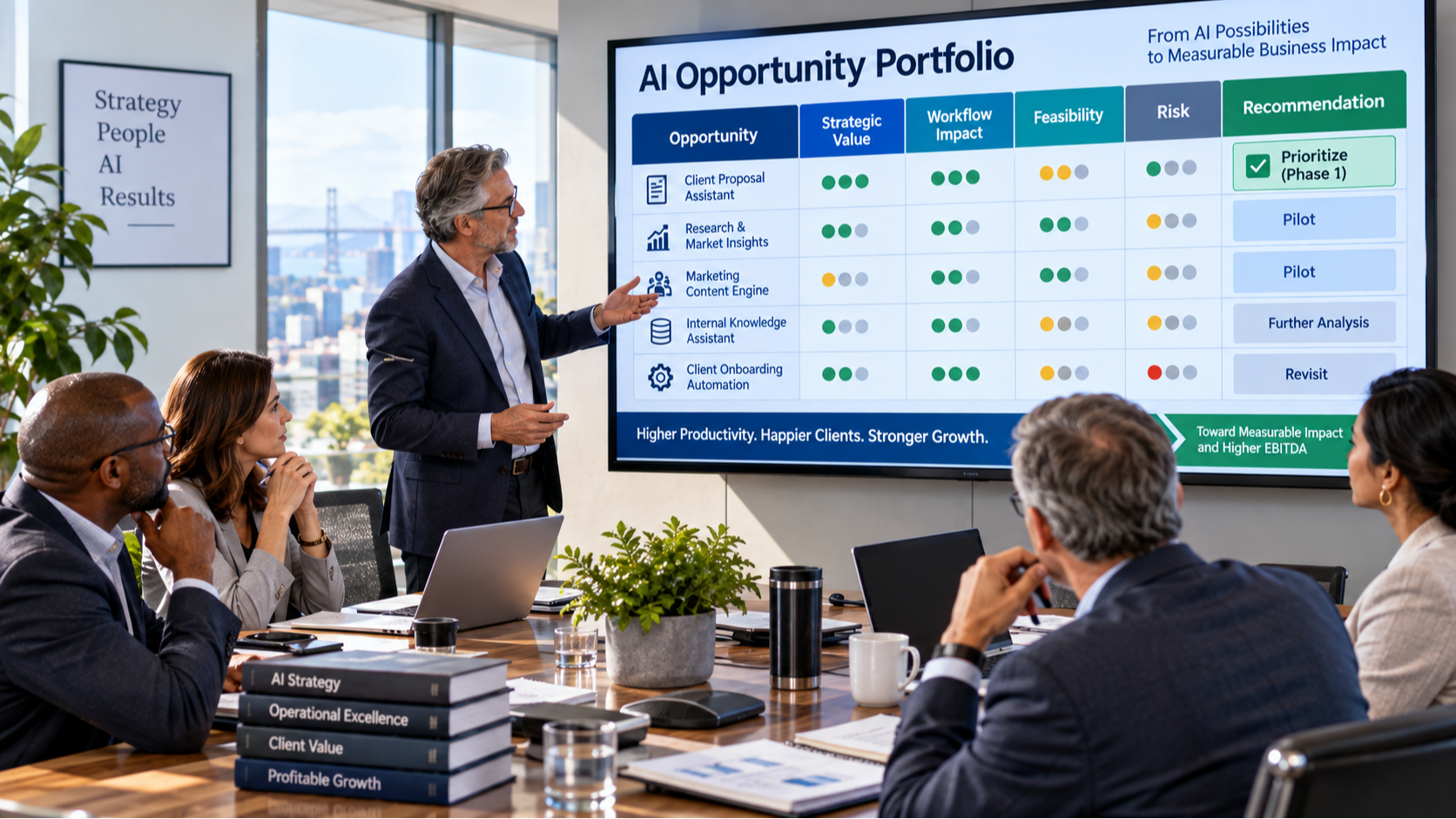
The Four Pillars and the Path from Individual Productivity to Firm Performance
Go beyond summaries and email drafting. Discover how AI can empower professional knowledge, accelerate learning, sharpen thinking, boost productivity, and help firms deliver measurable business results.
Answer: What Does It Take to Achieve Peak Professional Performance with AI?
Achieving Peak Professional Performance with AI means using artificial intelligence to extend professional knowledge, accelerate learning and production, strengthen reasoning and decisions, and drive measurable strategic improvements.
This takes more than learning a few simple prompts. You and your firm need to learn new methods, new ways to approach your work, and how to work with AI as a partner.
TL;DR: Takeaways
The essentials for building Peak Professional Performance:
- AI empowers professional knowledge. It helps professionals learn faster, explore unfamiliar subjects, brainstorm, analyze problems, challenge assumptions, and improve decisions.
- Four pillars organize AI opportunities. The four pillars, Business Building, Professional Productivity, Professional Thinking, and Firm Performance, provide a practical framework for building and developing AI capabilities.
- AI should improve workflow, not just generate content. Some of AI's greatest value comes from automating repetitive processes and breaking through workflow bottlenecks.
- Professional judgment remains essential. AI can produce convincing errors, so verification, critical thinking, and human accountability are necessary.
- Individual improvements can become a firm’s advantage. To gain the greatest contribution to EBITDA and competitive advantage, firms need to align AI improvements with the workflows that drive departmental goals and strategic objectives.
- CTS provides two complementary approaches. AI for Peak Professional Performance strengthens professional thinking and productivity. ADVIS – the AI Implementation and Integration Framework - aligns AI performance with strategic objectives and scales AI systems throughout the firm.
What It Means: What Is Peak Professional Performance with AI?
AI builds Peak Professional Performance by consistently producing more valuable professional work by combining human knowledge, experience, creativity, and judgment with AI-capabilities – the two, professional and AI, work together to accelerate production and create greater value.
This is not simply about doing the same work faster. It means expanding what professionals accomplish.
For example, AI can help a consultant investigate unfamiliar industries, brainstorm alternate solutions for a client's issues, challenge recommendations, and structure defensible decisions.
AI systems can help a manager explore alternatives, identify risks, rehearse difficult conversations, and evaluate different courses of action.
It can help a professional team transform meeting discussions into verified decisions, assigned responsibilities, and coordinated action.
The important shift is from using AI to draft content to using AI to think and create better.
At Critical to Success, we organize this opportunity around four reinforcing pillars: Business Building, Professional Productivity, Professional Thinking, and Firm Performance.
The first three strengthen professional capabilities and how they're applied. The fourth, Firm Performance, connects the other three to measurably impact the firm’s performance. All four reinforce one another.
For firms, the ADVIS - AI Implementation & Integration Framework™ provides a systematic way of aligning AI improvements with strategic objectives.
Opportunities: AI Can Help Professionals Perform at Much Higher Levels
For years, professionals have relied on their knowledge, experience, analytical abilities, and judgment to deliver value. Now we have a power tool for our minds.
Yes, you can work faster, but it’s far more important to learn how to work better.
Artificial intelligence offers significantly more than traditional productivity software. With AI you can:
- Interact with information
- Explore ideas
- Question assumptions
- Analyze alternatives
- And develop client solutions and products through iterative conversations
AI gives you the power to extend your knowledge and accelerate your intellectual work.
When you learn how to use it correctly it’s like a mentor and assistant who can both help you with repetitive, mundane work and simultaneously give you insights into problems you might have missed, investigate unfamiliar topics, challenge proposed solutions, and improve the detail and clarity of your recommendations.
I’ve been using ChatGPT since its release and I’ve been training it for the last two years. I now consider it both an assistant and a guide. It’s done far more than increase productivity. It’s increased my ability to solve problems, develop new work, and learn new domains.
Consider a consultant evaluating why a client's customer retention has declined. (This is one of the cases we use in one of our professional workshops.)
A conventional use of AI might be to summarize customer feedback or draft a competitive report. That can save time.
A second, and far more valuable approach is to use AI throughout your feedback investigation and analysis:
- Clarify the business problem
- Formulate questions
- Identify possible causes
- Research and validate relevant evidence
- Challenge competing explanations
- Develop recommendations
This second approach improves your professional ability to investigate and solve problems -not merely produce documents, reports, and emails faster.
The difference between increased productivity and increased ability and intellectual power is central to Peak Professional Performance.
The Four Pillars of Peak Professional Performance
Critical to Success organizes AI-enabled professional improvement around four connected pillars.
These pillars build a base of practical professional ability upward to organizational performance. Each pillar strengthens the others, and improved professional thinking contributes to every pillar.
The four pillars we help professionals and firms develop are:
- Business Building
- Professional Productivity
- Professional Thinking
- Firm Performance
Pillar 1: Business Building
Use AI to identify opportunities, attract and develop clients, strengthen relationships, and grow business.
Business development depends on understanding customers, markets, competitors, changing conditions, and the problems people are willing to pay to solve.
AI can help professionals do deep research into prospective clients, investigate industry developments, discover opportunities, prepare for sales conversations, and improve proposals.
For example, an independent consultant can use AI-assisted deep research to investigate a target industry, develop critical questions, and identify important business issues and opportunities.
The objective is not to use AI to generate more generic sales messages.
As a professional you should be using AI to develop a better understanding of prospective clients and initiate more valuable conversations.
Value: Better-informed business development, more relevant client conversations, stronger proposals, and improved growth opportunities.
Pillar 2: Professional Productivity
Improve the efficiency, quality, consistency, and value of professional work.
Professional productivity takes far more than completing tasks faster.
Consider the activities that consume a professional's day: preparing for meetings, reviewing information, writing reports, coordinating projects, creating presentations, communicating decisions, and following up on commitments.
AI can assist with these activities, but its greatest value often comes from improving the entire work process.
For example, an AI-generated meeting summary is useful. If fact, that comes standard with most AI-augmented meeting tools, like Zoom. However, a repeatable process that converts meeting information into verified decisions, assigned actions, deadlines, and follow-up communications is considerably more valuable.
The first produces information. The second helps professionals and teams act on it and drive results.
Value: Less routine effort, more consistent work, fewer overlooked responsibilities, and greater capacity for higher-value activities.
Pillar 3: Professional Thinking
Stronger deeper research, analysis, reasoning, creativity, critique, and professional judgment.
This may be one of AI's most important opportunities for knowledge professionals.
AI can serve as an interactive thinking partner, helping professionals explore unfamiliar subjects, generating ideas, questioning assumptions, comparing alternatives, and identifying weaknesses in reasoning and solutions.
It can support brainstorming when new possibilities are needed and critique ideas when they need to be tested.
For example, a management consultant preparing a strategic recommendation might ask AI to generate alternative explanations for a business problem, identify evidence that could disprove a proposed conclusion, or challenge the recommendation from a skeptical executive's perspective.
A Red Team/Blue Team exercise can extend this process. One AI perspective develops and defends a proposal while another AI perspective deliberately challenges its assumptions, evidence, and risks.
Using AI like this does not take your professional judgement and experience out of the equation. Using AI like this is like having a roomful of colleagues all developing and critiquing solutions. Your professional judgement and experience in the real world is what keeps the solutions real, valuable, and in line.
Your professional judgement is critical to success. But now with AI you have more alternatives, deeper analysis, and critiques from more points of view. But you are still in control of the solution.
Value: Better questions, stronger analysis, more creative alternatives, more defensible recommendations, and improved decisions.
Pillar 4: Firm Performance
Integrate professional capabilities across people, teams, and workflows to measurably improve strategic performance.
An organization does not automatically improve simply because employees become proficient with AI tools.
Poorly implemented AI has produced many stories of AI Pilot Purgatory – unaligned islands of productivity that produce no measurable impact on a firm’s objectives.
There is a time and place for individual and team AI implementation, for example, developing AI Champions and testing select AI pilots. But it needs to be orchestrated to produce a bigger outcome.
Individual improvements must be connected to shared practices, workflow requirements, department and domain goals, and strategic objectives.
Imagine several consultants independently using AI to improve client research.
Each may become more productive. But improving one bottleneck in a workflow does not improve total throughput if there are other bottlenecks. This is a basic concept in the Theory of Constraints.
Another issue is that learning and improvements in an AI system aren’t shared throughout the firm when one professional improves but doesn’t share the knowledge or when others are using a different AI system on the same problem. Individual effort should be rewarded but it needs to be orchestrated.
Firms need to align their AI systems and workflow optimization with strategic and Big Bet objectives, they need to share Best Practices across domains, set and manage governance, data, and risk, and target firm-wide KPIs or OKRs.
When leaders orchestrate peak professionals using AI they can produce a symphony. Left to play their own tunes it can become a cacophony. (It’s corny, but it’s an apt metaphor! That was the image that came to my mind.)
Value: Strategic impact, quality brand and client relationships, reliable workflows, quality deliverables, and increased capacity.
AI Empowering Professional Knowledge: Beyond Summaries and Drafting Emails
Many professionals start with simple AI tasks: summarizing documents, drafting messages, or rewriting content.
That’s a start, but it’s only a small part of AI's potential.
The bigger opportunity is empowering and accelerating professional knowledge.
Knowledge empowerment means using AI to extend your ability to investigate, understand, analyze, create, and evaluate ideas.
Acceleration means helping you produce results faster and more efficiently without abandoning quality controls.
Here are several ways this can work.
Accelerating research and learning. A professional entering an unfamiliar industry can use AI to organize a research plan, identify important questions, explain unfamiliar concepts, and compare evidence. You can even create Anki cards and timed refreshers to help you remember new terms and concepts. Of course, you’ll want to use one of the AI validation methods to ensure your data is valid.
Expanding creativity and brainstorming. AI can generate alternative approaches to a client problem, explore possibilities you might otherwise overlook, and help refine promising ideas. You can even ask for pros and cons or alternative points of view on the options.
Improving analytical thinking. AI can help structure complex questions, identify relationships, compare explanations, and apply analytical frameworks. As a professional, you must use your judgment and experience to determine whether the chosen framework and evidence are appropriate.
Challenging conclusions. AI can critique a proposal, expose unsupported assumptions, develop counterarguments, or simulate different stakeholder perspectives. Another method we teach is to give AI a list of weighted criteria. It can then provide weightings for different conclusions.
Strengthening decisions. AI can help organize alternatives, evaluate criteria, risks, tradeoffs, and uncertainties so decision-makers can exercise better-informed judgment.
Improving professional deliverables. You can combine research, analysis, critique, and communication to create stronger reports, proposals, presentations, and recommendations. You can create your own identity branding or use industry-standard formats, such as a McKinsey & Co. report format.
These capabilities are especially valuable when you combine them, from initial deep research to the final report and presentation.
A professional might begin with research, develop competing explanations, analyze the findings, challenge them, and produce an executive recommendation. Each activity contributes to the quality of the final result.
The goal is not to make AI perform every step independently. The goal is to strengthen your ability to direct, evaluate, and improve the work.
From Isolated Prompts to Repeatable Professional Capabilities
A key difference exists between using an AI tool occasionally and developing a repeatable professional capability.
Suppose you ask AI:
Summarize this client meeting.
You receive a summary. That may be helpful, but the process ends with a document.
With little effort and the help of AI you can produce a more powerful result.
You capture the meeting, identify decisions, extract action items, verify responsibilities and deadlines, prepare follow-up communications, and check that commitments are completed.
AI may assist at several stages. People remain responsible for confirming accuracy and following through.
This is a repeatable professional process rather than an isolated prompt.
The same principle applies to research, business development, consulting analysis, proposal preparation, and many other activities.
A useful professional AI capability typically combines a clear objective, appropriate information, a repeatable method, AI assistance, professional review, and a way to evaluate the result.
As these capabilities become more reliable, professionals can reuse and combine them in increasingly sophisticated work.
How to Start Using AI to Do Better Work
As a solo professional or professional within a firm, you don’t need to redesign your entire job to begin improving your performance with AI.
Start with one activity.
Step 1 - Pick one task. Choose something you do regularly, such as preparing a report, researching a client, or getting ready for a meeting.
Step 2 – Check with your AI leader. If you are in a firm, check with your AI leader, champion, or AI strategist to see if the firm has already developed an AI system you can use. This will keep your AI system standardized and up to date.
Step 3 - Decide what better means. Would you like to finish faster, make fewer mistakes, produce a more useful result, or explore better ideas?
Step 4 - See how you do it today. Notice how much time the activity takes and what makes the finished work good or bad.
Step 5 - Ask AI to help. Try using AI for research, brainstorming, analysis, drafting, or checking your work. Give it clear instructions and appropriate information. TALK TO AI AS THOUGH IT IS AN ASSISTANT. Tell it what you want to do and ask for its help in how to give instructions.
Step 6 - Check the results yourself. Run the prompt or agent multiple times with normal inputs, then with outliers and intentional input errors. Look for mistakes, missing information, weak reasoning, or anything that does not meet your requirements.
Step 7 - Compare the results. Did the work improve? Was it faster? Was the quality better? Did AI create additional review work? How can you improve it?
If the approach helped, consider how to make it repeatable.
Remember: Using AI is not the goal. Doing better work is the goal.
From Professionals to Teams to Firms
Peak Professional Performance begins with people, but its potential extends beyond individual work.
Professionals develop stronger capabilities and improve the quality, speed, and effectiveness of their work.
Teams combine those capabilities into shared practices, AI systems and optimized workflows, consistent methods and SOPs, coordinated activities, and reliable deliverables.
Firms define objectives and orchestrate improvements, using improved capabilities and workflows to drive strategic objectives, improve firm-wide performance, and maintain governance, manage risk, and manage data.
Progressing through these three levels is not automatic.
A professional may become more efficient without improving the performance of the larger workflow. A team may adopt AI enthusiastically without addressing its most important business problems.
Organizations therefore need to connect AI-enabled work to the outcomes they seek.
CTS expresses this relationship through a strategic performance chain:
Strategy → Department Goals → Workflows → AI Systems → Professional Capabilities → Measurable Performance
This chain helps eliminate productivity islands that don’t contribute to a firm’s EBITDA.
A firm should be able to explain not only which AI tools and systems employees use, but also which workflows are improving, why the improvement matters, and how results will be evaluated.
Don't stop with initial AI systems and workflow development - many firms forget that AI systems and optimized workflows need long-term management and maintenance to meet the performance goals you set.
Two Complementary Approaches to Peak Performance
Critical to Success brings together two complementary approaches.
AI for Peak Professional Performance
Enhanced professional thinking and productivity.
Critical to Success works with the AI team to deliver AI workshops to professionals, staff, and leadership. Workshops are built around the AI systems and workflows in your firm. AI training often covers concepts and keystrokes that are quickly forgotten and ineffective. Workshops develop the capabilities needed to research, learn, analyze, solve problems, communicate, and produce higher-quality work with AI.
Peak Professional Performance focuses on strengthening what professionals accomplish.
ADVIS — AI Implementation/Integration Framework
Aligning AI performance with strategic and Big Bet objectives.
The ADVIS Implementation/Integration Framework™ provides a disciplined, best-practice approach to aligning AI opportunities with key business goals, improving workflows, testing solutions, implementing changes, and scaling measurable results.
The framework consists of five phases.
ADVIS: ALIGN → DIAGNOSE → VALIDATE → IMPLEMENT → SCALE
We will examine the framework in a dedicated upcoming issue.
The essential distinction is:
Peak Professional Performance develops professional capabilities;
ADVIS integrates those capabilities into measurable business performance.
Both approaches can strengthen all four pillars: Business Building, Professional Productivity, Professional Thinking, and Firm Performance.
AI Benefits, Limitations, and Responsible Use
AI can create substantial opportunities for professionals, but its limitations are important.
Faster answers and products are not necessarily better or more accurate. Your professional experience and judgment are paramount.
AI-generated responses may contain factual errors, fabricated citations, incorrect calculations, incomplete analysis, or convincing arguments built on unsupported assumptions.
An AI system may also overlook critical context or present uncertain information with unwarranted confidence.
This means professionals, leadership, and staff must continue to exercise judgment.
Sensitive client information, confidential documents, and regulated data require particular care. Professionals should follow applicable organizational policies and verify that the tools and configurations they use are appropriate for the information involved.
For critical or frontier work, the time required to review and verify AI output must be included when you are managing projects.
Measure What Matters: Measure AI’s Result, Not AI Activity
Rather than judging success by the number of prompts written, tools adopted, or documents generated, CTS recommends evaluating whether AI improves the actual work.
Both professionals and firms need baseline operational metrics and target metrics.
Surprisingly, the AI system may take more time than the original system. This is usually not because the AI system takes longer to produce results, but because people must monitor, cross-check, and validate its output. Sometimes that review process takes longer than the original system.
In some cases, this additional time to cross-check and monitor AI results eliminates the time savings from AI’s rapid production.
Useful production measures for projects may include:
- Time required to complete a task, including review.
- Accuracy, completeness, or consistency of the finished work.
- Quality of analysis and recommendations.
- Number of errors or required revisions.
- Client or stakeholder usefulness.
- Improved workflow results compared with an appropriate baseline.
These are production measures. They are not measures of contribution to the firm’s objectives.
For firms, ADVIS extends the measurement discipline to operational outcomes and strategic objectives.
Frequently Asked Questions
1. Beyond summaries and drafting emails, what are some high-value ways AI can help professionals?
AI can support research, accelerated learning, brainstorming, problem-solving, analytical reasoning, critique, decision support, and professional communication. Its value often increases when professionals combine these capabilities into repeatable methods that improve the quality of their work.
2. What professional skills can AI help me develop?
AI can help professionals practice questioning, analytical thinking, research, creative problem-solving, communication, and evaluating alternatives. AI prompts and tools, such as Gemini Notebook, can also help professionals rapidly learn new domains. AI can provide examples, simulated scenarios, critiques, and practice opportunities. However, skill development requires active participation, feedback, and independent judgment - not simply accepting AI-generated answers.
3. I've read that AI produces a lot of errors and hallucinations. How can I avoid this?
You cannot guarantee that AI will never produce an incorrect answer. You can reduce risk by supplying reliable source material, requesting citations, checking original sources, independently verifying important facts and calculations, challenging assumptions, and using qualified human review. More confident wording or sycophantic praise from AI does not make an answer more reliable. You must learn how to train your AI and put boundaries on it to prevent or reduce errors, hallucinations, and misleading praise.
4. What are the biggest mistakes professionals make when using AI?
Common mistakes include relying on AI without verification, using vague instructions, treating AI-generated content as finished professional work, sharing information inappropriately, and prioritizing speed over quality. Another mistake is using AI only for isolated tasks instead of building reusable professional capabilities. Untrained professionals often don't know how to train their AI systems to give them constructive feedback instead of sycophantic praise.
5. How should a firm or individual begin implementing AI across its teams and workflows?
Follow the ADVIS Implementation Framework.
ALIGN – Identify key strategic objectives and the objectives and workflows that drive them.
DIAGNOSE – Diagnose the workflows, metrics, and systems and use one of the pilot selection methods to select AI Pilots to evaluate. Establish ownership, governance, data quality, and risk management.
VALIDATE – Develop and test the AI system and workflow in a controlled environment, usually a single domain with skilled operators.
IMPLEMENT – Roll out the AI system and related optimized workflows to real work domains, and train the domain professionals who will use it. Use workshops rather than training courses. Workshops using real work systems, situations, and scenarios have 2X the adoption and retention rate as concept/keystroke training.
SCALE – Once the new systems are running and being managed, roll them out to additional domains where they can be used. Maintain common systems management to reduce errors and maintain agent performance.
6. How can a company measure whether its AI investments are improving business performance?
Start with a baseline for the workflow or business result the company wants to improve. Identify relevant measures and historic data, set targets using industry standards, set management and system reviews, and investigate whether and how AI contributed to the change.
Long-term evaluation and continued performance improvement are central disciplines within ADVIS.
What Comes Next?
Throughout this series of newsletters on AI professional performance, ADVIS implementation frameworks, and Best/Bad practices, we will explore practical ways you can improve your professional thinking, increase productivity, develop more clients and business, and create measurable organizational performance improvement.
Next Issue: Our next issue introduces Deeper Deep Research: How to Build a Reliable AI-Assisted Research System. Deep Research is a critical foundation for discovering niches, knowing your Ideal Client Profile, finding and developing alternative solutions, learning new domain expertise and more. It is Critical to Success.
Later newsletters will show how you can combine these foundational capabilities into practical systems for client prospecting, meeting follow-through, evidence-based SWOT analysis, proposals, and professional communications.
Each capability builds toward something more valuable than an isolated AI output: stronger professional performance.
Week by week, Critical to Success will show you how to build the thinking, skills, and AI capabilities you need to achieve
Peak Professional Performance.