Why AI Implementations Fail - and What Successful Organizations Do Differently
Aug 11, 2026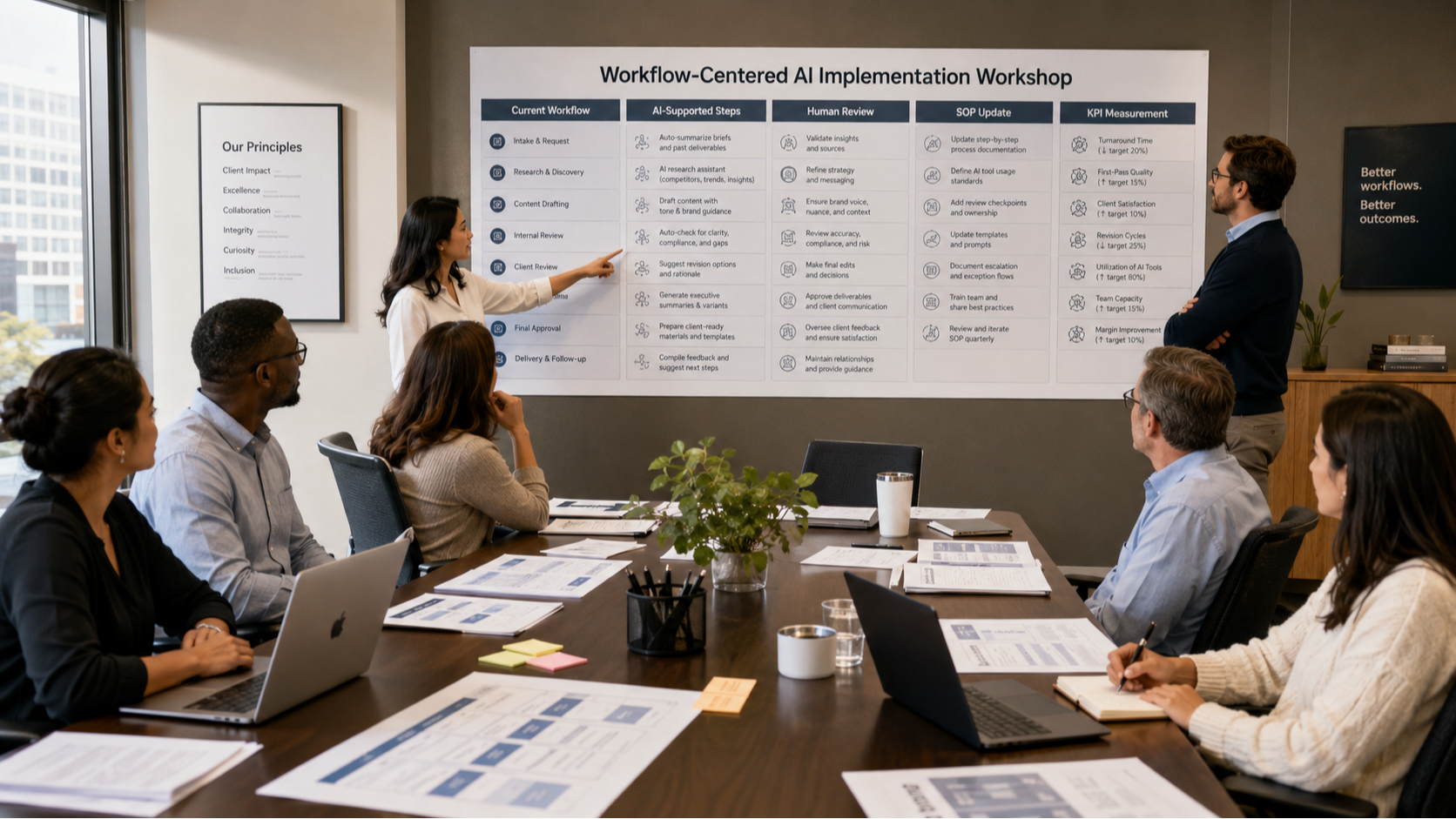
AI implementations rarely fail because of technology. They fail because organizations don’t make the strategic, workflow, and management changes that turn AI’s power into measurable performance.
- AI initiatives fail when they are not aligned with strategic objectives and workflows
- Adding an AI system to a workflow may improve a task in the workflow but fail to impact the workflow objective.
- Poor-performing tasks in workflows can cascade their bad performance throughout the workflow.
- Poorly selected use cases and AI pilots create AI Pilot Purgatory: scattered experiments, unfocused efforts, divided resources, and unmeasured results.
- Successful organizations redesign the entire workflow and orchestrate Human + AI. They don’t just automate a task.
- Successful organizations follow disciplined implementation frameworks like the CTS ADVIS Implementation Framework:
Align with strategy and objectives, Diagnose the workflow and system, Validate data and new workflows, Implement and retest within the work environment, and Scale and integrate.
AI implementations fail when organizations treat AI as a technology deployment rather than a change in how the business operates. The strongest evidence points to seven interconnected causes that can create an interconnected chain of failure points.
Similarly, research into the organizations who drive strategic success with AI systems has shows there are a few decisions and structures that are critical to the success in driving strategic performance.
This article describes the key causes of failure and success in implementing AI to drive strategic performance improvement.
Why AI Use Is Growing Faster Than AI Impact
AI adoption is no longer the primary challenge. Turning adoption into sustained business performance is.
McKinsey reported that 88% of surveyed organizations were regularly using AI in at least one business function, yet only 7% described AI as fully scaled across their organizations and 39% reported any enterprise-level EBIT impact. Deloitte likewise found that only one-quarter of surveyed organizations had moved at least 40% of their AI experiments into production, while most had not substantially redesigned jobs around AI (Deloitte, 2026; McKinsey & Company, 2025b).
Professional services show the same gap. Thomson Reuters reported rapidly increasing GenAI use while ROI measurement continued to lag adoption (Thomson Reuters Institute, 2026).
These findings do not mean AI is failing everywhere. AI can create significant gains on appropriate tasks. The problem is that task-level improvement is not the same as workflow improvement, and workflow improvement is not automatically strategic or financially valuable.
That distinction explains many apparent AI failures.
The Seven Primary Causes of AI Implementation Failure
Multiple studies have identified seven mutually reinforcing causes. These mistakes should be viewed as parts of a single business performance system rather than as seven isolated mistakes.
1. AI Is Not Aligned With a Strategic Objective, Its Workflows, and Measurable Business Value
The first and most consequential failure often occurs before an AI tool is selected. There is a failure to ask, “Why?”
An organization decides to “use AI,” “deploy Copilot,” “build an agent,” or “increase AI adoption.” Those are activities, not strategic objectives.
For AI to produce measurable bottom-line impact, the initiative must begin with an important strategic or operational objective and then connect that objective to the workflows that produce the result.
For example, a professional-services firm may want to increase profitable growth without increasing professional headcount at the same rate. AI cannot improve that objective directly. Leadership must identify the workflows that influence it—such as proposal development, client onboarding, research, engagement delivery, account management, or business development—and then determine where AI-enabled changes can improve those workflows.
The logic used to drive business performance with AI should be:
Strategic objective → critical workflow → measurable workflow improvement → business result.
BCG found that unclear connections between AI initiatives and financial outcomes remained a major barrier to impact at scale, while stronger performers were more likely to define P&L effects and establish business accountability as part of the AI implementation (Boston Consulting Group, 2026b).
Even legitimate productivity gains may fail to create economic value. A six-month field experiment across 66 firms found that employees using generative AI spent approximately two fewer hours per week on email, yet researchers found no detectable change in the overall quantity or composition of their work (Dillon et al., 2025).
The issue is not whether time was saved.
It is what the organization does with the time saved.
Does that time saved become greater client capacity, shorter delivery cycles, increased selling time, lower overtime, reduced write-offs, higher margins, or better client service?
Successful implementation therefore begins with strategic alignment, the workflows that drive the objective, measurable target, baseline measurements, value-conversion hypothesis, and an accountable owner.
2. Failure to Redesign and Integrate the End-to-End Workflow
A common mistake is inserting AI into one task while leaving the rest of the process unchanged.
AI might reduce the first draft of a client proposal from three hours to 30 minutes. But the complete workflow still includes research, verification, pricing, review, approvals, revisions, and client-specific customization. If the AI output increases correction or review effort, the overall process may improve very little.
McKinsey found that fundamental workflow redesign was the organizational characteristic most strongly associated with self-reported EBIT impact among the attributes it examined (McKinsey & Company, 2025a).
Workflow redesign requires decisions such as:
What should AI prepare? What must a human verify? Which sources may it use? When should exceptions be escalated? How does output enter the system of record? Who remains accountable for errors?
These are workflow questions, not prompting questions.
3. Diffuse Ownership and Weak Executive or Business Accountability
AI initiatives often involve many participants but fail to define an owner of business processes and results.
Technology selects the platform. A department proposes the use case. Legal reviews risk. HR provides training. Finance reviews economics. Users experiment.
Each function may do its job correctly while the overall initiative still fails.
Implementation requires decisions across organizational boundaries. Resources may need to move. Roles may change. Metrics may change. Old steps may need to disappear.
For a mid-sized professional services firm, the change management structure does not need to be elaborate. A practical team can include an executive sponsor, workflow owner, technical or vendor lead, quality/risk owner, and measurement owner.
The important requirement is clear accountability and decision rights.
4. Inadequate Production Data, Context, Integration, Reliability, and Evaluation
AI demonstrations often work under controlled conditions.
Production runs in the real world and all its variations and chaos.
Real work includes incomplete files, outdated information, inconsistent terminology, client-specific requirements, permission restrictions, confidential data, edge cases, and multiple systems.
A system that performs well in a demonstration may fail under normal operating conditions.
Data readiness does not require every firm to undertake a massive enterprise data project. It does require the selected workflow to have sufficiently reliable source information, appropriate permissions, known gaps, representative test cases, and a process for correcting errors.
AI also must be evaluated against the actual work it will perform in a real-work environtment, not against an ideal demonstration or generic benchmark. The performance will vary by task, user, context, and workflow.
5. Weak Measurement, Feedback, Learning, and Stop-or-Scale Discipline
An impressive pilot is not proof of successful implementation.
Users may like the tool. Executives may see compelling demonstrations. Employees may report time savings.
Those results are not business impact.
A credible measurement system examines several levels:
Task: Did AI improve speed or quality?
Workflow: Did the complete process improve after review, corrections, exceptions, and handoffs?
Business: Did the improvement create capacity, revenue, margin, quality, client value, or lower risk?
Strategic: Did the improvement materially advance the objective that justified the initiative?
Economic: Did the benefits exceed the full costs of technology, implementation, training, governance, maintenance, and human review?
Successful organizations also build feedback loops and continue to evaluate, evolve, and improve. Errors and exceptions are captured. Workflow owners examine recurring problems. Systems, rules, prompts, retrieval, training, or processes are adjusted and tested again.
Implementation becomes a Continuous Learning Loop rather than a one-time deployment.
6. Insufficient Role Redesign, Incentives, Training, Trust, and Change Capacity
Teaching employees how to prompt an AI system is not the same as preparing them to work in an AI-enabled process.
People need real-work workshops that go beyond “training.” People need workshops where they are learning and doing with AI systems and workflows that simulate their real-world work.
People need to understand how their responsibilities change, how the interconnected system works, and how they can look for improvements. This incorporates:
What does AI do? What does the employee remain responsible for? What must be verified? When should AI not be used? What happens when it is wrong? How will performance be evaluated?
There are many adoption issues that workshops can cover that go beyond keystroke and concept training:
- Resistance to AI is sometimes treated as a training problem. Often it is a rational response to uncertainty.
- Professionals may be concerned about confidentiality, unreliable sources, poor context, professional liability, or changes to their roles.
- Trust is built through strong workflow design, reliable performance, appropriate controls, role-specific training, and credible leadership communication—not simply by encouraging faster adoption.
7. Pilot Proliferation and Poor Use-Case Selection
Experimentation is valuable when it has a focus and it is testing a hypothesis.
Experimentation is dangerous and a waste when it is just for demonstration, excitement, or general trials.
Organizations sometimes start dozens of pilots because they are easy, visible, or interesting. The result often becomes AI Pilot Purgatory. Resources are wasted. Training and learning are scattered and unfocused. No measurable hypotheses are being tested. As a result, few pilots receive adequate support, measurable testing, or follow-through.
How the Seven Failure Causes Become a Cascade
These seven problems don’t stay isolated. They interact and compound.
An unclear strategic objective makes it harder to identify the workflows that matter most.
Poor workflow selection makes meaningful measurement difficult.
Weak measurement makes value difficult to prove.
Without evidence of value, leadership hesitates to fund workflow redesign, integration, and training.
Poor workflow design creates future failures, additional reviews, and system failure.
Low trust reduces adoption and standardization.
The consequence is that people lose trust in the system, and the leadership sees no need to waste funds or resources on more pilots that fail to produce.
What Successful Organizations Do Differently
Success is not dependent on the AI model you choose. In fact, in 2026, the performance and capabilities of the top LLM models all began approaching a ceiling; they are all reaching the same limits.
Multiple studies by large consulting firms, such as McKinsey & Co. and Deloitte has revealed that success is dependent on using proven implementation frameworks.
Here are the factors that research shows are critical to success.
1. Align Every Initiative with a Strategic Objective and the Workflows That Drive It
Successful firms begin by asking “Why?” This is usually, “What is the strategic objective we want to improve with AI?”
Successful firms identify an important strategic or operational objective and determine which workflows most influence it. They then look for how the workflow can be improved and identify AI opportunities within those workflows.
For each initiative, they establish a strategic objective to improve, set target metrics, define the critical workflow, identify where the workflow is best improved, apply AI systems, and measure the impact.
The chain becomes:
Strategic objective → critical workflow → AI-enabled improvement → operational result → financial or strategic impact.
2. Redesign the Complete Human + AI Workflow
Successful organizations design the process as a system.
They determine what AI does, what people do, where professional judgment is required, what must be verified, how exceptions are handled, and where accountability remains human.
They optimize the workflow, not one automated step at a time.
3. Concentrate Resources on a Limited Portfolio of High-Value Workflows
Instead of funding dozens of disconnected experiments, stronger organizations select only a few initiatives with meaningful strategic and economic potential.
Limiting the portfolio gives each initiative enough management attention, workflow redesign, technical support, and change management to have a realistic chance of succeeding.
4. Establish Clear Executive, Business, Technical, Quality, and Measurement Accountability
Strong organizations make ownership explicit.
Business leaders own business results. Technical leaders own system reliability. Quality and risk leaders define required controls. Measurement owners protect the integrity of performance and value calculations.
Critical responsibilities are not left out between departments.
5. Build Production-Ready Data, Context, Integration, Evaluation, and Monitoring
Successful organizations do not confuse a successful demonstration or pilot with operational readiness.
They test AI against representative work in real work environments with real information, real exceptions, and real quality requirements.
6. Measure Workflow Performance and Business-Value Conversion
High-performing organizations do not confuse “hours saved” or “AI usage” with strategic impact.
They determine whether the full workflow improved, whether the improvement advanced the strategic objective, and whether the operational gain produced measurable economic or strategic value. They go from AI to ROI, not AI to Activity.
7. Use Real, Work Environment Training, Incentives, Communication, and Feedback
Training is far more than AI keystrokes and concepts.
Workshops that simulate AI systems in a real-work environment with their teams are far more effective at implementation, retention, and adoption.
Professionals and staff learn what good output looks like, what they must verify, what unacceptable output looks like, when to escalate, and how to report and repair problems.
Leaders learn they must use new management approaches, including human-AI collaboration.
8. Embed Governance and Human Review Before Scaling
Governance is not added after an AI system becomes successful.
Quality standards, confidentiality requirements, human reviews, escalation rules, monitoring, and accountability are built into the workflow before scale.
NIST's Generative AI Profile likewise treats trustworthiness as part of the design, evaluation, operation, and monitoring of AI systems rather than an afterthought (Autio et al., 2024).
Success Also Creates a Cascade
The same reinforcing effects that drive failure can work to reinforce success. The self-reinforcing chain of success flows like this:
- A clear strategic objective identifies the most important workflows.
- Better workflow selection makes it easier to define use cases, pilots, and target KPIs.
- Well-defined workflows clarify human and AI responsibilities.
- Clear responsibilities make training and decisions easier.
- Workshops based on real-work improve training performance, teamwork, and retention.
- Stronger evidence with defined targets makes the scale-or-stop decision easier.
Successful AI implementation is not a single event. It is a sequence of connected decisions and results that build and reinforce success.
Professional-Service Firms Need a Disciplined AI Implementation Framework
The causes of failure in implementing AI in professional-service firms can be like the connecting fibers in a spider's web. There are rarely single points of failure and multiple points of failure are difficult to identify.
That is just one reason that professional service firms benefit from a disciplined AI implementation framework when they build their AI systems.
Critical to Success uses the ADVIS AI Implementation Framework™—Align, Diagnose, Validate, Implement, and Scale.
ADVIS begins by aligning AI initiatives with strategic objectives and the workflows that impact those objectives. It addresses the data and operating conditions required for the selected workflow, diagnoses and validates the proposed human+AI system before broad deployment, implements AI systems in real work with clear ownership and controls, and scales only after there is evidence that the system is reliable, adopted, governed, and creating measurable value.
A disciplined framework must also reveal when an AI initiative should not proceed.
An AI initiative may be stopped, redesigned, or returned to an earlier stage when the evidence shows that the economics, workflow, data, quality, risk, or operating conditions do not support further investment.
Identifying clear stop points is a strength, not a failure.
The objective is not to implement more AI.
It is to implement the right AI systems, in the right workflows, for the right strategic reasons - and produce evidence that they create measurable business impact.
What Leaders Should Ask Before the Next AI Initiative
The question should not be:
“Where else can we use AI?”
A better question is:
“Which strategic objective are we trying to improve, which workflows drive that objective, how must those workflows change, and what evidence will prove that AI created measurable value?”
That shift moves AI from experimentation toward implementation.
Organizations that succeed with AI look beyond LLMs and prompts. They align AI with strategy, improve the workflows that drive strategic performance, establish ownership, prepare the operating environment, develop people, measure results, learn from evidence, and scale deliberately.
Professional-service firms should bring those activities together through a disciplined implementation methodology rather than manage them as isolated projects.
AI technology creates the capability.
A proven implementation framework helps the organization turn that capability into business results.
Frequently Asked Questions
Why should a professional-services firm use an AI implementation framework?
Because AI implementation involves interconnected decisions in areas such as strategy, workflows, governance, risk, data, measurement, human + AI orchestration, and scaling. A disciplined framework reduces the risk that critical decisions and structures are skipped or addressed only after problems appear.
Why do AI implementations fail?
AI implementations most often fail because organizations do not connect the technology to a strategic and measurable business objective, and they often fail to redesign the workflows, responsibilities, data, controls, measurement, and operating model that is required for strategic performance improvement.
Is it accurate to say that 95% of AI projects fail?
The often reported 95% AI-project failure rate is NOT supported by sufficiently strong evidence. The widely reported figure comes from preliminary MIT NANDA research with methodological limitations and is more appropriately treated as evidence of a serious pilot-to-value gap rather than a universal failure rate. However, AI failure rates continue to show significantly high failure rates for the causes discussed above.
Why is workflow redesign so important?
AI usually changes only part of a business process. Overall performance still depends on handoffs, approvals, data, human review, exceptions, incentives, quality controls, and decision rights. These elements must work together if AI is expected to improve end-to-end performance.
When should an AI implementation be scaled?
Scale after the AI system demonstrates repeatable performance in a normal operating environment, meets required quality and risk thresholds, has clear ownership, and produces credible evidence of strategic, operational, or economic benefit. The ADVIS Implementation Framework™ identifies multiple criteria for developing a strong, lasting AI system that will drive strategic performance.
Citations
Autio, C., Schwartz, R., Dunietz, J., Jain, S., Stanley, M., Tabassi, E., Hall, P., & Roberts, K. (2024). Artificial intelligence risk management framework: Generative artificial intelligence profile (NIST AI 600-1). National Institute of Standards and Technology. https://doi.org/10.6028/NIST.AI.600-1
Boston Consulting Group. (2026a). As AI investments surge, CEOs take the lead: BCG AI Radar 2026. https://www.bcg.com/publications/2026/as-ai-investments-surge-ceos-take-the-lead
Boston Consulting Group. (2026b). CEOs are starting to see value from AI. Now comes execution. https://www.bcg.com/publications/2026/how-ceos-scale-ai-value
Deloitte. (2026). State of AI in the enterprise: The untapped edge. https://www.deloitte.com/us/en/what-we-do/capabilities/applied-artificial-intelligence/content/state-of-ai-in-the-enterprise.html
Dillon, E. W., Jaffe, S., Immorlica, N., & Stanton, C. T. (2025). Shifting work patterns with generative AI (NBER Working Paper No. 33795). National Bureau of Economic Research. https://doi.org/10.3386/w33795
McKinsey & Company. (2025a). The state of AI: How organizations are rewiring to capture value. https://www.mckinsey.com/capabilities/quantumblack/our-insights/the-state-of-ai-how-organizations-are-rewiring-to-capture-value
McKinsey & Company. (2025b). The state of AI in 2025: Agents, innovation, and transformation. https://www.mckinsey.com/capabilities/quantumblack/our-insights/the-state-of-ai
Thomson Reuters Institute. (2026). 2026 AI in professional services report. https://www.thomsonreuters.com/en/reports/2026-ai-in-professional-services-report