IMPLEMENT
Implement Turns AI Pilots into Operational Systems
IMPLEMENT: Implementing AI into a Professional Firm
Most professional service firms are not short on AI ideas, experiments, and pilots.
They are short on AI implementation that works.
Their teams are experimenting. Their employees are prompting. Their managers are watching demos. Their departments are testing copilots, assistants, research tools, workflow automation, and early-stage agents. In many firms, AI usage has spread far enough that leaders can honestly say, “We are using AI.”
But their operating model has barely changed.
Projects still move through the same bottlenecks. Proposals still require too much senior review. Research still takes too long to synthesize. Marketing teams still struggle to turn insight into campaigns. Client onboarding still depends on scattered documents and tribal knowledge. Delivery quality still varies by team. Knowledge remains buried in files, inboxes, project folders, and individual experience.
AI may be saving individuals time, but the firm itself does not yet perform differently.
That is the difference between AI adoption and AI implementation.
Adoption means people are using AI. Implementation means AI has been embedded into the way the firm actually works.
For professional-service firms, this distinction between adoption and implementation is becoming critical.
Professional service firms compete through expertise, trust, speed, judgment, client insight, and repeatable delivery. If AI remains a personal productivity tool, it may help individuals move faster. But if AI is aligned and implemented correctly, it can change how the firm creates value.
Quick Answer
What is the IMPLEMENT Stage?
In the IMPLEMENTATION stage of the CTS AXIS Framework™, professional service firms embed AI systems that have passed the XAMINE stage into real operational workflows. The IMPLEMENT stage implements AI throughout the firm.
In this stage the firm redesigns how work is done. It is far more than just layering AI tools on top of existing processes.
Successful AI implementation includes:
- Redesigning workflows around Human + AI collaboration
- Converting validated pilots into operational processes
- Creating reusable prompt systems, AI assistants, agents, and knowledge repositories
- Assigning workflow ownership, reviewing responsibility, and accountability
- Managing governance, risk, and data quality
- Monitoring metrics at check points and improving the AI system
The IMPLEMENT stage of the CTS AXIS Framework™ helps professional service firms move beyond experimentation and turn AI into a disciplined operational capability.
TL;DR
Take Aways
- In the IMPLEMENT stage AI systems move from pilots into real workflows. Professionals and staff upskill with workshops that use AI in real business operations - AI becomes a key part of the firm’s operating model.
- IMPLEMENT prepares the firm to SCALE by integrating AI workflows into the firm’s operating model, creating a culture of AI adoption and use, and proving that AI improves the firm’s business and client services.
- Professional service firms often fail at implementation because they add AI tools to old workflows and train people on AI keystroke skills instead of AI operations. The IMPLEMENT stage prevents these failures.
- Real implementation begins with validated workflows from XAMINE, not random tools or scattered experiments.
- Successful implementation requires workflow ownership, Human-In-The-Loop review, data protection, adoption support, and measurable KPIs.
- AI workshops for departments and functional teams bring every user onboard by upskilling and applying AI to real work, not by watching generic software demonstrations.
Why This Matters
Why the IMPLEMENT Stage Matters
Why the IMPLEMENT Stage Matters
The IMPLEMENT stage of the CTS AXIS Implementation Framework™ exists for one reason – to ensure that AI is implemented effectively in your firm.
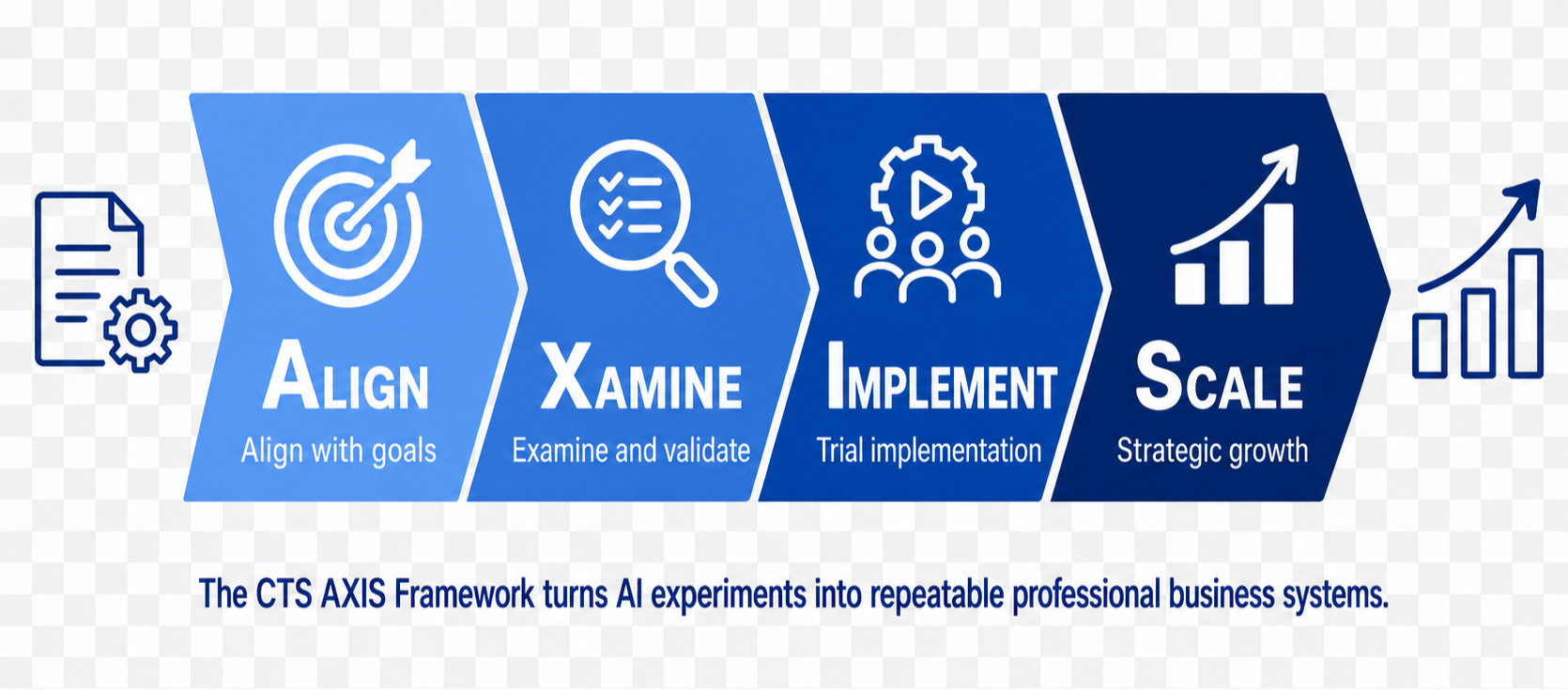
Critical to Success defines the CTS AXIS Implementation Framework™ as a practical framework for moving firms from experimentation to scalable AI-enabled operating systems. The word AXIS represents the four stages in creating an AI-driven operating model,
- ALIGN aligns AI with strategic objectives, Big Bets, workflows, data systems, and high-value opportunities.
- XAMINE validates workflows, data quality, use cases, pilots, and proof-of-value.
- IMPLEMENT turns validated AI opportunities into working operational systems.
- SCALE expands proven systems across the firm and continuously improves them.
The IMPLEMENT stage creates operational systems, and management and staff skills that impact the operating model of your professional service firm.
Implementation is where many firms fail.
They do not fail because AI is weak. They fail because they attempt to implement AI into workflows that aren’t ready, using fragmented data with weak ownership, inconsistent review standards, and poorly defined operating processes.
The IMPLEMENT stage must be treated as an operating-model stage, not a software rollout. You are building a high-performance professional services firm that works best with a collaboration between people and AI.
The IMPLEMENT stage gives managers the opportunity to develop those Human – AI collaboration management skills.
The firms that win will not be the firms with the most AI licenses. The winners will be firms that successfully integrate AI - creating a collaborative Human – AI team that drives high performance.
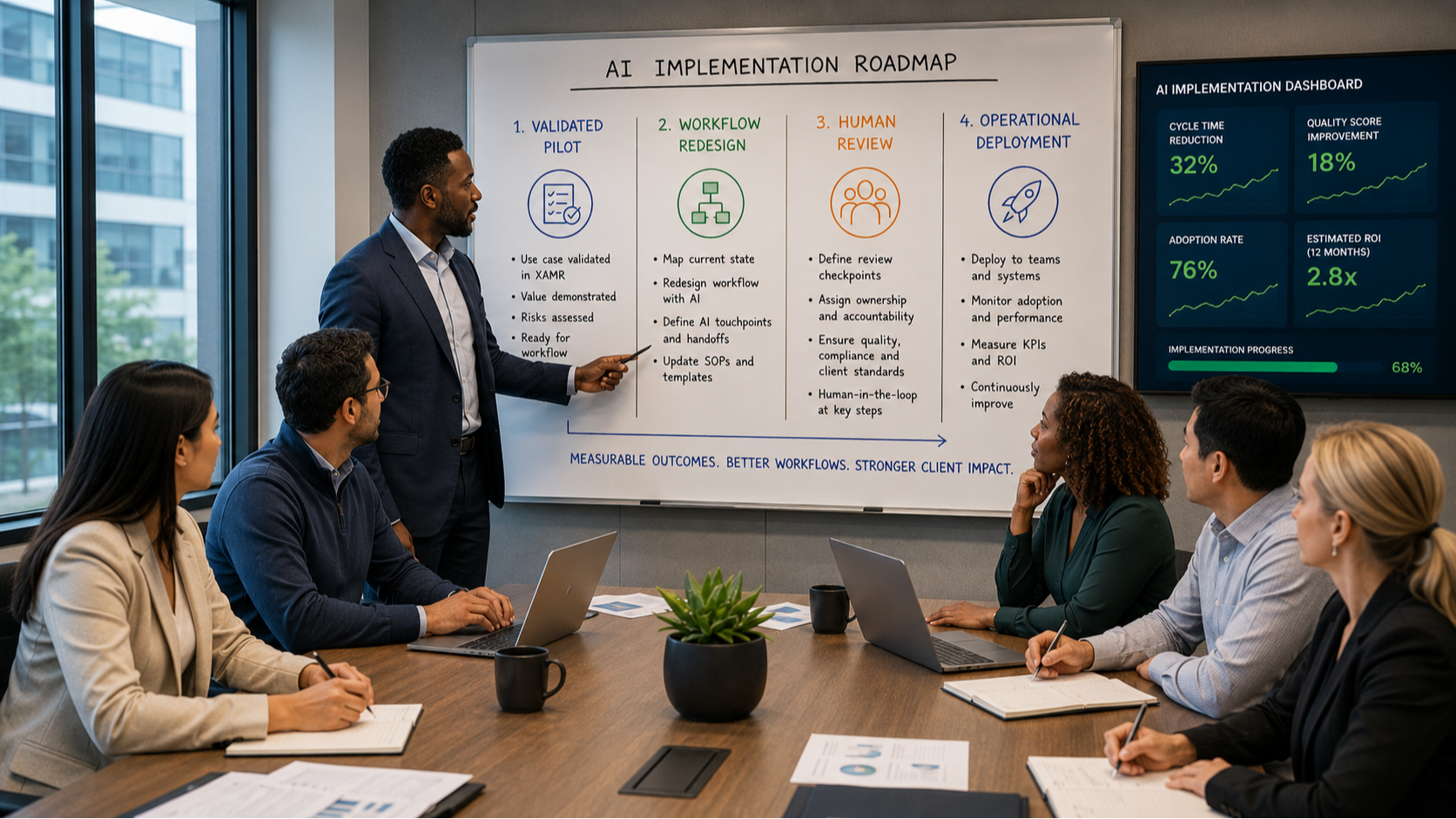
The IMPLEMENT Stage in the CTS AXIS Framework™
The CTS AXIS Framework™ helps firms avoid the most common AI implementation trap, moving too quickly from initial excitement and piloting to building the operating foundation.
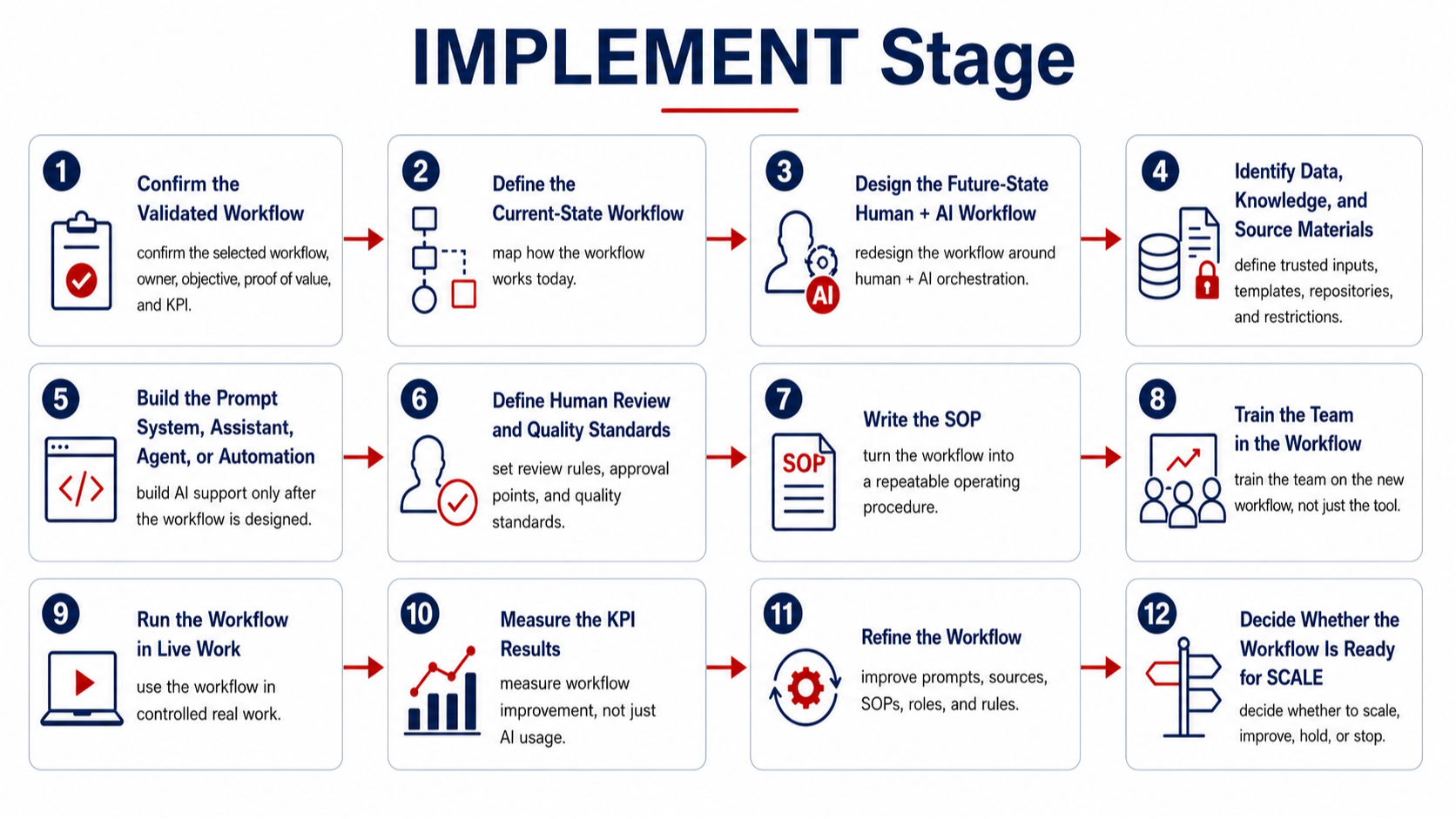
In the IMPLEMENT stage the workflow, AI optimization, and support structures are added to the firm’s operating model in a practical sequence,
- Confirm valid workflows
The firm confirms the workflows validated in the XAMINE stage. This keeps implementation focused on a validated opportunity instead of a random experiment. - Define Current-State Workflow
Map the current workflow, interview users, and look for bottlenecks - Design Future-State to include Human + AI collaboration
Redesigned the workflow around Human + AI collaboration. The team identifies where AI supports the work, where humans review, where decisions are made, and where outputs go next. - Identify Data, Knowledge, and Sources
Identify and validate sources. Create data test, management, and monitoring systems to ensure ongoing validity. Data and AI systems that have been developed and tested in the XAMINE stage may need refinement when they face the “chaos” and variety of real-world environments. - Build out and refine AI prompts, agents, and automations
Ensure AI systems operate correctly over time in real work environments and with real data. Refine for valid output at least three times. Create recheck schedule. - Define review standards
All AI data input, outputs, and metrics should be approved and reviewed on a schedule by the owner to ensure continued validity. Creeping errors can be deadly and hard to detect without disciplined monitoring. - Document SOPs
Translate the workflows into practical SOPs. Document using PDFs and video with easy access. Identify an owner responsible for updating. - Train with real AI system workshops
After basic AI training, train professionals and staff in AI implementation workshops that incorporate real workflows and data. This produces 2X greater adoption and retention. - Test in live working situations
The normal staff and professionals must use the new workflow in real work. This often reveals AI or data changes that were "managed" out in the XAMINE stage. - Track metrics
The IMPLEMENT team helps track KPIs, monitors metrics for variation, and identifies changes that must be met prior to SCALE. - Refine the workflow
Document last-minute recommendations and areas to monitor, define expected metrics and goals. Identify owners and communication in case of issues. - SCALE decisions
Make final executive decision if workflow is ready for integration and scaling.
Include governance at all stages
All AXIS stages have elements of governance to maintain data rules, risk management, security, confidentiatlity, review checkpoints, and ownership.
The stages in the AXIS framework help firms move from strategy to validation to operational deployment to scale.
IMPLEMENT is where AI begins improving the operating systems of your firm.
How Professional Firms Fail without the IMPLEMENT Stage
Even having successfully passed the XAMINE stage and being aligned with a strategic workflow or Big Bet there are many ways AI can fail as it is implemented in a professional firm. Failure in the IMPLEMENTATION stage usually follows a few recognizable patterns.
- Poor data quality and management
Data is not monitored and reverts to poor or inconsistent quality. - Tool-first thinking
Frequently, firms take a "tool-first" implementation approach. A firm selects an AI platform, agent, assistant, or automation tool before redesigning the workflow. The tool may be impressive, but the team does not know exactly where it belongs in the work system or how to integrate it. - AI pilots sheltered from the real world
Another cause is that pilots do not face the real world. A team runs a successful pilot and assumes it is ready for full deployment. But the pilot may have worked because, in earlier stages, a skilled person manually guided it. Once operation is expanded to the entire team, the workflow fails because instructions, review points, data inputs, and exception handling were never completed to include the special details. - Failure to test in a cross-functional environment
Lack of cross-functional integration is another. Marketing, consulting, operations, finance, and HR each experiment independently without a federating body. At first this feels empowering. But over time it creates tool sprawl, duplicated effort, inconsistent standards, weak governance, and poor knowledge sharing. - Lack of ownership
A lack of ownership means no one is accountable for the AI workflow's outcome. IT may own access. A department may own usage. A senior sponsor may approve the initiative. But no one owns the redesigned workflow from beginning to end. - Weak design review
Another cause is weak human review. People are told to “check the AI output,” but the firm does not define what to check, who checks it, how review is documented, and what happens when output fails. - Failure to define success
You don’t know success unless you define it. Firms implement AI before establishing baseline metrics. Later they cannot prove whether cycle time improved, quality increased, rework decreased, or margin improved.
How Successful Firms Use the IMPLEMENT Stage
High-performing firms understand that AI implementation is actually improving or building a new operating model for the firm.
High-performing firms start with validated workflows, not scattered experiments. They rely on ALIGN and XAMINE to identify strategic priorities, evaluate use cases, validate data, prove pilots and validate metrics before implementation begins.
They redesign the workflow before deploying AI tools. That means mapping the workflow, defining the AI-supported steps, clarifying the Human-In-The-Loop review, identify data inputs, and documenting the updated operating process.
They assign business ownership. A workflow owner is accountable for performance, adoption, quality, and improvement. IT may support the platform, but the business owns the outcome.
They create reusable systems. Instead of allowing every employee to invent prompts from scratch, they build shared prompt libraries, assistants, templates, repositories, and review standards.
They implement governance inside the workflow. Confidentiality, permissions, review, quality, and escalation are part of the process, not afterthoughts.
They measure what matters. They track workflow KPIs that connect to revenue, margin, productivity, quality, speed, and client value.
They learn and refine. Implementation is not complete when the system goes live. It is complete when the workflow produces repeatable improvement and the team knows how to keep improving it.
Measuring Implementation Impact
AI implementation should be measured at the workflow level.
Too often firms fall back to measuring weak, but easily accessible metrics like user activity levels.
Firms that fail primarily count actvity levels: licenses, tool usage, number of prompts created, number of employees trained, or number of AI experiments launched. These metrics may be useful as activity indicators, but they do not prove business impact.
IMPLEMENTATION KPIs must measure and improve critical metrics, usually economic metrics.
For professional-service firms, economic leverage often comes from improving the workflows that impact:
- Revenue
- Margin
- Utilization
- Client value
- Quality
- Speed
- Scalability
Some areas where professional service firms measure economic impact from AI are:
- Employee utilization - The percentage of an employee's billable time spent on billable client work.
- Gross margin - project revenue minus the cost of delivering services.
- Proposal creation - Measured by faster turnaround, better personalization, reduced senior review time, and improved win-rate support.
- Client discovery - Measured by faster synthesis, better pain-point identification, stronger issue framing, and improved client insight.
- Research and analysis - Measured by reduced research time, improved synthesis quality, faster report drafting, and better source validation.
- Marketing Operations - Measured by faster campaign creation, stronger message consistency, better conversion support, and lower content production cost.
- Client Onboarding - Measured by shorter onboarding cycle, fewer errors, clearer handoffs, and stronger client experience.
- Knowledge Retrieval - Measured by faster access to firm expertise, reduced duplicated work, and better reuse of intellectual capital.
- Client Deliverables - Measured by faster document review, improved exception detection, better consistency, and stronger professional leverage.
When you define your KPIs for a workflow, you will, of course, measure input, output, baseline, and target. But to manage your metrics and maintain consistency and governance, you also need to record the owner, data source, review frequency, and decision rubrics.
The exact metrics depend on the workflow. But the principles of what you should collect and monitor are universal.
Do not measure AI implementation by AI activity or how much it is used.
Measure the implementation by how much the workflow and strategic metrics improve.
Coordinating Cross-Functional Workflows
Most professional-service workflows involve multiple departments.
Generating a proposal may involve sales, consulting, marketing, finance, legal, and delivery leadership
A client onboarding workflow may involve business development, operations, account leadership, delivery teams, finance, and administrative support
A marketing campaign may involve strategy, content, design, sales, analytics, and executive review
This is why cross-functional coordination must be part of IMPLEMENT.
If AI is implemented only inside one department, it may improve a local task while weakening the end-to-end workflow. A marketing team may create content faster, but sales may not use it. A consulting team may generate analysis faster, but partners may not trust it. Operations may automate onboarding steps, but client-facing teams may not follow the new process. Finance may produce faster reports, but leadership may not know how to interpret them.
When you IMPLEMENT, remember, the goal is not local AI productivity. The goal is improved workflow performance.
Cross-functional coordination requires several practical decisions.
- First, the firm must identify workflow dependencies. Which teams provide inputs? Which teams approve outputs? Which teams use the final work product? Where does delay occur? Where does rework occur? Where does quality fail?
- Second, the firm must define who owns decisions. Who approves the AI-enabled workflow? Who can modify the prompt system? Who approves client-facing output? Who owns the KPI?
- Third, the firm must coordinate data access. AI workflows often require information from multiple systems or teams. Without access rules, knowledge repositories, and data standards, the workflow will remain fragmented.
- Fourth, the firm must define escalation paths. When AI output is incomplete, sensitive, inaccurate, or outside policy, the team needs to know what happens next.
This does not require heavy bureaucracy. In fact, too much bureaucracy can kill adoption. But the firm does need clear operating rules.
Cross-functional implementation is one place where professional service firms decide whether AI remains a productivity tool or it becomes a firm-wide operating capability.
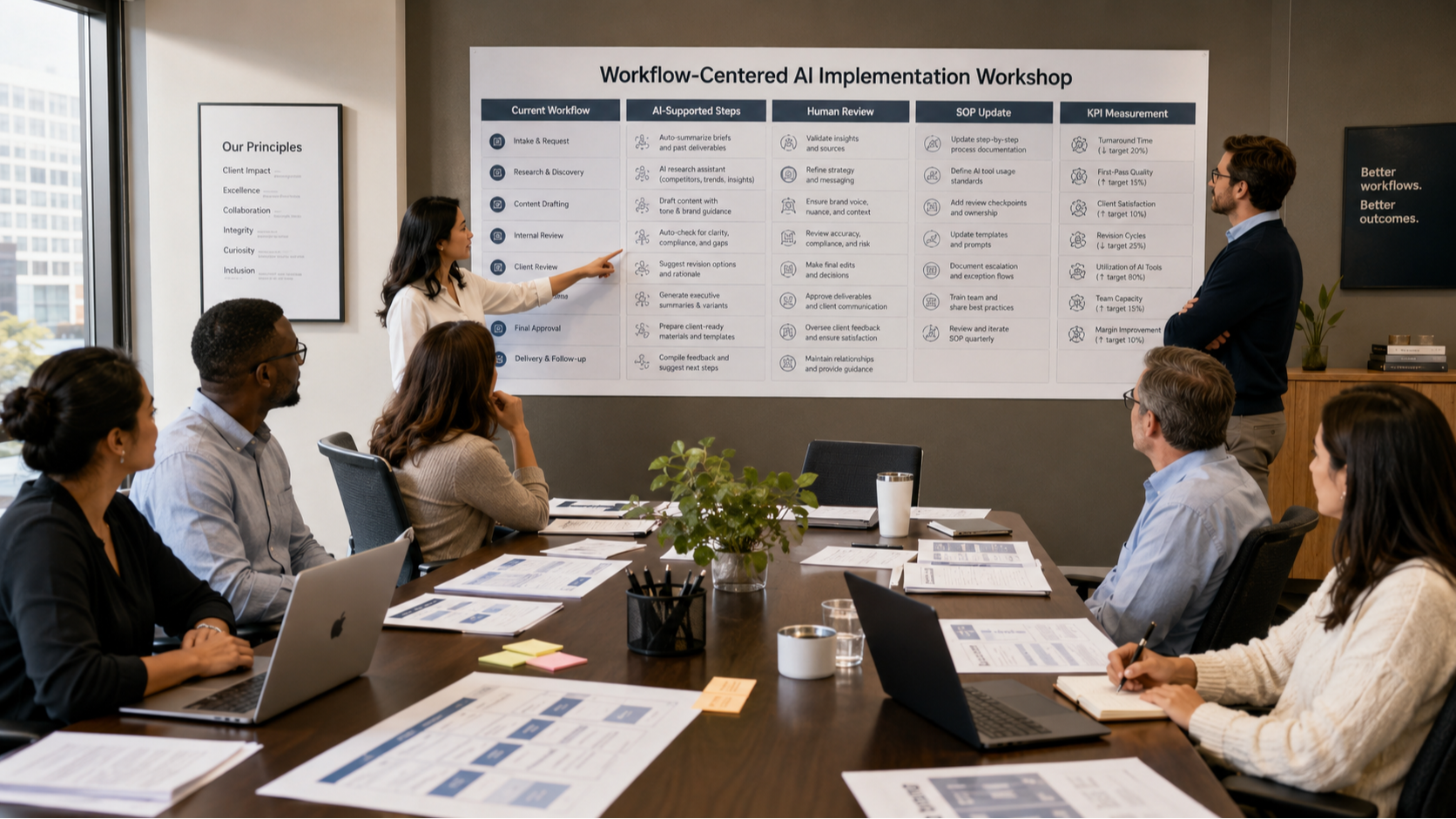
Department and Functional Integration
AI implementation usually begins at the department or workflow level before expanding across the whole firm.
This does not mean the firm should stick with islands of department-level implementation. It means AI implementation can begin at one or more department levels and then they can be integrated.
A critical workflow for your firm is any client-facing workflow. It affects trust. AI may support faster response, better personalization, and more consistent service delivery, but final accountability remains with the professional and the firm.
For example, some department-level workflows are,
Marketing Implementation
Marketing implementation might use a workflow containing,
- Niche and audience research
- Client analysis
- Content planning
- GEO/AEO content creation
- Campaign distribution
- Lead nurturing
- Services delivery
Consulting Implementation
Consulting implementation might use a workflow containing,
- Client discovery
- Market research
- Proposal development
- Project planning
- Meeting synthesis
- Analysis and issue development
- Presentation drafting
- Presentation of deliverable
Accounting and Financial Advisory Implementation
Accounting and financial advisory implementation might use a workflow containing,
- Client intake
- Document review
- Regulatory research
- Exception detection
- Advisory note drafting
- Reporting
- Client communication
HR, Recruiting, and
Staffing Implementation
HR, recruiting, and staffing implementation might involve,
- Job intake
- Candidate research
- Screening support
- Outreach
- Interview summaries
- Role-fit analysis
- Onboarding
- Internal knowledge support
Department Workshops vs Ineffective Training Courses
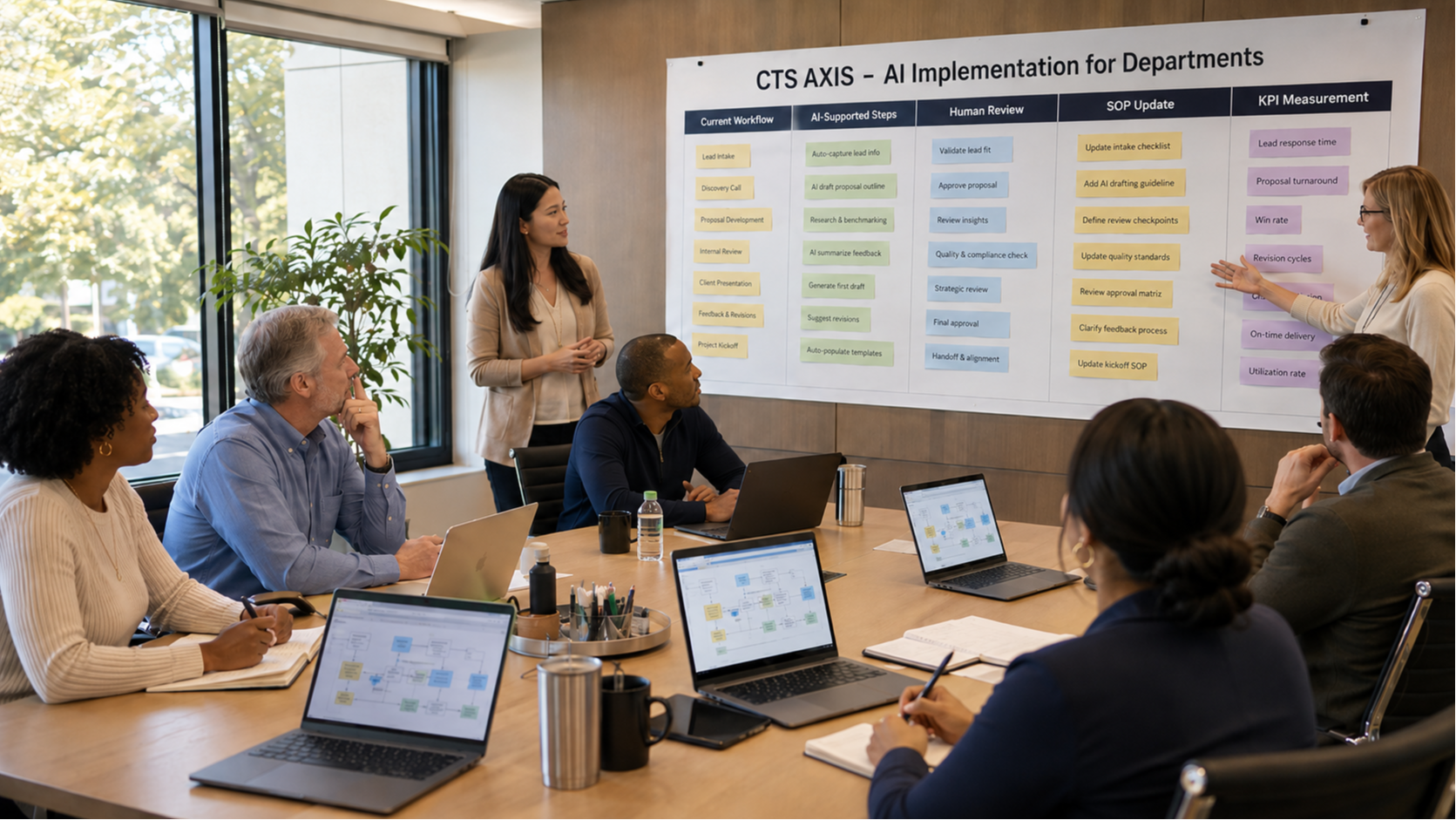
The CTS Workshop implementation training model is especially well suited to implementing and training an entire department.
Department workshops guide teams through an AI implementation process while teaching the team how to apply AXIS stages and developing their AI prompt and agent skills.
Teams do not simply learn about AI. They learn and practice with the AI systems they will be using for their departmental and functional teamwork.
This is a major point of difference from AI training.
Generic AI training often teaches features, tools, or prompting tips. That can be useful, but it rarely changes the operating model for a firm or department. An AI implementation workshop helps the team build a functional AI system while learning how to operate and improve it.
Over a hundred years of learning research has shown that people learn and retain 2X better when they learn on the systems and apply the skills they use in daily work.
At CTS, we believe strongly in workshops that rapidly get teams up to speed and making an impact.
AI Adoption by the Workforce
Adoption must also be designed into the workflow.
Training alone rarely changes behavior. People often revert to their old way of working when they are unfamiliar with a new system. That is just one of the reasons workshops using real work systems are more effective.
People adopt new systems when those systems help them do real work better, faster, or with less friction. This is why department-level implementation workshops are powerful. Teams learn by applying AI to real work, reviewing outputs together, improving AI systems, and building shared confidence.
CTS AI Implementation Workshopstm build operational AI systems and a culture that uses them.
Creating Libraries of Prompts, Agents, and Knowledge Repositories
In early stages of AI implementation most firms think only of building one-off prompts that improve a single task. For example, writing an email nurture sequence. Or drafting a proposal from notes from a client strategy session.
For true success, professional firms must move beyond one-off prompts.
One-off prompts are useful for early experimentation. They help individuals learn what AI can do. But they do not improve operations or drive strategic objectives.
A professional service firm needs reusable and shareable AI systems that can work with workflows involving multiple departments or functions.
A prompt system is a complete set of structured instructions, inputs, workflow steps, quality standards, and output formats designed for a recurring business task.
For example, a consulting research prompt system may include the AI, business context, business problem, source documents, analysis steps, assumptions, constraints, output format, risk checks, review criteria, and next steps. It is far more than just a prompt or agent.
The next layer in complexity is an AI assistant. Assistants help or “assist” a human and are configured around a role, workflow, or knowledge base. A firm might create a proposal assistant, client discovery assistant, market research assistant, onboarding assistant, content strategy assistant, or internal policy assistant.
The next layer up is an AI agent. Agents are action oriented. They perform defined sequences of work, use tools, retrieve information, update systems, summarize results, or trigger next steps. But agents also raise the implementation bar. They require well-structured and tested instructions, better data, clear permissions, human oversight, and monitoring.
Building this library to support your professional firm takes time, knowledge, and skill. You can’t start with it on day one.
When you work with Critical to Success, we help you get started with libraries that match the department or functional workshops you take. Your professionals and staff not only build their skills and implement a critical workflow in our workshops, but they also start with a library of essential prompts, agents, and contexts.
Creating a library does not require a massive knowledge architecture on day one. You can build that in the SCALE stage. But IMPLEMENT should create a practical foundation that can be expanded to include validated source documents, reusable prompt libraries, role-based assistants, workflow-specific templates, quality-review rules, and data standards.
Governance, Adoption, Accountability, and Data Protection
Governance
Governance appears at different stages across the AXIS Framework, but the IMPLEMENT stage has a specific governance responsibility.
In the IMPLEMENT stage, governance and management are not yet mature. That belongs more fully in SCALE. But the IMPLEMENT stage does need operational governance: the rules, standards, and accountability needed to deploy AI safely into real work.
Operational governance should answer practical questions:
- Who may use the AI system?
- What data may be uploaded?
- Which client information is restricted?
- What outputs require review?
- Who approves client-facing use?
- Where are prompts stored?
- Where are outputs stored?
- What happens if AI output is wrong?
- How are exceptions escalated?
- How are results measured?
Professional-service firms must be especially careful because they often handle confidential client information, proprietary methods, financial data, employee information, strategic plans, legal or regulatory issues, and sensitive business communications.
The risk is not only technical – impacting AI work and valid responses.
The biggest risks are to your client's security and your reputation and brand.
Governance and risk management is a balancing act.
A firm that implements AI without standards creates hidden risks.
But a firm that over-governs AI may slow adoption so much that teams work “covertly” around the system. The answer is practical governance designed into the workflow.
Governance in the IMPLEMENT stage should be lightweight, clear, and enforceable.
It should include,
- Approved use cases
- Restricted data categories
- Review requirements
- Client-facing approval rules
- Platform standards
- Final-output accountability
- Exception handling
- KPI reporting
Accountability
Accountability is important to ongoing reliability and improvement.
Every implemented AI workflow should have a business owner. That owner does not have to build the AI system. But they must be accountable for the workflow outcome. Without ownership, implementation drifts. With ownership, the firm can improve the workflow over time.
How IMPLEMENT Prepares the Firm for SCALE
The IMPLEMENT stage should create operational proof.
It should not try to solve every scaling problem. SCALE is where the firm expands successful workflows across departments, matures governance, standardizes systems, strengthens dashboards, develops reusable platforms, and improves performance over time.
But IMPLEMENT must prepare the firm for SCALE.
It does this by creating repeatable patterns.
A successful IMPLEMENT stage should produce:
- A redesigned workflow map
- An updated SOP
- Approved prompt systems or assistants
- Documented human review standards
- Data and confidentiality rules
- KPI baselines and targets
- Team adoption lessons
- Governance notes
- An improvement backlog
- Recommendations for improvement and reproduction
The development and assets in IMPLEMENT make AI an integral part of the firm’s operating model.
They also prepare the firm and its AI initiatives to move from isolated, successful workflows to organizational improvement across the entire firm.
That is the transition from IMPLEMENT to SCALE.
IMPLEMENT proves workflows.
SCALE expands and improves the AI system and workflows throughout the firm.
SCALE expands AI systems and workflows across departments, builds a culture of AI adoption and innovation, matures governance, and drives continuous improvement.
FAQ
Frequently Asked Questions
Why are department-level AI implementation workshops more productive?
What is AI implementation in a professional service firm?
How is AI implementation different from AI adoption?
Why do AI pilots fail to become operational systems?
What workflows should be implemented first?
What is Human + AI workflow orchestration?
How should professional service firms manage AI risk during implementation?
What KPIs should firms use for AI implementation?
How does the IMPLEMENT stage prepare the firm for SCALE?
About the Author
Ron Person is the founder of Critical to Success (CTS) and the creator of the AXIS AI Implementation Framework™. Ron guides professional service firms in using the AXIS AI Implementation Frameworktm to align AI with strategic objectives, validate and implement AI in departments and functional teams, and then SCALE AI for business impact.
He brings more than 30 years of consulting experience with Fortune 1000 and Global 1000 firms. His experience includes business strategy, digital marketing, data analytics, process improvement, and technology implementation.
Ron has authored 27 books with almost 3 million copies in print and has served as an adjunct professor in the Executive Extension at University California, Berkeley. He has an MBA Marketing/Finance, MS Physics, Black Belt Six Sigma, and is certified in Balanced Scorecard.


About Critical to Success
Critical to Success helps professional service firms implement AI to impact strategic objectives, Big Bets for the future, and workflow performance. The firm works with consultants, marketers, accountants, financial service firms, architecture firms, engineering firms, and other knowledge-based businesses that want to measurably improve strategic objectives, workflow performance, productivity, and client value.
Critical to Success developed the CTS AXIS AI Implementation Frameworktm to help firms move from random AI experimentation to structure implementation. The framework guides firms through four stages of adopting AI: Align, eXamine, Implement, and Scale.
Critical to Success provides AI advisory services, AI implementation workshops tailored to departments and functional teams, executive education, AI implementation playbooks, and development of AI solutions.
This article is part of the Critical to Success AI implementation library and is designed to help leaders move from AI experimentation to structured, measurable, and scalable AI adoption.
Editorial Note
This article is part of the Critical to Success AI implementation library. It is written for professional service firm leaders who need practical guidance on AI strategy, workflow improvement, governance, adoption, and measurable business value. Content is periodically reviewed and updated to reflect changes in AI tools, implementation practices, and the needs of professional service firms.
SOURCES
Boston Consulting Group. (2023). Biopharma’s path to value with generative AI (BCG).
https://www.bcg.com/publications/2023/biopharma-path-to-value-with-generative-ai
Boston Consulting Group. (n.d.). AI agents: What they are and their business impact (BCG).
https://www.bcg.com/capabilities/artificial-intelligence/ai-agents
Box. (2025a). AI-first transformation: Box’s principles, strategy, and execution framework (Box Blog). https://blog.box.com/ai-first-part-1
Box. (2025b). From 100 agents to strategic big bets: How Box found focus in AI deployment (Box Blog). https://blog.box.com/ai-first-part-2
Box. (2026). How AI transformation really happens (Box Blog).
https://blog.box.com/coo-ai-transformation-lessons
McKinsey & Company. (2026a). From promise to impact: How companies can measure—and realize—the full value of AI (QuantumBlack, AI by McKinsey).
https://www.mckinsey.com/capabilities/quantumblack/our-insights/from-promise-to-impact-how-companies-can-measure-and-realize-the-full-value-of-ai
McKinsey & Company. (2026b). The AI transformation manifesto (McKinsey Quarterly).
https://www.mckinsey.com/capabilities/tech-and-ai/our-insights/the-ai-transformation-manifesto