SCALE
SCALE for AI Performance Throughout Your
Professional Services Firm
SCALE: Scale AI for Learning, Optimization, and Strategic Performance
Most professional service firms do not fail at AI because their AI pilots are weak. They fail because the islands of AI productivity fail to integrate and drive strategic objectives.
At first, islands of AI productivity can look like progress. Teams are experimenting. People are learning. Executives and managers are excited by pockets of productivity. But over time, many firms develop a more serious problem:
AI chaos, often called Pilot Purgatory.
When you look at a firm where AI has grown in pockets, you can see these islands of increased productivity. But there are few strategic workflows. In fact, there are rarely inter-departmental AI workflows, and no firm-wide AI knowledge sharing.
- A marketing team builds a strong AI-assisted content workflow, but no one standardizes it or shares it with other departments.
- A consulting team creates a research assistant that saves hours, but it remains trapped within a single practice area. Other teams that could use it, like sales and support, don't even know it exists.
- A finance team improves reporting speed, but the workflow is not connected to firm-wide performance dashboards and financial data has never been integrated with marketing and production, so there is no proven operating model.
- A few AI champions become dramatically more productive, but they have no way to share their learnings. So the rest of the organization feels uncomfortable with AI and drops-back to their old ways.
The SCALE stage of the CTS AXIS Framework™ exists to solve this problem.
In the AXIS framework, SCALE is not simply “roll out more AI.” It is the stage where professional service firms turn AI from the IMPLEMENT stage into a dependable operating model that is repeatable, controllable, measurable, and continuously improving.
AI must change from scattered islands of activity to become a continent of integrated strategic assets.
Quick Answer
What is Scaling AI in a Professional Services Firm?
Professional service firms scale AI successfully when they move from isolated pilots to standardized, governed, measurable AI-enabled workflows that the firm can depend on as a strategic asset.
Scaling requires workflow replication, shared operating standards, data and knowledge governance, adoption systems, AI lifecycle management, KPI dashboards, and continuous improvement loops.
Successful AI scaling involves:
- Scaling only AI workflows that have proven measurable value
- Standardizing prompts, agents, workflows, review rules, and operating practices
- Embedding AI into SOPs, dashboards, governance, budgeting, and management cadence
- Monitoring adoption, technical performance, workflow impact, risk, cost, and ROI
- Continuously improving human + AI collaboration as business needs, data, models, and client expectations change
The firms that scale AI most effectively treat AI as a managed operating capability rather than a collection of disconnected tools.
TL;DR
SCALE is the AXIS stage where proven AI workflows become repeatable, governed, measurable operational assets.
- AI-systems should be scaled only where pilots have demonstrated strategic, operational, workflow, or financial value.
- Scaling requires validated, standardized workflows, reusable AI assets, operating standards, adoption systems, data governance, dashboards, and lifecycle management.
- Human + AI orchestration becomes more important at scale because management must supervise, refine, and improve humans and AI-enabled workflows. Humans and AI must learn to collaborate.
- Leading firms are treating AI scaling as an operating-model discipline, not a technology rollout.
- The main failure pattern is AI spreading chaotically: disconnected tools, prompts, agents, workflows, and experiments outpacing governance and measurement.
- Continuous optimization belongs inside SCALE because AI workflows must be measured, tuned, governed, and improved as the business, clients, and AI evolve.
What is Scaling AI in a Professional Services Firm?
Professional service firms scale AI successfully when they move from isolated pilots to standardized, governed, measurable AI-enabled workflows that the firm can depend on as a strategic asset.
Scaling requires workflow replication, shared operating standards, data and knowledge governance, adoption systems, AI lifecycle management, KPI dashboards, and continuous improvement loops.
Successful AI scaling involves:
- Scaling only AI workflows that have proven measurable value
- Standardizing prompts, agents, workflows, review rules, and operating practices
- Embedding AI into SOPs, dashboards, governance, budgeting, and management cadence
- Monitoring adoption, technical performance, workflow impact, risk, cost, and ROI
- Continuously improving human + AI collaboration as business needs, data, models, and client expectations change
The firms that scale AI most effectively treat AI as a managed operating capability rather than a collection of disconnected tools.
Why This Matters
Why the SCALE Stage Matters
The first wave of AI adoption inside many firms has been driven by individual initiative.
That can be useful, but it is not enough.
Early adopters discover ways to use AI to write proposals, summarize research, analyze client interviews, draft campaign plans, or review documents. These improvements may be real. Some may save hours. Some may improve quality. Some may even change client delivery economics.
But without a scaling system, these gains remain localized and do not improve a firm's capability or capacity.
The knowledge of how to use AI is lost to the firm:
- The firm does not capture learning
- The workflow is not documented
- The prompt is not validated
- The agent is not monitored
- The output quality is not benchmarked
- The data source is not governed
- The KPI impact is not measured
- The process owner is unclear
- New employees are not trained
- Other teams either reinvent the workflow or ignore it entirely
While the islands of productivity are exciting demos of possibility, it is easy to see the many failure points they can create.
AI initiatives that reach the SCALE stage should be ALIGNED with strategic or Big Bets, validated and eXAMINED, and integrated in the IMPLEMENT stage. They should be ready to become operational assets with owners, dashboards, governance, and reviews.
What are the Steps in Scaling AI?
Scaling AI turns AI systems that have been through the IMPLEMENT stage into repeatable systems that improve business performance across teams, departments, and operating units.
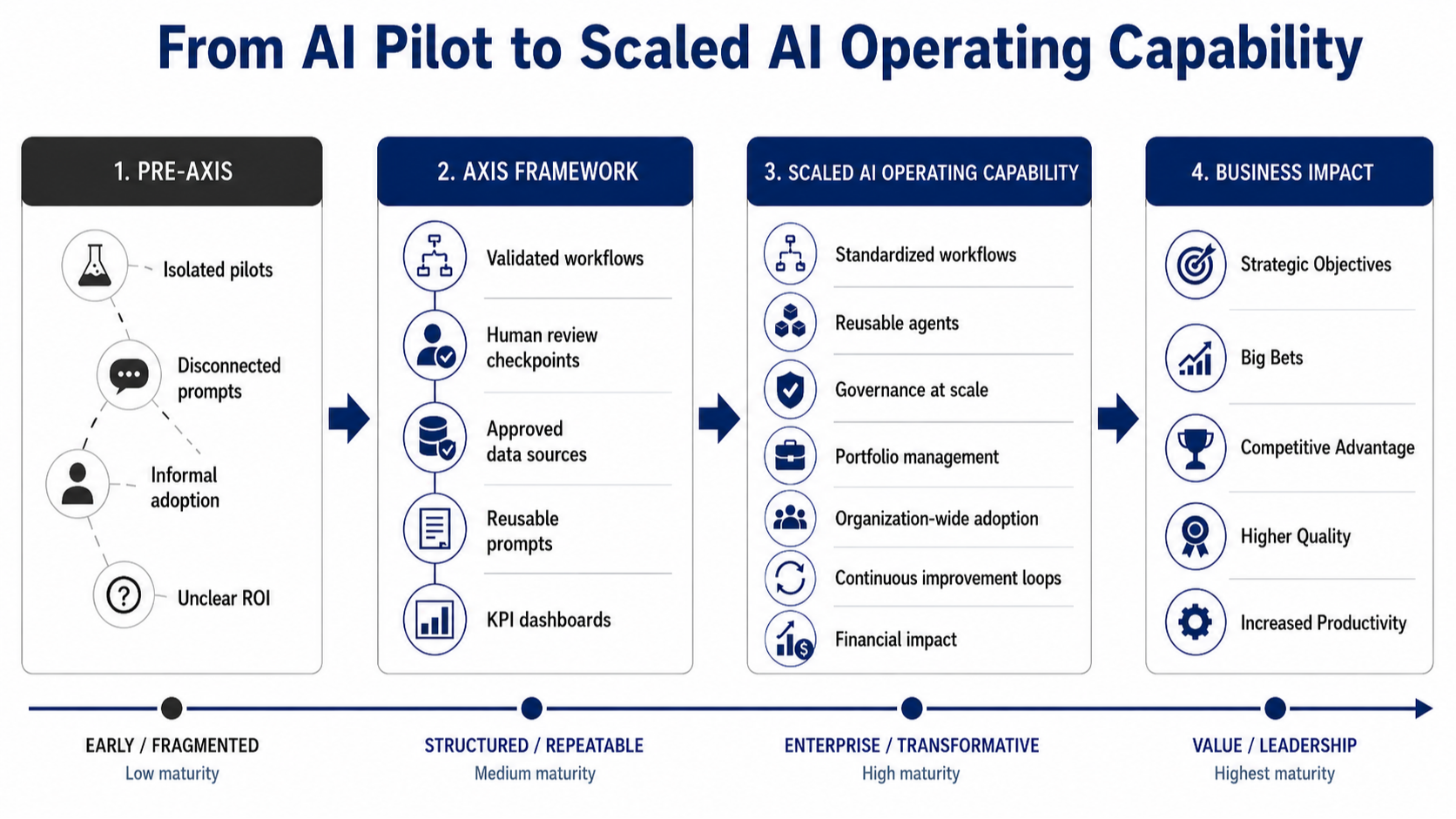
In a professional service firm, scaling AI usually involves five steps. The firm needs to,
- Standardize workflows with proven value.
- Create reusable prompts, agents, playbooks, templates, and knowledge assets.
- Govern AI usage, data access, confidentiality, quality, and human review.
- Measure AI performance through adoption, workflow, strategic, and financial metrics.
- Improve AI-enabled workflows continuously as the firm learns.
Scaling AI is definitely not the same as giving everyone access to AI tools. Tool access creates activity. Scaling creates operating capability.
How Professional Firms Fail with AI in the SCALE Stage
AI initiatives fail to scale when they have not completed the key parts of the ALIGN, XAMINE, or IMPLEMENT stages. They are not connected to strategic workflows, do not have clear owners, they use weak data, they lack governance, or they fail to have a measurable impact on business.
The most common failure pattern is moving from pilots in the XAMINE stage to the SCALE stage without creating optimized workflows, managing data, SOPs, and maintaining governance.
The central question is, “Can this AI system work repeatedly, safely, measurably, and profitably across the firm?”
In the XAMINE and IMPLEMENT stages, some AI pilots may succeed because a few skilled users know how to make it work. But scaling requires normal teams and staff to use it reliably in normal and non-normal operating conditions.
In some firms, AI systems work initially because a few skilled users know how to make it work. When it reaches professionals and staff, it fails.
What Successful Firms Do in the SCALE Stage
Successful professional firms treat AI scaling as a management discipline. They complete the key steps in the ALIGN, XAMINE, and IMPLEMENT stages before the SCALE stage.
Successful firms treat AI scaling like any critical asset or objective.
They scale the workflows that prove value. They do not leave AI usage to chance.
They embed AI into SOPs, onboarding, dashboards, team meetings, review routines, budget cycles, and governance systems.
They do not rely on heroic early adopters in their "AI Islands." Successful firms create repeatable systems that ordinary teams can use.
- They standardize the workflows that matter.
- They create reusable AI assets.
- They build governance into the system.
- They measure performance at multiple points.
- They make continuous improvement part of the system.
Mid-sized professional service firms need enough structure to scale AI responsibly, but not so much structure that innovation gets buried in the process.
Scaling AI vs. AI Chaos
Scaling AI and letting AI loose to run rampant are not the same thing.
Letting AI run rampant through your firm creates chaose and waste – firms can spread AI quickly by buying licenses, hosting generic AI-prompt training sessions, encouraging experimentation, and celebrating use cases. Activity may increase, but strategic impact will not.
Scaling doesn’t ask the question, “What can our people do with AI?”
It asks, “What can the firm improve and where can we make a strategic impact with AI?”
A Portfolio View of Scaling AI
The strongest firms with the best return from AI are not those that scale the most AI. They are firms that scale AI workflows aligned with strategic objectives, operating performance, and economic value.
But you may not want to put all your AI-assets in one basket.
An excellent way to manage this is to manage AI as a portfolio of operating improvements.
This portfolio should be segmented into AI initiatives that drive strategic objectives; Big Bets that may create future strategic advantage; workflows that require refinement; quick wins and selected productivity workflows.
Using a portfolio gives executives a practical way to allocate budget, risk, and resources.
Some AI systems may have strong sponsors who want to promote their pet AI system, but do not start your AI implementation with a large portfolio. Begin with a few strategic AI systems, learn, and move forward.
Standardizing Data Across Teams and Departments
At small scale, teams can sometimes work around weak data.
At firm-wide scale, they cannot and that is guaranteed trouble.
AI systems depend on the quality, accessibility, and permissions of the data they use. This is especially important for professional-service firms because so much value sits in unstructured knowledge: proposals, research notes, client deliverables, call transcripts, strategy documents, project plans, reports, case studies, templates, and expert insights.
If this knowledge is scattered across folders, inboxes, personal drives, Slack threads, and outdated documents, AI systems will struggle. They may retrieve the wrong content, miss context, produce inconsistent answers, or create outputs that require too much human correction.
McKinsey’s agentic AI research makes the same point: nearly two-thirds of enterprises have experimented with agents, but fewer than 10 percent have scaled them to tangible value, and data limitations are a major roadblock to scaling.
As AI use expands, the firm must reduce duplication, inconsistent data use, conflicting definitions, and isolated team practices. SCALE creates the structure needed for multiple teams to use AI without creating fragmentation, confusion, or loss of operational control.
Many professional service firms will not be ready for advanced agents until they improve their knowledge and data systems.
Many professional service firms will not be ready for advanced agents until they improve their knowledge and data systems. SCALE therefore includes not only more AI, but better content infrastructure, stronger knowledge management, and more disciplined information architecture.
The old adage of garbage in, garbage out is even more true when used with AI.
Department or Team Workshops as the Fastest Path to AI SCALE
One of the most effective ways to scale AI across a professional service firm is through department and functional team workshops using implementation and real workflows.
General AI training introduces concepts, tools, and keystroke skills. But this training is soon forgotten.
Functional workshops guide teams in applying AI immediately to the work they do every day.
Research into learning effectiveness and retention continually shows that work-centered workshops are over 200% better than training - AI skills are retained best when people use them inside familiar work, with real inputs, real outputs, and clear performance expectations.
Your department or team workshops should use:
Marketing teams can identify client needs, plan campaigns, develop content for multiple channels, and then publish it.
Consulting teams conduct client research, create presentations, and practice presenting.
Finance teams can accelerate reporting and analysis.
Functional workshops also increase adoption because they reduce the gap between learning and doing. Many professionals leave AI training interested but uncertain. They understand the tool, but they do not know where it fits into their workflow, what data they can use, what quality standards apply, or how much human review is required.
Workflow-based workshops solve these problems by guiding teams through projects that mirror their workflow from beginning to end.
In CTS AI Implementation Workshops teams use:
- AI prompts and systems that are the same or similar to their work
- They improve and modify AI prompts and agents
- They use SOPs they carry forward to work
- They use Human-In-The-Loop checkpoints
- They develop governance, risk, and data standards
Adoption rates increase because AI is no longer an optional tool learned in a course and separate from their work.
These workshops also create the psychological safety teams need before they begin to innovate. Professionals are often hesitant to use AI because they fear errors, confidentiality problems, poor output quality, or looking inexperienced in front of peers.
Team workshops create a shared learning environment where people can test ideas, ask practical questions, compare results, and build confidence together. This is especially important in the SCALE stage because broad adoption depends on normal users, not just early AI champions. When teams learn together, they develop common language, shared standards, and enough security to move from cautious use to responsible experimentation.
Department and functional workshops also reduce the very real problem that people will fall back to old methods. Without reinforcement, many users return to the old familiar workflow as deadlines approach. The old process feels safer, even if it is slower. A well-designed workshop prevents this by producing usable workflow assets: prompt templates, review checklists, SOPs, role assignments, data-use rules, and quality standards. The team leaves with a working system, not just inspiration. This makes the new AI-enabled workflow easier to repeat, manage, and improve over time.
For leaders and the executive team, these workshops are also a practical means of scaling. They allow AI adoption to expand department by department without creating unmanaged variation. Each team can adapt AI to its own work, metrics, risks, and client requirements while still operating within firm standards. Over time, the firm builds a library of reusable workflows, prompts, playbooks, and lessons learned.
Functional workshops help firms move from scattered AI productivity to firm-wide AI ability.
Balancing Human + AI Orchestration at Scale
As AI scales, the role of professionals changes.
The goal of scaling is not to remove humans from professional work. The goal is to redesign work so that humans and AI each do what they are best suited for.
For professional service firms, elements such as quality of deliverables, experience applied to decisions, personal interactions, ethics, are a few of the elements that cannot be left to AI.
Balancing Human + AI orchestration ensures you have clear standards and SOPs for:
- Who supervises AI workflow?
- What decisions remain human-owned?
- What outputs require review?
- What errors are unacceptable?
- What feedback improves the agent or prompt?
- Where must Human-In-The-Loop be included?
- How do professionals learn to work with the system?
- How is performance monitored over time?
How are you planning to orchestrate Human + AI cooperation? Don’t leave this out because this coordination and orchestration is where you can get unforeseen advances in productivity and improve your executive decision making.
AI Performance Measurement
Without consistent measurement you cannot answer the central question to AI use,
Is AI improving business performance?
The SCALE stage is not complete without a measurement system that measures AI systems impact on business objectives.
Your system should consistently monitor:
- Is the AI system accurate and reliable?
- Are there reliable input, output, and baseline data?
- How is the AI workflow impacting strategic or Big Bet metrics?
- Are professionals using it inside the intended workflow?
- Is the total cost of ownership justified?
- Is the workflow improving over time?
For professional service firms, you can track these metrics through something as simple as a spreadsheet, but tracking must have ownership and be part of governance.
The register should track each AI workflow or agent, its owner, purpose, department, approved data sources, risk level, review frequency, adoption metrics, business KPIs, last review date, and next improvement action.
You can build metrics dashboards yourself in Excel or Google Sheets or ask AI to build it for you. However you do it, you need to watch and report your metrics.
Although this may sound like bureaucracy, it is just part of good is operational control. There is no point in implementing and scaling a system unless you monitor it.
And do not be afraid to downgrade or redevelop AI systems that under performer. Not every AI workflow deserves to scale.
Scaling Between Departments and
Across Business Units
Marketing, consulting delivery, finance, HR, operations, and client service may all use AI, but they use different workflows, risks, data, metrics, and adoption barriers.
Workflows that depend on data and decisions from other departments can find themselves facing problems.
When you scale AI across departments it requires a shared operating model. The shared model should define how the firm defines and records workflows, validates use cases, manages and validates data, builds AI assets, reviews outputs, measures results, and governs risk.
In a marketing team, scaled AI may focus on market research, persona analysis, content strategy, campaign planning, AEO/GEO optimization, LinkedIn carousels, email sequences, and conversion analysis.
In a consulting practice, scaled AI may focus on client research, interview synthesis, diagnostic frameworks, proposal development, benchmarking, workshop design, and deliverable drafting.
In an accounting or advisory firm, scaled AI may focus on document review, research summaries, client communication, compliance monitoring, workflow checklists, and advisory report generation.
In an HR or recruiting firm, scaled AI may focus on role analysis, candidate screening support, interview guides, onboarding, workforce planning, and training content.
The scaling question is not whether each department should use the same tools. The question is whether departments are using a common management discipline.
That discipline should include common AI development and documentation standards, approved data sources, human review requirements, shared KPIs, workflow documentation, reusable templates, department-specific adoption plans, and regular performance reviews.
Many firms use a federated model. A central AI leadership group sets standards, governance, architecture, and measurement expectations. Department leaders own workflows, adoption, and business outcomes. Technical or operations teams support integration, data quality, security, tooling, and lifecycle management.
For mid-sized firms, this does not have to be a large bureaucracy. It may begin with an AI steering group, a few workflow owners, a shared AI operating playbook, monthly KPI reviews, and a practical governance checklist.
Executive Decision Support Systems
As firms scale AI, they can begin using AI not only to execute work, but to improve decision-making.
This is where strategic and executive intelligence systems become important.
An executive and strategic intelligence system built with AI can help management teams make better decisions.
AI should not be used to make the decision, but it should be used for analysis, evaluation, and critique.
An Executive Decision Support System (EDSS) uses AI to aggregate market data, client insights, sales activity, delivery trends, utilization data, pricing patterns, competitive signals, and internal knowledge to aid executives in analyzing, comparing, contrasting, and forecasting in the aid of making decisions.
For professional service firms, that might include identifying which client segments are becoming most profitable and why, which services are underpriced and how to increase them, which workflows are slowing delivery, which marketing messages are converting, which proposals are losing, or which industries show rising demand.
Executive Decision Support Systems can be a key competitive advantage.
Be careful in building such a system. Strategic intelligence systems are only as valid and strong as the data, judgment, governance, and interpretation behind them.
But over time, SCALE can become a major differentiator. Integrating clean, reliable data and building a data warehouse of knowledge your AI can learn from.
How SCALE Prepares Professional Firms for Long-Term Advantage
The SCALE stage is not the end of AI transformation.
It is the beginning of AI adoption and innovation.
Once a firm scales AI responsibly, it can begin building more advanced capabilities,
- Executive AI advisors
- Professional AI advisors
- Institutional knowledge systems
- Multi-agent workflows
- Strategic intelligence dashboards
- AI-assisted management systems
- Continuous innovation and upgrades
But don’t rush into advancing AI development.
The firms that jump too quickly into advanced agents without workflow discipline, data quality, governance, and measurement end up creating fragile systems - without a solid, proven foundation they fail under pressure.
The firms that build solid, proven foundations first are better positioned to take advantage of more powerful AI tools and capabilities that are continually being released.
Building a solid foundation in the SCALE stage gives a professional firm the ability to absorb future AI innovation without being overwhelmed.
This is why SCALE is not only about AI expansion in the firm.
It is about managing AI + Human collaboration.
It is building a culture of learning, adoption, and innovation.
It is building competitive advantage.
It is about reaching strategic objectives.
Ultimately, the SCALE stage turns AI into a platform for strategic advantage.
FAQ
Frequently Asked Questions
What is the SCALE stage in a professional service firm?
Why do AI pilots fail to scale?
What is AI Pilot Purgatory and why does it cause failures?
How should firms measure AI at scale?
Why is governance important when scaling AI?
How does SCALE differ from IMPLEMENT in AXIS?
What is the biggest risk in the SCALE stage?
About the Author
Ron Person is the founder of Critical to Success (CTS) and the creator of the AXIS AI Implementation Framework™. Ron guides professional service firms in using the AXIS AI Implementation Frameworktm to align AI with strategic objectives, validate and implement AI in departments and functional teams, and then SCALE AI for business impact.
He brings more than 30 years of consulting experience with Fortune 1000 and Global 1000 firms. His experience includes business strategy, digital marketing, data analytics, process improvement, and technology implementation.
Ron has authored 27 books with almost 3 million copies in print and has served as an adjunct professor in the Executive Extension at University California, Berkeley. He has an MBA Marketing/Finance, MS Physics, Black Belt Six Sigma, and is certified in Balanced Scorecard.


About Critical to Success
Critical to Success helps professional service firms implement AI to impact strategic objectives, Big Bets for the future, and workflow performance. The firm works with consultants, marketers, accountants, financial service firms, architecture firms, engineering firms, and other knowledge-based businesses that want to measurably improve strategic objectives, workflow performance, productivity, and client value.
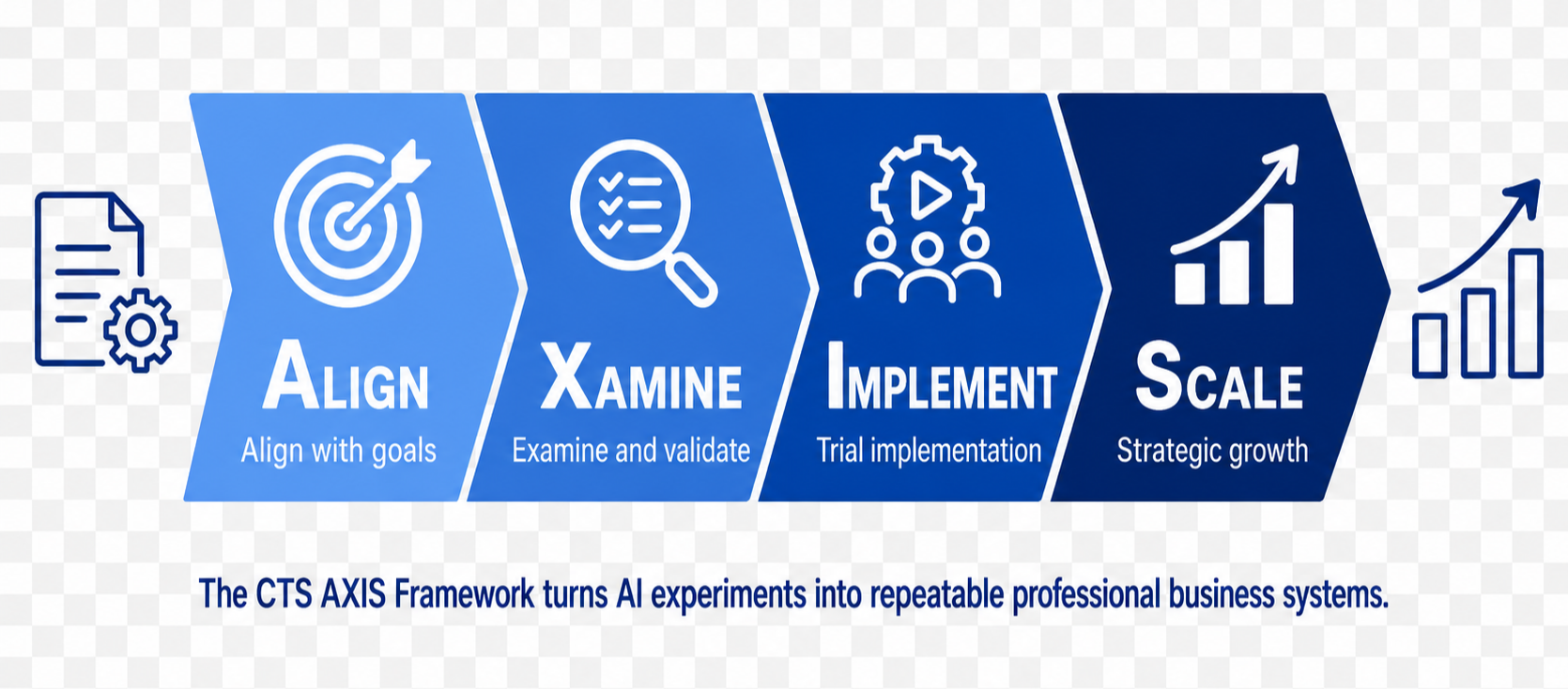
Critical to Success developed the CTS AXIS AI Implementation Frameworktm to help firms move from random AI experimentation to structure implementation. The framework guides firms through four stages of adopting AI: Align, eXamine, Implement, and Scale.
Critical to Success provides AI advisory services, AI implementation workshops tailored to departments and functional teams, executive education, AI implementation playbooks, and development of AI solutions.
This article is part of the Critical to Success AI implementation library and is designed to help leaders move from AI experimentation to structured, measurable, and scalable AI adoption.
Editorial Note
This article is part of the Critical to Success AI implementation library. It is written for professional service firm leaders who need practical guidance on AI strategy, workflow improvement, governance, adoption, and measurable business value. Content is periodically reviewed and updated to reflect changes in AI tools, implementation practices, and the needs of professional service firms.
SOURCES
Lorenz, J.-T., Abraham, J. C., Levin, R., & Ziman, D. (2026). From promise to impact: How companies can measure—and realize—the full value of AI (McKinsey & Company / QuantumBlack).
https://www.mckinsey.com/capabilities/quantumblack/our-insights/from-promise-to-impact-how-companies-can-measure-and-realize-the-full-value-of-ai
Pereira, E., Graylin, A. W., & Brynjolfsson, E. (2026). The Enterprise AI Playbook: Lessons from 51 Successful Deployments (Stanford Digital Economy Lab).
https://digitaleconomy.stanford.edu/publication/enterprise-ai-playbook/
Tavakoli, A., Goodman, B., Soller, H., & Rowshankish, K. (2026). Building the foundations for agentic AI at scale (McKinsey Technology / QuantumBlack).
https://www.mckinsey.com/capabilities/mckinsey-technology/our-insights/building-the-foundations-for-agentic-ai-at-scale