
IMPLEMENT
Implement AI Systems in Operational Environments
TL;DR
Take Aways
IMPLEMENT determines whether AI success from VALIDATE's controlled environment can become dependable AI systems in a real work environment.
- Convert the validated pilot into a workflow for operations.
- Define human and AI responsibilities, controls, ownership, and SOPs.
- Use AI implementation workshops to prepare and train teams while implementing the real system.
- Measure performance with real users, real workloads, real systems, and real exceptions.
- Proceed to scale only after the firm has operational proof.
Quick Answer
The IMPLEMENT stage develops operational proof for the AI-system.
The team installs the AI system in a real work environment, assigns human and AI responsibilities, configures tools and data, establishes governance and ownership, and upskills teams with AI Implementation Workshops.
AI implementation prepares AI to become part of a firm's real business operations.
Where is the IMPLEMENT Stage in ADVIS?
ALIGN → DIAGNOSE → VALIDATE → IMPLEMENT → SCALE
ALIGN = Strategic Justification →
DIAGNOSE = Diagnostic Evidence →
VALIDATE = Controlled Proof →
IMPLEMENT = Operational Proof →
SCALE = Sustained & Expanded Proof
Why This Matters
Why Implementing AI in a Controlled Environment Matters
AI use is becoming common inside organizations, but widespread use does not mean AI has been successfully implemented.
McKinsey's 2025 global research found that nearly nine in ten respondents said their organizations regularly use AI. Yet most organizations had not embedded AI deeply enough into workflows and processes to create broad enterprise-level value. Nearly two-thirds had not begun scaling AI across the enterprise (McKinsey & Company, 2025a).
Workflow redesign is particularly important. McKinsey's earlier 2025 research found that among 25 organizational practices tested, workflow redesign had the largest effect on respondents' ability to report EBIT impact from generative AI (McKinsey & Company, 2025b).
BCG reached a similar conclusion in research involving more than 10,600 workers across 11 countries. AI use had become mainstream, yet the organizations capturing more value were going beyond tool deployment and redesigning workflows, investing in workshops and upskilling, managing organizational change, and measuring tangible results (Boston Consulting Group, 2025).
IMPLEMENT is where those changes become part of the operating business.
IMPLEMENT proves how AI systems work in real business environments.
An individual employee or team may become faster at research, writing, analysis, or document preparation using AI.
That can be useful. However, real improvement requires more.
To prove success, the new AI system and optimized workflow must identify how information moves, what AI impacts, where people exercise judgment, how quality is checked, who owns the outcome, and how performance is measured.
IMPLEMENT tests the variety of conditions that could not be tested in the controlled conditions of VALIDATE.
Real operations create variation.
Employees have different levels of skill.
Work arrives under deadline pressure. Information may be incomplete. Clients make unusual requests. Systems fail. Exceptions appear. Managers introduce competing priorities.
A system that performed well during VALIDATE must prove that it remains useful under those conditions.
IMPLEMENT builds organizational capability.
The goal is not simply to install an AI system.
The work team needs enough knowledge to operate, review, improve, and manage that system.
That becomes especially important for AI for professional services, where successful implementation must combine AI capability with expert judgment, client knowledge, professional standards, and human accountability.
IMPLEMENT creates the evidence needed for SCALE.
Expanding an AI system before it has demonstrated dependable operational performance multiplies uncertainty.
IMPLEMENT reduces that uncertainty before additional departments, teams, locations, or business units become dependent on the system.
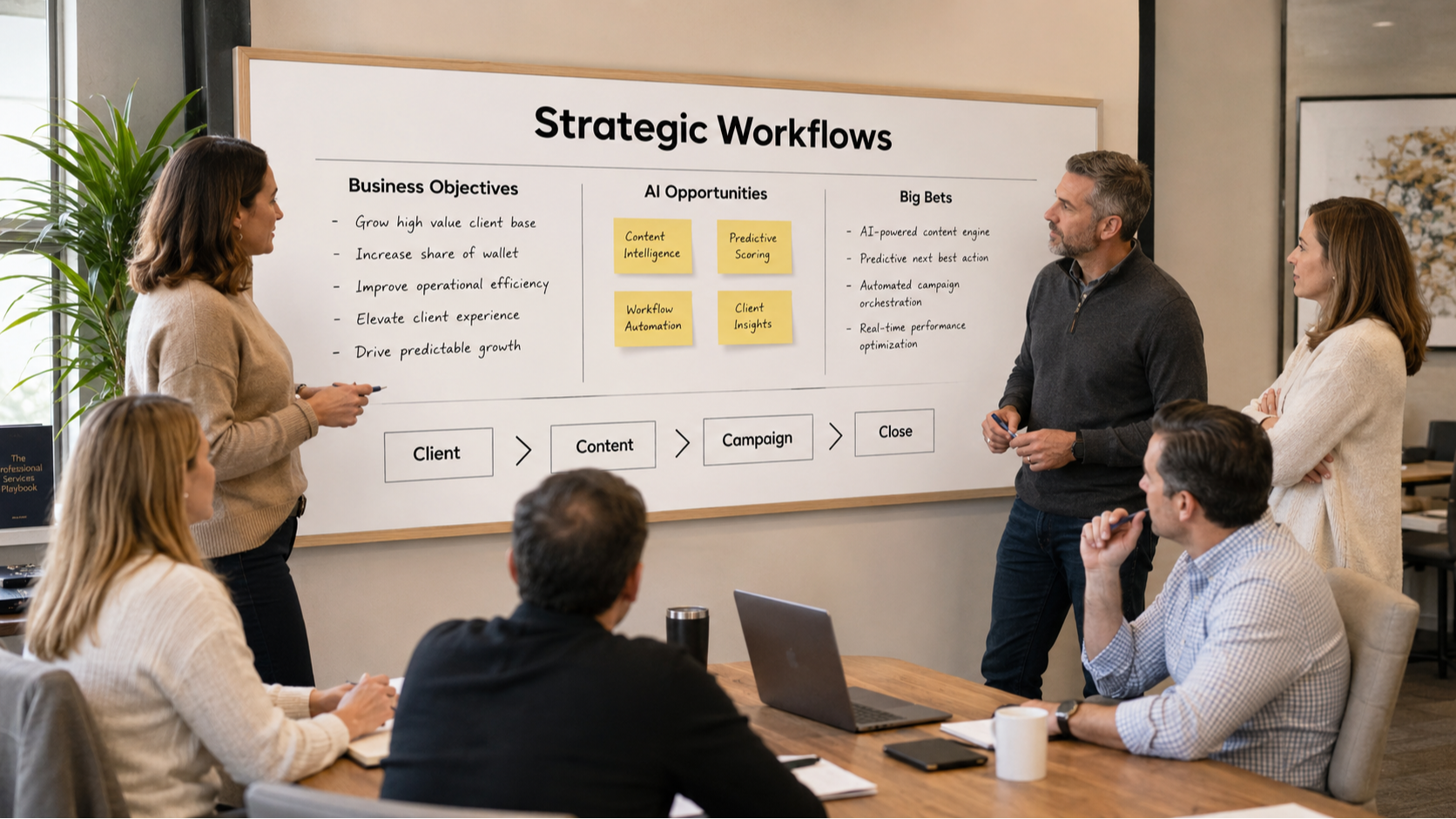
IMAGE DESCRIPTION — INFOGRAPHIC
Infographic: A simple horizontal diagram titled “From Controlled Proof to Operational Proof.” Show four large connected stages: Validated System → Operational Deployment → Operational Integration → Ready to Scale. Under Operational Deployment, include only Real Users + Real Work. Under Operational Integration, include Systems + Handoffs + Operating Segments. Highlight Operational Proof between the two implementation stages. Clean white background, dark blue and charcoal consulting style, large readable typography, ample white space, no technical architecture and no dense detail.
Image Caption: IMPLEMENT moves a validated AI system through real operational deployment and business-system integration before scaling.
What Successful Firms Do
IMPLEMENT succeeds when the organization has evidence that the AI-enabled workflow performs dependably in the environment where it will actually be used.
Real employees can operate the system.
The workflow cannot depend on the project team or a few highly skilled AI enthusiasts.
People who perform the work should be able to use the system with the training, instructions, tools, and support that will exist after the initial project.
Quality remains acceptable
Operational speed or productivity should not come at the expense of professional quality.
The organization should continue measuring the quality requirements established during VALIDATE.
Performance is reliable under normal conditions
The system must work when workload varies, deadlines are real, information is imperfect, and users have different experience levels.
Human oversight is practical
Review, approval, escalation, and exception handling should be clear.
Human-in-the-loop controls must provide enough protection without creating so much review work that the value of AI disappears.
Adoption is sufficient to produce business value
Usage alone is not the objective.
People need to use the AI-enabled workflow consistently enough that the organization can observe its effect on business performance.
SOPs and ownership are established
Employees know how the workflow should operate.
Managers know who owns performance, data, quality, exceptions, technology, and future improvements.
Operating costs are understood
The organization can measure more than license costs.
It understands the effects of human review, integration, support, training, monitoring, and other operating requirements.
The workflow operates inside the surrounding business system
Inputs arrive correctly.
Outputs reach the people or systems that need them.
Cross-functional handoffs work.
Data moves as intended.
Governance and reporting function in practice.
The system works across the operating variation needed to justify SCALE
This may include different teams, roles, client groups, workflow types, or locations.
IMPLEMENT does not require organization-wide deployment.
It requires enough operating breadth to show that the implementation is dependable within its most important work domain. The SCALE stage will test the AI system across a variety of new work domains, which often requires adjustments.
What Causes Failure
Treating validation as production readiness
A successful pilot does not prove that employees can operate the system during normal work.
VALIDATE and IMPLEMENT answer different questions.
Training individuals instead of the complete work team
One or two strong users can make an AI system appear successful.
The actual workflow may depend on multiple roles, handoffs, approvals, and management responsibilities.
Research into workforce training for professionals and staff has shown that workshop-style training involving simulated real work drives greater adoption and 2X skills retention.
By training work teams, they can share and reinforce SOPs and work standards.
Treating AI training as a substitute for AI implementation
General AI training can improve awareness and individual skills but it does not improve system productivity or strategic performance.
Workshops that train using real work environments and AI systems create greater adoption and skills retention.
Ignoring workflow redesign
Installing AI inside the old process can preserve unnecessary steps and outdated responsibilities.
Approximately 30% of a workforce may want to fall back to their work methods and are slow to adopt new workflows and AI systems. Again, workshops that involve all or critical portions of a work team can increase adoption and usage.
Monitor usage and avoidance in your metrics.
The operational workflow should incorporate what was learned during DIAGNOSE and VALIDATE.
Poor human and AI role definition
Employees need to know what AI may perform, what people must review, what requires approval, and what should be escalated.
Weak operational governance
Governance cannot remain a policy document. Management and measurement must be continuous.
Ongoing management and monitoring of new system effectiveness is especially critical during early implementation as this is when anomalies outside of the VALIDATE stage can cause errors.
Continuous metrics and KPI monitoring systems must be installed during implementation. This not only helps you prove the systems impact on key objectives, it also alerts people to system performance problems.
Even more critical is having a baseline monitor system that alerts operators when an AI system slowly degrades below operational norms. Slow degradation can sometimes be difficult to see so degradation continues until it becomes a serious issue.
Those errors from the real-world environment will require additional workflow changes or modifications to the AI system.
Failing to test cross-system effects
An AI workflow may work well on its own while creating problems upstream or downstream.
Test operational integration before scaling.
IMPLEMENT IN TWO PHASES
IMPLEMENT has two internal phases, Deployment and Integration. These are not separate ADVIS stages. Together these two stages create operational proof.
Stage 1 - Operational Deployment
This stage answers the question:
Does the AI-enabled workflow work in actual operations?
The organization moves the validated system into a SINGLE controlled real-work environment. The new systems should be deployed and tested within a single operating environment before being deployed to multiple work environments.
This stage includes:
- Upgrading the VALIDATE workflow to operate in the IMPLEMENT environment
- Defining AI and human responsibilities
- Configuring operational tools, data, prompts, agents, and required integrations
- Establishing governance and operating controls
- Creating SOPs and trouble-escalation methods
- Assigning business, workflow, technology, data, and measurement ownership
- Preparing the complete work team
- Deploying the system with real work
- Measuring performance and adoption
- Capturing problems, failures, exceptions, and improvement requirements
The system should use a PDCA (Plan-Do-Check-Act) loop to continually monitor performance and errors and then improves the system until it is dependable enough to test within the wider business environment.
Stage 2 - Operational Integration
This stage presents the BIG question:
Does the AI-enabled workflow operate well as part of the larger operating system?
The implementation team must examine:
- Upstream workflows
- Downstream workflows
- Data flows and quality
- Business applications
- Cross-functional handoffs
- Shared KPIs
- Governance
- Security
- Management reporting
- Required operating segments
Stage 2 does not deploy AI across the entire enterprise – it keeps the system begin tested within one or two operational environments. Expanding throughout the enterprise remains for the SCALE phase.
The purpose in this stage is to establish that the implementation is robust enough to consider scaling.
HOW TO IMPLEMENT AN AI SYSTEM
Use the following process after VALIDATE has produced sufficient controlled proof.
- Design the future-state workflow.
Document how the complete workflow should operate with AI included.
Show the trigger, information flow, AI tasks, human tasks, decisions, reviews, exceptions, handoffs, and final outputs.
- Define AI responsibilities.
Specify what AI is authorized to do.
This may include retrieving information, analyzing documents, drafting content, classifying cases, recommending actions, or performing multi-step work through agents.
- Define human responsibilities.
Identify where people provide judgment, approval, correction, interpretation, client interaction, or accountability.
- Configure operational tools and data.
Move from the limited pilot configuration into the tools, information sources, permissions, prompts, agents, and integrations required for actual operation.
- Establish governance and controls.
Put the controls identified during VALIDATE into daily practice.
Examples may involve approved data sources, access permissions, review requirements, escalation, monitoring, privacy, security, or client confidentiality.
- Create SOPs.
Document the operating method.
The SOP should make clear how people use AI within the workflow rather than merely explain how to operate an AI tool.
- Assign ownership.
Define who owns:
- Business performance
- Workflow performance
- AI system operation
- Data and knowledge
- Risk and governance
- Measurement
- Future improvement
- Conduct the AI Implementation Workshop.
Train the team using the workflow and system it will actually operate.
This is not generic classroom AI training in AI keystroke skills and features. Use workshops that actually put the workforce in the real or simulated AI environment being implemented. Many studies show this increases adoption, increases skills retention, and improves personal motivation to use and improve the new system.
Participants should understand why and where the workflow changed, how AI is used to improve the workflow, when and where human judgment is required, what data is permitted, how exceptions are handled, how quality is reviewed, and how performance will be measured.
- Deploy with real work.
Begin with enough operational control that problems can be identified and corrected without exposing the organization to unnecessary risk.
- Measure actual performance in the implemented work environment.
Track quality, cycle time, productivity, review effort, cost, adoption, errors, exceptions, risk, and contribution to the strategic KPI.
- Capture exceptions and problems.
Use an exception log or improvement backlog.
Operational failures often reveal conditions that were not visible during controlled validation.
These exceptions and problems are what make the difference between VALIDATE and IMPLEMENT. You must repair or improve workflows and AI systems to eliminate these issues before full operation or scaling.
- Revise until dependable.
Change workflows, prompts, data sources, controls, SOPs, training, or technology where evidence shows improvement is required.
This is why metrics, measures, and exceptions need to be tracked in the IMPLEMENT stage. They help you identify where and why and issue occurs and verify that you have fixed it.
- Test operational integration.
Examine how the workflow interacts with surrounding processes, systems, data, and teams.
- Test required operating segments.
Where necessary, test different roles, teams, client groups, workflow variants, or other operating conditions.
- Determine readiness to SCALE.
Proceed only when operational evidence supports broader expansion.

IMAGE DESCRIPTION — PHOTOREALIST
Photorealist: A professional services department participating in an AI Implementation Workshop. Show a mixed-race, mixed-gender group of six to eight professionals of varied ages wearing casual business clothes around a large table with laptops open. A facilitator is working with the team at a wall display titled “AI Implementation Workshop.” The display shows only five large headings: Workflow, AI Tasks, Human Review, SOP, KPI. Participants are actively working on their real business process rather than listening to a lecture. Natural daylight, modern professional office, realistic collaboration, no robots, no futuristic AI effects.
Image Caption: An AI Implementation Workshop prepares a team while it develops and learns to operate the AI-enabled workflow it will actually use.
CTA!
AI Optimize Now!TRAIN WITH AI IMPLEMENTATION WORKSHOPS:
LEARN AI WHILE IMPLEMENTING AI
People do not create a firm’s capability merely by learning AI concepts or AI keystrokes and features. Training must transfer into the work itself.
Research on workplace learning shows that training design, opportunities to apply learning, motivation to transfer, and the work environment strongly affect whether new skills are actually used and maintained on the job.
Critical to Success highly recommends teaching teams using the same or simulated AI-enabled workflows they will actually operate with. (Baldwin & Ford, 1988; Gegenfurtner, 2011).
Baldwin and Ford's foundational training-transfer research defines transfer in terms of whether learning generalizes to the job and whether skills are maintained over time. Their review identifies training design, learner characteristics, and the work environment as important conditions affecting transfer.
Gegenfurtner's later meta-analysis examined 148 professional-training studies involving more than 31,000 participants and found meaningful relationships between motivation and transfer, with instructional and assessment conditions affecting those relationships.
That research supports an important distinction for CTS:
AI training just teaches skills.
An AI Implementation Workshop builds a lasting learning environment for high-performance productivity, innovation, and capability.
Participants learn the workflows and AI systems while they:
- Incorporate new SOP workflows in their mental workflow
- Develop prompts, agents, and ai-supported tasks
- Define human-in-the-loop checkpoints
- Update and correct the new AI system when needed
- Use approved data and knowledge
- Create SOPs
- Apply governance requirements
- Measure quality and performance
- Learn how to manage and improve the system
This is especially relevant for AI for professional services.
Professional work frequently depends on tacit knowledge, judgment, client context, quality standards, and accountability. Those elements are difficult to address through generic AI training alone.
The AI Implementation Workshop puts learning inside the system the professionals will operate.
AI Implementation Workshops create teams that not only understand how the new system works, the team learns how others work, they evaluate opportunities for future improvement, and they can immediately impact strategic performance.
HOW IMPLEMENT WORKS: FROM VALIDATED PILOT TO OPERATING SYSTEM
Consider the consulting firm example we’ve been using – the firm that validated an AI-assisted proposal-development workflow.
During VALIDATE, the pilot successfully retrieved prior work and produced usable first drafts. It reduced drafting effort while maintaining quality.
But some problems continued to exist
Some weaknesses remained.
Incomplete client information created poor drafts. Older case studies occasionally entered the output. Complex proposals still required significant senior review.
Those findings shaped what needed to be done in the IMPLEMENT stage.
The future state is redefined and redesigned
The firm redesigns proposal development from the point where an opportunity is qualified to be accepted.
Client and opportunity information must be complete before the AI drafting system begins.
The system retrieves only approved source material.
AI creates a structured first draft.
A proposal manager reviews routine sections.
Complex technical claims are routed to the appropriate subject-matter expert.
Pricing and final approval remain human responsibilities.
Operating controls are modified
Approved knowledge sources are defined.
Outdated case studies are removed from retrieval.
Permissions restrict sensitive client information.
The SOP defines review and escalation requirements.
AI Implementation Workshops Motivate and Upskill Staff and Professionals
Business-development staff, proposal managers, selected consultants, and operations personnel learn the system together.
They work with real proposal scenarios.
They practice identifying when the AI output is sufficient, when corrections are needed, and when expert escalation is required.
They also learn how quality and cycle time will be measured.
The system enters operational deployment
The firm begins using the system on a limited set of live proposals.
The team tracks cycle time, drafting effort, quality, senior review, exceptions, and user adoption.
Problems are added to an improvement backlog and corrected.
The system is ready for operational integration
Once the workflow is dependable, the organization tests how it interacts with CRM data, document systems, pricing approvals, subject-matter experts, and management reporting.
Now the firm has something much stronger than a successful AI pilot.
It has an operating business system.
IMAGE DESCRIPTION — INFOGRAPHIC
Infographic: A simple two-stage diagram titled “IMPLEMENT Creates Operational Proof.” Left half labeled Phase 1 — Operational Deployment with four items: Real Users, Real Work, SOPs & Controls, Measure Performance. Right half labeled Phase 2 — Operational Integration with four items: Systems, Data Flows, Handoffs, Operating Segments. A large arrow moves from Phase 1 to Phase 2 and ends at Ready to SCALE. Clean white background, dark blue and charcoal accents, minimal icons, large text, no dense workflow details.
Image Caption: IMPLEMENT first proves the workflow in real work, then proves that it functions within the wider business environment.
HOW IMPLEMENT WORKS: FROM VALIDATED PILOT TO OPERATING SYSTEM
Consider the consulting firm example we’ve been using – the firm that validated an AI-assisted proposal-development workflow.
During VALIDATE, the pilot successfully retrieved prior work and produced usable first drafts. It reduced drafting effort while maintaining quality.
But some problems continued to exist
Some weaknesses remained.
Incomplete client information created poor drafts. Older case studies occasionally entered the output. Complex proposals still required significant senior review.
Those findings shaped what needed to be done in the IMPLEMENT stage.
The future state is redefined and redesigned
The firm redesigns proposal development from the point where an opportunity is qualified to be accepted.
Client and opportunity information must be complete before the AI drafting system begins.
The system retrieves only approved source material.
AI creates a structured first draft.
A proposal manager reviews routine sections.
Complex technical claims are routed to the appropriate subject-matter expert.
Pricing and final approval remain human responsibilities.
Operating controls are modified
Approved knowledge sources are defined.
Outdated case studies are removed from retrieval.
Permissions restrict sensitive client information.
The SOP defines review and escalation requirements.
AI Implementation Workshops Motivate and Upskill Staff and Professionals
Business-development staff, proposal managers, selected consultants, and operations personnel learn the system together.
They work with real proposal scenarios.
They practice identifying when the AI output is sufficient, when corrections are needed, and when expert escalation is required.
They also learn how quality and cycle time will be measured.
The system enters operational deployment
The firm begins using the system on a limited set of live proposals.
The team tracks cycle time, drafting effort, quality, senior review, exceptions, and user adoption.
Problems are added to an improvement backlog and corrected.
The system is ready for operational integration
Once the workflow is dependable, the organization tests how it interacts with CRM data, document systems, pricing approvals, subject-matter experts, and management reporting.
Now the firm has something much stronger than a successful AI pilot.
It has an operating business system.
IMPLEMENTATION BREADTH IS NOT THE SAME AS SCALE
The IMPLEMENT stage needs enough variation to establish operational reliability.
That may require testing the system across several teams, roles, workflow variants, client groups, or locations.
The purpose is proof that the system works in environments it may be deployed in. That is different than SCALE.
SCALE has a different purpose.
Once the organization has evidence that the system is dependable, SCALE asks where the proven capability should be expanded, where it may need modification, and how the larger system will be managed.
A useful distinction is:
IMPLEMENT proves operations in a real environment. SCALE expands that to firm wide operation.
If a firm needs to test the same workflow with two proposal teams to demonstrate operational reliability, that belongs in IMPLEMENT.
Rolling a proven proposal system across twelve offices and several business units belongs in SCALE.
Results and Deliverables
A completed IMPLEMENT stage should produce an operational package that can support daily work and the scale decision.
Future-State Workflow
The complete AI-enabled operating process.
Operational AI System
The configured tools, prompts, agents, data sources, and integrations required for use.
Human/AI Responsibility Model
Clear assignment of AI tasks, human judgment, review, approval, escalation, and accountability.
SOPs
Documented procedures for normal work and exceptions.
Governance Controls
Operational data, access, privacy, security, quality, and risk controls.
Trained Work Team
Employees capable of operating the workflow.
Ownership Structure
Business, workflow, technology, data, governance, and measurement responsibilities.
Operational KPIs
Measures of real performance.
Adoption Findings
Evidence about actual use and barriers.
Exception Log
Problems, unusual cases, failures, and responses.
Integration Findings
Evidence from surrounding systems and processes.
Operating-Segment Findings
Results from required teams, roles, client types, or workflow variations.
Improvement Backlog
Prioritized changes still needed.
Scale Recommendation
Evidence-based decision about broader expansion.
RECOMMENDED RESOURCES
CTS has developed assessments, templates, worksheets, and canvases that make it easier and more straightforward to complete each ADVIS stage. In this stage, clients use:
- AI Implementation Readiness Checklist
- Human/AI Responsibility Matrix
- AI Workflow SOP Template
- AI Governance Checklist
- AI Exception Log
- Operational KPI Scorecard
- AI Scale-Readiness Assessment
These assets are used by CTS to support consulting engagements, AI Implementation Workshops, executive assessments, and future lead-generation resources.
Download Checklists
CTA!
AI Optimize Now!
Decision Gates
You need a decision before moving to the SCALE stage. Possible decisions include:
Proceed to SCALE
Operational performance is dependable and broader expansion is justified.
Continue Limited Operation
The system is producing value but needs more operational evidence.
Revise the Workflow
Operating evidence shows that the process requires change.
Improve the AI Implementation Workshop or Team Support
Users need additional knowledge, practice, role clarity, or management support.
Revise Integrations or Controls
The core workflow works, but surrounding systems or governance require improvement.
Return to VALIDATE
Operational evidence raises questions about technology quality, reliability, risk, or acceptance criteria that require controlled retesting.
Return to DIAGNOSE
The implementation has exposed a deeper workflow or root-cause problem.
Stop
The system cannot produce sufficient value or acceptable operational performance.
A Stop decision remains a legitimate ADVIS outcome.
WHAT COMES NEXT: SCALE
In the IMPLEMENT stage teams prove that an AI-enabled system operates in a real work environment.
In the SCALE stage a team makes implemented systems work throughout different domains in a firm.
The firm decides where the proven capability can create additional value, standardize reusable elements, establish broader governance and ownership, support more users, monitor performance, and adapt the system as technology and business conditions change.
The system should move into SCALE only after IMPLEMENT has produced sufficient operational proof that it works in operational environments and has the potential to improve its strategic objectives.
HOW CRITICAL TO SUCCESS CAN HELP
Your team can both learn AI systems and how to implement them.
CTS AI Implementation Workshops are designed around department or functional team workflows rather than using generic training demonstrations.
These workshops are based on the most valuable workflows used in consulting, marketing, sales, sales development, human resources, finance, executive decision making, and more.
Teams learn practical AI skills as they diagnose, develop, validate, implement, document, measure, and learn to manage AI-enabled systems similar to their own systems and strategic objectives.
The workshops combine learning in AI, implementation, and performance improvement:
Learn AI + Implement AI + Build Organizational Capability
For professional services firms, this means AI training is placed inside the context that matters most: the firm's own professional work, client requirements, knowledge, quality standards, human judgment, and business objectives.
CTS also supports implementation teams through AI Strategic Advisory Consulting, including identifying strategic objectives, identifying workflows and key metrics, governance, AI and agentic development, and preparation for scaling.
RECOMMENDED CTA
Ready to move from AI experimentation and training to real implementation?
CTS can help your team build, test, implement, and learn to manage an AI-enabled workflow tied to measurable business results.
CTA BUTTON: EXPLORE AI IMPLEMENTATION WORKSHOPS
CTA BUTTON: DISCUSS YOUR AI IMPLEMENTATION
Call To ActionFAQ
Frequently Asked Questions
What is AI implementation?
How are AI Implementation Workshops different from AI training?
What is an AI Implementation Workshop?
Why should teams train and implement together?
What is human-in-the-loop AI?
How do you govern AI in daily operations?
How do you measure AI implementation success?
When is an AI system ready to scale?
References
Baldwin, T. T., & Ford, J. K. (1988). Transfer of training: A review and directions for future research. Personnel Psychology, 41(1), 63–105. DOI: 10.1111/j.1744-6570.1988.tb00632.x.
Boston Consulting Group. (2025). Companies must go beyond AI adoption to realize its full potential. Boston Consulting Group.
Gegenfurtner, A. (2011). Motivation and transfer in professional training: A meta-analysis of the moderating effects of knowledge type, instruction, and assessment conditions. Educational Research Review, 6(3), 153–168. DOI: 10.1016/j.edurev.2011.04.001.
McKinsey & Company. (2025a). The state of AI in 2025: Agents, innovation, and transformation. McKinsey & Company.
McKinsey & Company. (2025b). The state of AI: How organizations are rewiring to capture value. McKinsey & Company.
About Ron Person
Ron Person is an AI strategic advisor, consultant, author, and educator with more than 30 years of experience in technology, strategy, performance improvement, and digital marketing. He consulted for 17 years as one of Microsoft’s first independent consultants and later for 14+ years advising Fortune 1000 and Global 1000 organizations on strategic performance improvement and digital marketing. Ron has written 27 business and technology books, taught at the University of California, Berkeley Executive Extension, and has worked extensively with Generative AI since its public release.
About Critical to Success
Critical to Success helps professional service firms turn AI experimentation into measurable performance improvement. CTS provides AI Strategic Advisory, AI Implementation Consulting, and AI Implementation Workshops for professional teams and departments. CTS applies its proprietary CTA ADVIS Implementation Frameworktm to align AI systems and optimize workflows that drive strategic objectives. It then diagnoses and validates workflows, metrics, governance, and risk before implementing in a controlled environment and later scaling to additional professional domains.
Editorial Note
This article is part of the Critical to Success AI implementation library. It is written for professional service firm leaders who need practical guidance on AI strategy, workflow improvement, governance, adoption, and measurable performance improvement. Content is periodically reviewed and updated to reflect changes in AI tools, implementation practices, and the needs of professional service firms.
Declaration of AI Assistance
Disclaimer: This article was researched and drafted with the assistance of AI tools. You can read our full human-oversight process in our AI Transparency Policy.