IMPLEMENT
Implement AI Systems in an Operational Environments
TL;DR
Take Aways
ALIGN ensures AI implementation drives measurable results in strategic objectives.
- Begin with the strategic objective, not an AI tool.
- Identify the business driver(s) that drive the strategic objective.
- Form an initial hypothesis about how AI will improve the performance.
- Establish ownership, metrics, baseline, and targets.
Quick Answer
AI implementation should begin with a business question:
What important result does the organization need to improve?
Most often, the question that is asked is:
What strategic objective should AI improve?
The answer to that gives AI its purpose, it's direction, and the tasks to be done.
Where is the ALIGN Stage in ADVIS?
ALIGN → DIAGNOSE → VALIDATE → IMPLEMENT → SCALE
ALIGN = Strategic Justification →
DIAGNOSE = Diagnostic Evidence →
VALIDATE = Controlled Proof →
IMPLEMENT = Operational Proof →
SCALE = Sustained & Expanded Proof
Why This Matters
Why Aligning AI with Strategic Objectives Matters
AI creates an unusual management problem: there are far more things an organization could do with AI than it can responsibly fund, implement, and manage.
That makes strategic focus critical.
BCG's 2025 AI research found that companies reporting significant value concentrated their effort on fewer AI initiatives and placed much more of their AI investment into reshaping important functions and developing new offerings. Leaders also tracked operational and financial outcomes systematically (Boston Consulting Group, 2025a). (BCG Global)
McKinsey's 2025 global AI survey reached a related conclusion. Although AI use had become widespread, most organizations remained early in enterprise scaling, and only 39% of respondents reported AI-related EBIT impact at the enterprise level (McKinsey & Company, 2025). (McKinsey & Company)
The issue is not whether organizations can find uses for AI.
The executive challenge is deciding which uses deserve serious implementation effort because they can improve strategically important results.
ALIGN concentrates investment on what matters.
Professional services firms can identify dozens of promising applications for AI.
Marketing can use it for research and content. Consultants can use it for analysis. Sales teams can improve account preparation. Client-service teams can accelerate response. Operations can reduce administrative work.
All of those may be useful. But few organizations have the resources or management capacity to implement all of them at once.
ALIGN creates a basis for prioritization by connecting possible AI initiatives to objectives such as:
- Profitable revenue growth
- Client retention
- Operating margin
- Professional capacity
- Service quality
- Cycle time
- Competitive differentiation
- Innovation
- Risk reduction
This matters particularly for AI for professional services, where much of the potential value lies inside knowledge-intensive workflows rather than simply automating repetitive tasks.
How ALIGN Makes Measurement Easier
A firm cannot credibly demonstrate improvement if it does not know what to measure, what the starting point is, and what the future target is.
ALIGN therefore must have a baseline and a target before the organization moves deep into AI implementation.
The target should represent a level of improvement that matters to the business.
Reducing a process from 18 hours to 17 hours may be measurable. It may not be strategically meaningful.
Reducing the same process from 18 hours to four hours could materially change client responsiveness, employee capacity, or competitive performance.
ALIGN forces that distinction early in the AI development framework.
How ALIGN Establishes Accountability
AI initiatives often cross organizational boundaries. That means leadership and ownership can be fuzzy.
Technology may support the system. Operations may redesign a process. Employees may use the new workflow. Consultants may assist with development. Legal or risk teams may define controls.
Someone needs to own the business result.
ALIGN establishes that responsibility before implementation becomes technically or organizationally complicated.
What Successful Firms Do
ALIGN is successful when leadership can clearly explain what the organization wants to improve, why it matters, and how improvement will eventually be measured.
The business objective should be specific enough that executives and implementation teams understand the intended result.
The organization also needs to identify a plausible business driver that moves that objective’s performance.
At this stage, the relationship is still a hypothesis. The DIAGNOSE stage will determine whether the hypothetical driver and its workflows actually influence the result as expected.
A successful ALIGN stage should answer seven questions.
- What strategic result are we trying to improve?
The objective should describe a business outcome rather than AI activity. In too many of failed AI implementations firms used AI usage and adoption as a measure of success. That resulted in no observable impact on EBITDA or a strategic objective.
Examples include improving client retention, increasing professional capacity, reducing proposal cycle time, improving operating margin, increasing qualified pipeline, or improving service quality.
- Why does this result matter now?
The reason may be competitive pressure, margin pressure, capacity limits, client expectations, growth requirements, quality concerns, risk, or a strategic opportunity.
Executives should understand why this objective deserves management attention.
- What business driver appears to influence the objective?
If the objective is increased client retention, one possible driver might be client responsiveness.
If the objective is increased consulting capacity, a driver might be the amount of expert time spent gathering and synthesizing information.
ALIGN identifies the likely driver without attempting a full workflow diagnosis.
- How might AI contribute?
The Strategic AI Hypothesis should be specific enough to investigate while remaining open to evidence.
For example:
AI-supported client support may reduce delays in client-response without reducing service quality.
The hypothesis does not assume that AI is the right answer.
- Who owns the result?
Ownership needs to sit with the business.
An executive sponsor may provide authority and resources, while a business owner remains accountable for performance. An owner for metrics and measurement must also be identified.
- What metric demonstrates improvement?
The metric used to measure improvement should connect directly to the objective or its critical driver.
Possible metrics include retention rate, average cycle time, conversion rate, utilization, gross margin, error rate, client satisfaction, qualified pipeline, or hours of expert effort. Most professional services firms will have historical data for the metric used for strategic performance.
- What are the baseline and target?
Leadership should know what current performance and improvements are required to make the AI initiative worthwhile.
These seven strategic questions should be clearly answered before continuing to the DIAGNOSE state.
What Causes Failure
Tool-first AI
Tool-first AI begins with the technology and then looks for somewhere to apply it.
A new model is released. A vendor demonstrates an agent. Employees begin experimenting with a new platform. Leadership then asks where it can be deployed.
Exploration can be valuable, but it should not determine strategic priorities.
The strongest AI implementation opportunities begin with business value.
AI Pilot Purgatory
Firms release AI licenses to a wide range of employees, staff and professionals. Employees receive basic AI training, but no guidance on usage other than “increase productivity on repetitive tasks.”
As a consequence, islands of AI productivity pop-up all over a firm. There is little to no shared knowledge, the AI output often uses up its time savings by requiring Human-in-the-Loop results crosschecks, and there is no impact on EBITDA or strategic objectives.
Vague strategic objectives
“Use AI.”
“Become AI-enabled.”
“Improve productivity.”
These are directions, not sufficiently defined strategic objectives.
A stronger objective identifies business results such as increasing capacity by 15%, reducing a critical cycle time by 40%, or improving client retention.
Unless firms or AI teams follow a well-defined implementation framework, like ADVIS, improvements are difficult or impossible to monitor, and no hypothesis can be proven.
Selecting convenient metrics instead of meaningful metrics
AI adoption is easy to count.
So are prompts, users, licenses, or hours of AI training.
Those measures may be useful in identifying AI adoption, but they do not establish whether AI is impacting bottom line or strategic objective.
The metric must reflect the result the organization is trying to create.
No credible baseline
Without a well-defined baseline and history of clean data, improvement becomes difficult to separate from gut-level perception.
Frequently firms discover that historical measurement is incomplete and data quality is poor. That does not mean an AI initiative must stop.
It does mean that a usable baseline must be established before later claims of improvement can be trusted.
No accountable business owner
AI initiatives sometimes become technology projects because technology teams control the tools and budget.
Technology ownership and business ownership are not the same.
If the performance impact is to an operational business unit; such as client responsiveness, professional capacity, revenue, quality, or margin, then the ownership of that AI system must go with the leader who is responsible for that outcome.
Assuming AI is already the answer
ALIGN establishes an AI hypothesis, not an AI mandate.
In the ALIGN, DIAGNOSE, VALIDATE, and even as late as IMPLEMENTATION, it may become obvious that AI is not the solution, or that is a part of a large systemic solution. Later evidence may show that workflow redesign, better information management, policy changes, conventional automation, additional training, or another approach would create more value.
Balancing AI Strategic Priorities
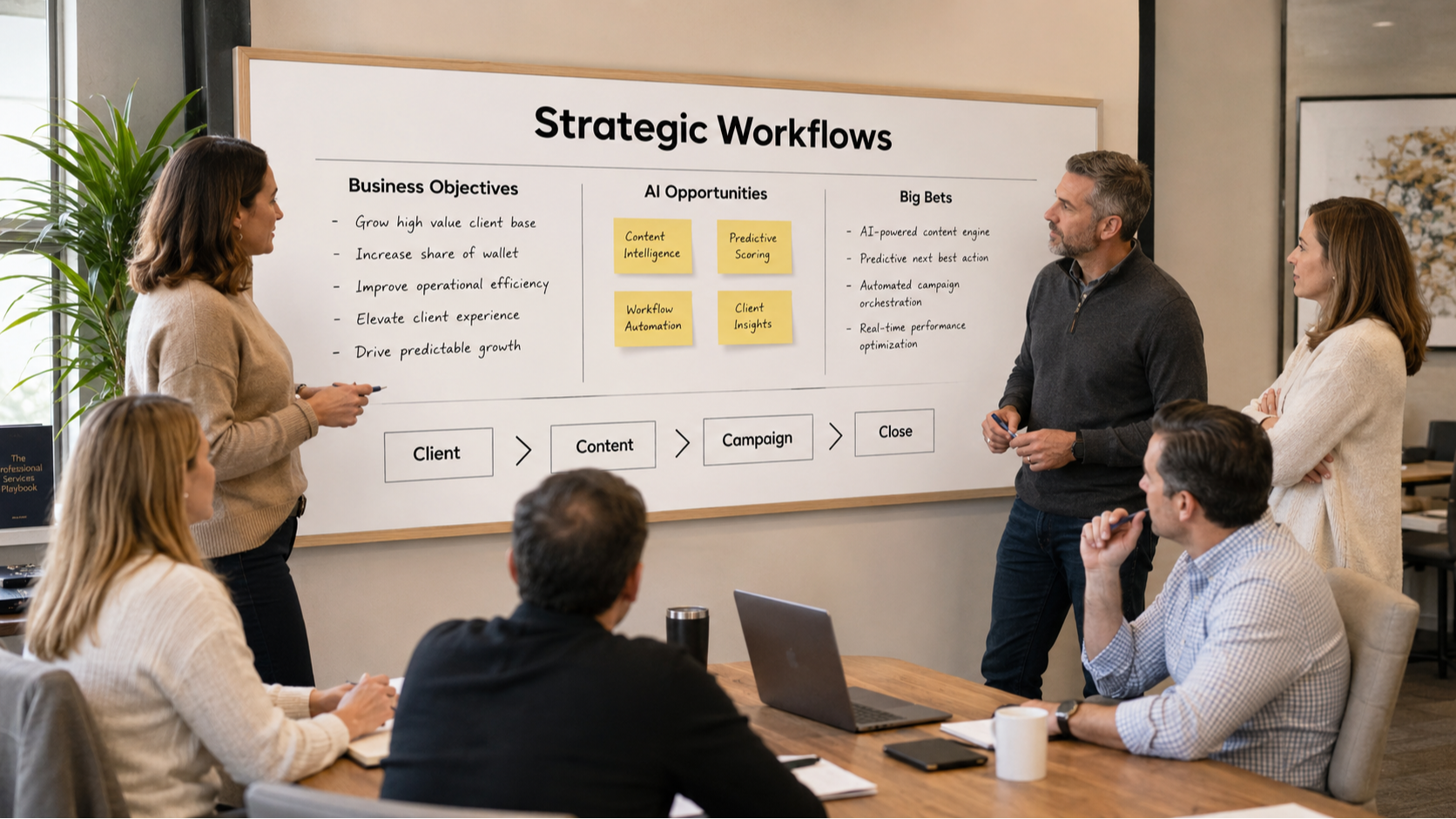
Professional service firms should not approach AI as a single large initiative. AI creates the greatest business value when organizations balance three different types of AI initiatives: Strategic Alignment, Big Bets, and Productivity Initiatives.
These three categories serve different purposes, produce different outcomes, and require different levels of executive involvement.
The majority of AI efforts should usually focus on Strategic Alignment because this is where competitive advantage, sustainable strategic impact and measurable business impact is most likely to occur.
1. Strategic Alignment
Failure to focus on strategic alignment is the primary reason the majority of AI efforts fail to create measurable impact.
Strategic Alignment focuses AI efforts on the workflows, business objectives, and operational priorities that drive strategic objectives. These are usually the 3 to 5 key metrics that measure the firm’s strategic performance.
Some of the most common Strategic Objectives for professional service firms are:
- Revenue growth
- Profitability
- Client retention
- Proposal velocity
- Competitive differentiation
- Delivery quality
- Operational leverage
Strategic Alignment usually concentrates on:
- Highest-value workflows
- Cross-functional workflows
- Client-facing workflows
- Operational bottlenecks affecting key outcomes
For most firms, Strategic Alignment should be the focus of 3 to 5 AI initiatives and involve approximately 60–70% of AI effort.
This is where AI is most likely to produce measurable operational and financial impact.
The purpose is not random experimentation. The purpose is measurable strategic leverage.
2. Big Bets
Big Bets are carefully selected strategic initiatives designed to strengthen future business such as competitive position, operational capability, or long-term differentiation.
These initiatives may not always produce immediate ROI, but they support future strategic direction and long-term organizational advantage.
Big Bets are typically:
- Longer term
- Important but not a current strategic objective
- Closely aligned to leadership priorities
Examples may include:
- Developing AI-enabled client intelligence systems
- Creating AI-enhanced knowledge platforms
- Expanding into a new strategic niche supported by AI
- Creating proprietary research platforms
- Building AI-supported advisory systems
Most firms should pursue only a small number of Big Bets at one time, no more than 3, and that should be after strategic alignment opportunities.
Attempting too many AI initiatives creates fragmentation, operational overload, and weak execution.
For many professional service firms, Big Bets may represent approximately 15–25% of AI effort.
The goal for Big Bets is not speculative AI futurism. The goal is to carefully select projects that build future strategic capability.
3. Productivity Initiatives
Productivity initiatives operate primarily at the individual, team, or functional level.
While productivity initiatives rarely contribute to the firm’s strategic objectives, they help build a culture of AI adoption and innovation.
Individuals who see productivity increases from their own AI creations are much more willing to use AI and develop their own skills. That can help the firm.
Productivity initiatives improve:
- Personal productivity
- Task execution
- Team efficiency
- Day-to-day workflow speed
Examples may include:
- Drafting email responses
- Meeting summaries
- Research acceleration
- Content creation
- Administrative automation
- Internal workflow assistance
Productivity projects are useful because they:
- Increase adoption
- Develop AI familiarity
- Create internal AI Champions and AI Heroes
- Help teams become more comfortable with AI-assisted work
However, productivity initiatives alone rarely create measurable firm-wide strategic impact.
When organizations overemphasize isolated productivity experimentation, they often create,
- Disconnected workflows
- Inconsistent outputs
- Duplicated prompts
- Fragmented systems
Fragmented and unaligned AI experimentation often results in what is commonly referred to as AI Pilot Purgatory
That is why productivity efforts should remain aligned to broader strategic priorities whenever possible.
For many firms, productivity initiatives may be approximately 5–15% of total AI effort and may include,
- Personal productivity projects
- Departmental AI projects outside a strategic workflow
- Experimentation
These initiatives support adoption and capability development, but they should not replace strategic alignment or Big Bets.
CTA!
AI Optimize Now!HOW TO ALIGN
ALIGN must be disciplined and completed, but it should not become an extended strategy exercise.
The objective is to create enough clarity to justify deeper diagnosis.
- Define the strategic objective
Use a Balanced Scorecard or OKR methodology to identify strategic objectives that are critical to success.
For a professional services organization, possible objectives could include:
- Improve client retention
- Improve billable utilization
- Increase profitable growth
- Increase professional capacity without proportional hiring
- Shorten proposal or client-delivery cycle time
- Improve quality and consistency
- Increase qualified pipeline
- Reduce administrative cost
- Improve client experience
- Accelerate development of new services
- Reduce material business risk
Avoid defining the objective around AI itself.
“Deploy generative AI across consulting” describes an activity.
“Increase consulting capacity while maintaining delivery quality” describes a strategic result.
- Identify the business driver
The driver describes something that appears to influence the objective.
Suppose a firm's objective is to improve client retention.
Possible drivers could include:
- Response speed
- Service quality
- Quality of advice
- Proactive communication
- Delivery consistency
- Relationship coverage
Leadership does not need to prove the relationship during ALIGN.
It needs enough evidence and experience to identify the probable driver(s) worth investigating.
DIAGNOSE will examine what actually happens inside the relevant workflows.
- Form the Strategic AI Hypothesis
Now identify how AI might improve that driver.
This should be a tentative hypothesis.
A useful structure is:
If AI can improve [workflow, driver or capability], then it may increase performance in [strategic objective].
For example:
If AI can help answer client inquiries more quickly while preserving expert review, it may improve responsiveness and contribute to higher client retention.
The wording matters because it keeps the team open to contrary evidence.
- Assign ownership
Lack of ownership and responsible management is one of the top causes of AI failure after implementation. Without ownership the system is not managed, metrics are not monitored, there is no risk management, and no feedback improvement loop. Ownership Is especially critical in the early months of real-world implementation.
Define at least:
Executive Sponsor — provides authority, resources, and strategic support.
Business Owner — owns the business result affected by the initiative.
Metric Owner — ensures performance is measured consistently and credibly.
In a smaller organization, one person may hold more than one role.
What matters is that accountability is clear and specific.
- Select the metric
Choose the measure most closely connected to the intended improvement.
The strategic objective may require more than one measure, but resist creating an oversized scorecard during ALIGN.
One primary metric and a small number of supporting measures are usually easier to manage.
- Establish the baseline
Determine current performance. Use existing operational data when it is reliable.
If reliable data does not exist, establish a temporary measurement method and gather enough observations to create a defensible starting point.
- Define a meaningful target
The target should answer:
How much improvement would make this initiative matter?
This becomes important later when VALIDATE establishes acceptance criteria and IMPLEMENT measures actual operating performance.
- Decide whether DIAGNOSE is justified
Leadership now has enough information for an initial investment decision.
If the opportunity is strategically important, measurable, owned, and plausible, proceed.
If not, refine it or choose another opportunity.
How to ALIGN with a Strategic Objective
For executives who want a concise process, use these eight steps:
- Identify the strategic objective.
- Identify the business driver that impacts it.
- Form a Strategic AI Hypothesis.
- Assign executive, business, and measurement ownership.
- Select the metrics, primary and support, that will demonstrate improvement.
- Establish current baseline performance.
- Set a meaningful target.
- Decide whether the opportunity warrants DIAGNOSE.
This is the beginning of an AI implementation process—not the end of AI strategy.
How ALIGN Works: A Professional Services Example
Consider a 150-person consulting firm facing increased competition.
Leadership has identified client retention as an important strategic objective.
Strategic Objective
Increase client retention.
The objective matters because replacing lost clients requires expensive new-business development and disrupts revenue predictability.
Business Driver
Leadership believes client responsiveness is one important driver.
Partners report that client questions sometimes wait too long for an expert response because senior professionals are overloaded.
Strategic AI Hypothesis
The initial hypothesis becomes:
AI-supported client inquiries and responses may reduce response delays without reducing the quality or professional oversight of client communication.
Notice what ALIGN has not concluded.
It has not assumed that client inquiries and responses are the true bottleneck.
It has not selected an AI model.
It has not decided whether an AI assistant, an agent, workflow automation, or another approach is appropriate.
It has not estimated the final ROI.
Those questions require additional evidence.
Ownership
The Client Services Director owns responsiveness.
A Senior Partner sponsors the strategic initiative.
Operations owns collection of response-time metrics.
Metric
Primary metric:
Average response time for defined categories of client inquiries.
Supporting metric (guardrail):
No decline in measured response quality or client satisfaction.
Baseline and target
Current baseline:
18 hours.
Meaningful target:
4 hours.
Now leadership has a strategically relevant hypothesis that can be diagnosed.
DIAGNOSE will determine where the delays actually occur and whether AI is part of the solution.
Results and Deliverables
A completed ALIGN stage should produce a concise set of decision-ready outputs.
Strategic Objective
The important business result the organization intends to improve.
Business Driver
The performance factor believed to influence that objective.
Strategic AI Hypothesis
The hypothetical explanation of how AI might improve the driver.
Executive Sponsor
The senior leader supporting the initiative and ensuring strategic relevance.
Business Owner
The person accountable for the business outcome.
Metric Owner
The person responsible for credible measurement.
Primary Metric
The measure that will indicate whether the desired result is improving.
Baseline
Current performance.
Target
The level of improvement that would be meaningful.
Initial Constraints
Known constraints involving regulation, risk, client expectations, security, economics, timing, or organizational capacity.
RECOMMENDED RESOURCES
CTS has developed assessments, templates, worksheets, and canvases that make it easier and more straightforward to complete each ADVIS stage. In this stage, clients use:
- AI Strategic Alignment Worksheet
- Objective–Driver–AI Hypothesis Canvas
- AI Initiative Ownership Table
- KPI Baseline and Target Worksheet
- AI Strategic Opportunity Checklist
Download Checklists
CTA!
AI Optimize Now!
Decision Gates
You need a decision before moving to the DIAGNOSE stage. Possible decisions include:
Proceed to DIAGNOSE
The objective is important, ownership is clear, measurement is possible, and the AI hypothesis is worth investigating.
Revise the objective
The proposed objective is too broad, too vague, or insufficiently important.
Change the driver or metric
The objective is sound, but the assumed driver or measurement approach needs improvement.
Select another strategic opportunity
A different objective appears more valuable or feasible.
Defer
The opportunity may become attractive later, but timing, resources, or dependencies make action premature.
Stop
The opportunity does not justify further investment.
A Stop decision is not a failure of ADVIS.
It is evidence that the framework prevented unnecessary AI implementation work.
What Comes Next: DIAGNOSE
ALIGN establishes what the organization wants to improve.
DIAGNOSE determines what is really happening inside the work and where AI should actually be applied to create strategic value.
The next stage examines current workflows, bottlenecks, root causes, data, knowledge, systems, human judgment, risks, and readiness.
DIAGNOSE may conclude that the organization should:
- improve the workflow without AI;
- fix important conditions before using AI; or
- develop a specific AI-enabled improvement for controlled validation.
That distinction prevents strategic enthusiasm from becoming premature implementation.
How Critical to Success Can Help
Start AI implementation with a business outcome worth improving
AI initiatives become expensive when organizations move too quickly from enthusiasm to implementation.
Critical to Success helps leadership establish strategic objectives and foundations first.
Through AI Strategy Advisory Consulting, an AI Workflow Opportunity and Readiness Assessment, or a CTS AI Implementation Workshop, teams can connect AI opportunities to strategic objectives, define measurable outcomes, establish ownership, and determine which opportunities deserve deeper investigation.
For professional services firms, this is especially important because valuable applications of AI for professional services often span expert knowledge, client delivery, judgment, workflows, data, and human review.
CTS ADVIS provides a structured path from strategic intent to evidence-based AI implementation.
RECOMMENDED CTA
Want to identify the AI opportunities most likely to create measurable business value?
CTS can help your team DIAGNOSE your AI opportunities and help VALIDATE them so you can begin implementation.
CTA BUTTON: SCHEDULE AN AI STRATEGY DISCUSSION
Secondary CTA:
CTA BUTTON: EXPLORE THE CTS ADVIS FRAMEWORK
Call To ActionFAQ